Heidelberg Institute of Global Health, Heidelberg, Germany.
Department of Global Health and Population, Harvard TH Chan School of Public Health, Boston, MA, United States.
JMIR Mhealth Uhealth. 2019 Jan 15;7(1):e12637. doi: 10.2196/12637.
Zambia is faced with a severe shortage of health workers and challenges in national health financing. This burdens the medical licentiate practitioner (MLP) program for training nonphysician clinical students in Zambia because of the shortage of qualified medical lecturers and learning resources at training sites. To address this shortage and strengthen the MLP program, a self-directed electronic health (eHealth) platform was introduced, comprising technology-supported learning (e-learning) for medical education and support for health care practice. MLP students were provided with tablets that were preloaded with content for offline access.
This study aimed to explore MLP students' and medical lecturers' perceptions of the self-directed eHealth platform with an offline-based tablet as a training and health care practice support tool during the first year of full implementation.
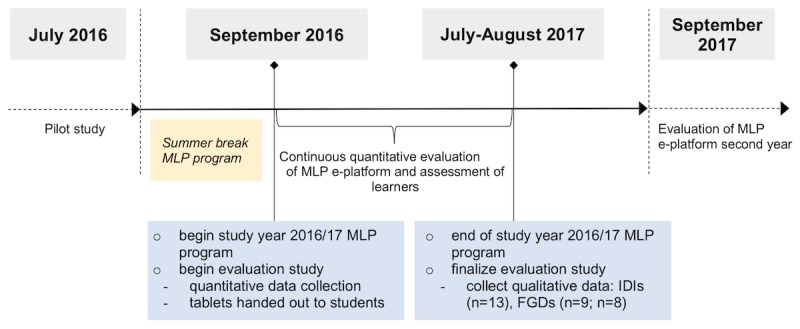
We conducted in-depth qualitative interviews with 8 MLP students and 5 lecturers and 2 focus group discussions with 16 students to gain insights on perceptions of the usefulness, ease of use, and adequacy of self-directed e-learning and health care practice support accessible through the offline-based tablet. Participants were purposively sampled. Verbatim transcripts were analyzed following hypothesis coding.
The eHealth platform (e-platform), comprising e-learning for medical education and health care practice support, was positively received by students and medical lecturers and was seen as a step toward modernizing the MLP program. Tablets enabled equal access to offline learning contents, thus bridging the gap of slow or no internet connections. The study results indicated that the e-platform appears adequate to strengthen medical education within this low-resource setting. However, student self-reported usage was low, and medical lecturer usage was even lower. One stated reason was the lack of training in tablet usage and another was the quality of the tablets. The mediocre quality and quantity of most e-learning contents were perceived as a primary concern as materials were reported to be outdated, missing multimedia features, and addressing only part of the curriculum. Medical lecturers were noted to have little commitment to updating or creating new learning materials. Suggestions for improving the e-platform were given.
To address identified major challenges, we plan to (1) introduce half-day training sessions at the beginning of each study year to better prepare users for tablet usage, (2) further update and expand e-learning content by fostering collaborations with MLP program stakeholders and nominating an e-platform coordinator, (3) set up an e-platform steering committee including medical lecturers, (4) incorporate e-learning and e-based health care practice support across the curriculum, as well as (5) implement processes to promote user-generated content. With these measures, we aim to sustainably strengthen the MLP program by implementing the tablet-based e-platform as a serious learning technology for medical education and health care practice support.
赞比亚面临着卫生工作者严重短缺和国家卫生筹资困难的问题。这给赞比亚培训非医师临床学生的医学执照实习医生(MLP)计划带来了负担,因为培训地点缺乏合格的医学讲师和学习资源。为了解决这一短缺问题并加强 MLP 计划,引入了一个自我指导的电子健康(eHealth)平台,该平台包括医学教育的技术支持学习(e-learning)和医疗保健实践支持。为 MLP 学生提供了预先加载有离线访问内容的平板电脑。
本研究旨在探讨 MLP 学生和医学讲师在全面实施的第一年对自我指导的基于电子学习的电子健康平台的看法,该平台具有基于离线的平板电脑,作为培训和医疗保健实践支持工具。
我们对 8 名 MLP 学生和 5 名讲师进行了深入的定性访谈,并对 16 名学生进行了 2 次焦点小组讨论,以了解他们对自我指导的电子学习和通过基于离线的平板电脑获得的医疗保健实践支持的有用性、易用性和充分性的看法。参与者是根据假设进行有针对性的抽样的。逐字记录在经过假设编码后进行分析。
电子健康平台(e 平台)包括医学教育的电子学习和医疗保健实践支持,受到学生和医学讲师的积极欢迎,并被视为使 MLP 计划现代化的一步。平板电脑使离线学习内容平等访问成为可能,从而弥补了互联网连接缓慢或不存在的差距。研究结果表明,该电子平台似乎足以加强在这种资源匮乏的环境下的医学教育。然而,学生自我报告的使用率很低,医学讲师的使用率甚至更低。一个原因是缺乏平板电脑使用方面的培训,另一个原因是平板电脑的质量。大多数电子学习内容的质量和数量都较差,被认为是一个主要问题,因为材料被报道已经过时,缺少多媒体功能,并且只涵盖了课程的一部分。医学讲师们表示,他们几乎没有承诺更新或创建新的学习材料。提出了改进电子平台的建议。
为了解决已确定的主要挑战,我们计划(1)在每学年开始时举办为期半天的培训课程,以使用户更好地为平板电脑的使用做好准备,(2)通过与 MLP 计划利益相关者合作并提名电子平台协调员,进一步更新和扩展电子学习内容,(3)成立一个包括医学讲师在内的电子平台指导委员会,(4)在整个课程中纳入电子学习和基于电子的医疗保健实践支持,以及(5)实施促进用户生成内容的流程。通过这些措施,我们旨在通过实施基于平板电脑的电子平台作为医学教育和医疗保健实践支持的严肃学习技术,可持续地加强 MLP 计划。
