Barteit Sandra, Guzek Dorota, Jahn Albrecht, Bärnighausen Till, Jorge Margarida Mendes, Neuhann Florian
Heidelberg Institute of Global Health, Heidelberg University Hospital, Heidelberg University, Germany.
Department of Global Health and Population, Harvard T.H. Chan School of Public Health, Boston, USA.
Comput Educ. 2020 Feb;145:103726. doi: 10.1016/j.compedu.2019.103726.
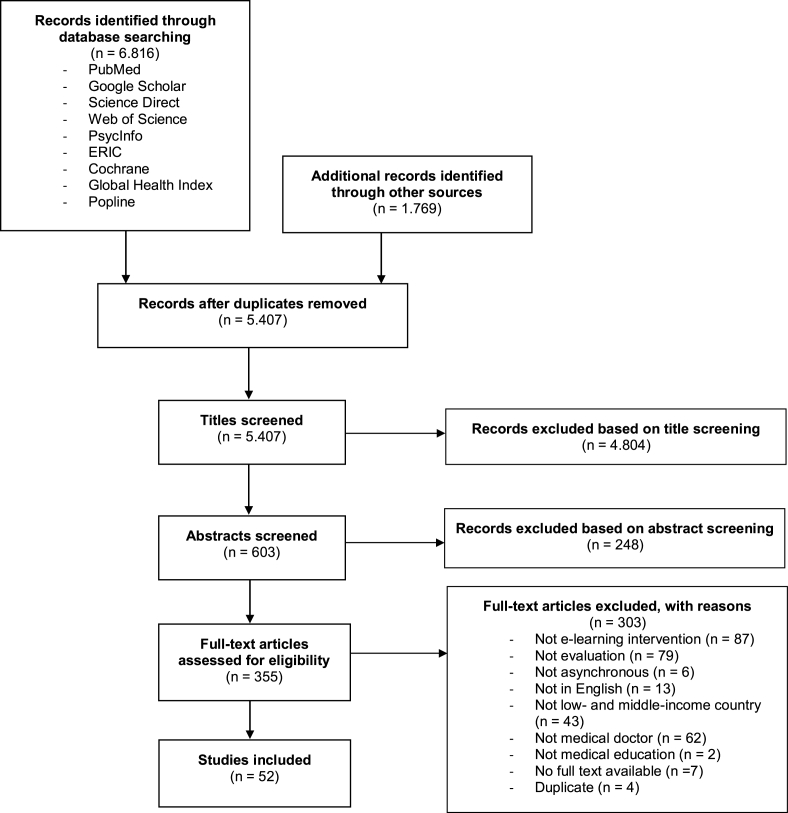
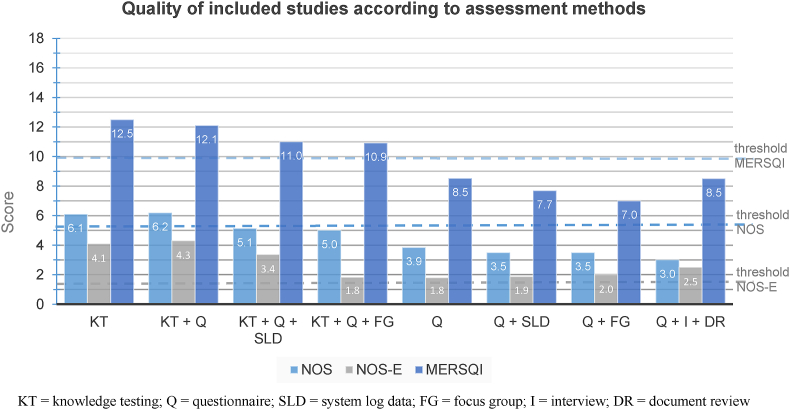
In low- and middle-income countries (LMICs), e-learning for medical education may alleviate the burden of severe health worker shortages and deliver affordable access to high quality medical education. However, diverse challenges in infrastructure and adoption are encountered when implementing e-learning within medical education in particular. Understanding what constitutes successful e-learning is an important first step for determining its effectiveness. The objective of this study was to systematically review e-learning interventions for medical education in LMICs, focusing on their evaluation and assessment methods. Nine databases were searched for publications from January 2007 to June 2017. We included 52 studies with a total of 12,294 participants. Most e-learning interventions were pilot studies (73%), which mainly employed summative assessments of study participants (83%) and evaluated the e-learning intervention with questionnaires (45%). Study designs, evaluation and assessment methods showed considerable variation, as did the study quality, evaluation periods, outcome and effectiveness measures. Included studies mainly utilized subjective measures and custom-built evaluation frameworks, which resulted in both low comparability and poor validity. The majority of studies self-concluded that they had had an effective e-learning intervention, thus indicating potential benefits of e-learning for LMICs. However, MERSQI and NOS ratings revealed the low quality of the studies' evidence for comparability, evaluation instrument validity, study outcomes and participant blinding. Many e-learning interventions were small-scale and conducted as short-termed pilots. More rigorous evaluation methods for e-learning implementations in LMICs are needed to understand the strengths and shortcomings of e-learning for medical education in low-resource contexts. Valid and reliable evaluations are the foundation to guide and improve e-learning interventions, increase their sustainability, alleviate shortages in health care workers and improve the quality of medical care in LMICs.
在低收入和中等收入国家(LMICs),医学教育的电子学习可能会减轻严重卫生工作者短缺的负担,并提供获得高质量医学教育的可承受途径。然而,特别是在医学教育中实施电子学习时,会遇到基础设施和采用方面的各种挑战。了解成功的电子学习的构成要素是确定其有效性的重要第一步。本研究的目的是系统评价低收入和中等收入国家医学教育的电子学习干预措施,重点关注其评价和评估方法。检索了九个数据库,以查找2007年1月至2017年6月期间的出版物。我们纳入了52项研究,共有12294名参与者。大多数电子学习干预措施是试点研究(73%),主要采用对研究参与者的总结性评估(83%),并用问卷对电子学习干预措施进行评估(45%)。研究设计、评价和评估方法显示出相当大的差异,研究质量、评价期、结果和有效性测量也是如此。纳入的研究主要采用主观测量和定制的评价框架,这导致可比性低和效度差。大多数研究自行得出结论,认为他们进行了有效的电子学习干预,从而表明电子学习对低收入和中等收入国家有潜在益处。然而,MERSQI和NOS评分显示,这些研究在可比性、评价工具效度、研究结果和参与者盲法方面的证据质量较低。许多电子学习干预措施规模较小,且作为短期试点进行。需要更严格的低收入和中等收入国家电子学习实施评价方法,以了解资源匮乏背景下医学教育电子学习的优缺点。有效和可靠的评价是指导和改进电子学习干预措施、提高其可持续性、缓解卫生保健工作者短缺以及改善低收入和中等收入国家医疗质量的基础。