Naleway Allison L, Ball Sarah, Kwong Jeffrey C, Wyant Brandy E, Katz Mark A, Regan Annette K, Russell Margaret L, Klein Nicola P, Chung Hannah, Simmonds Kimberley A, Azziz-Baumgartner Eduardo, Feldman Becca S, Levy Avram, Fell Deshayne B, Drews Steven J, Garg Shikha, Effler Paul, Barda Noam, Irving Stephanie A, Shifflett Patricia, Jackson Michael L, Thompson Mark G
Kaiser Permanente Northwest, Center for Health Research, Portland, OR, United States.
Abt Associates, Inc, Cambridge, MA, United States.
JMIR Res Protoc. 2019 Jan 21;8(1):e11333. doi: 10.2196/11333.
Although pregnant women are believed to have elevated risks of severe influenza infection and are targeted for influenza vaccination, no study to date has examined influenza vaccine effectiveness (IVE) against laboratory-confirmed influenza-associated hospitalizations during pregnancy, primarily because this outcome poses many methodological challenges.
The Pregnancy Influenza Vaccine Effectiveness Network (PREVENT) was formed in 2016 as an international collaboration with the Centers for Disease Control and Prevention; Abt Associates; and study sites in Australia, Canada, Israel, and the United States. The primary goal of this collaboration is to estimate IVE in preventing acute respiratory or febrile illness (ARFI) hospitalizations associated with laboratory-confirmed influenza virus infection during pregnancy. Secondary aims include (1) describing the incidence, clinical course, and severity of influenza-associated ARFI hospitalization during pregnancy; (2) comparing the characteristics of ARFI-hospitalized pregnant women who were tested for influenza with those who were not tested; (3) describing influenza vaccination coverage in pregnant women; and (4) comparing birth outcomes among women with laboratory-confirmed influenza-associated hospitalization versus other noninfluenza ARFI hospitalizations.
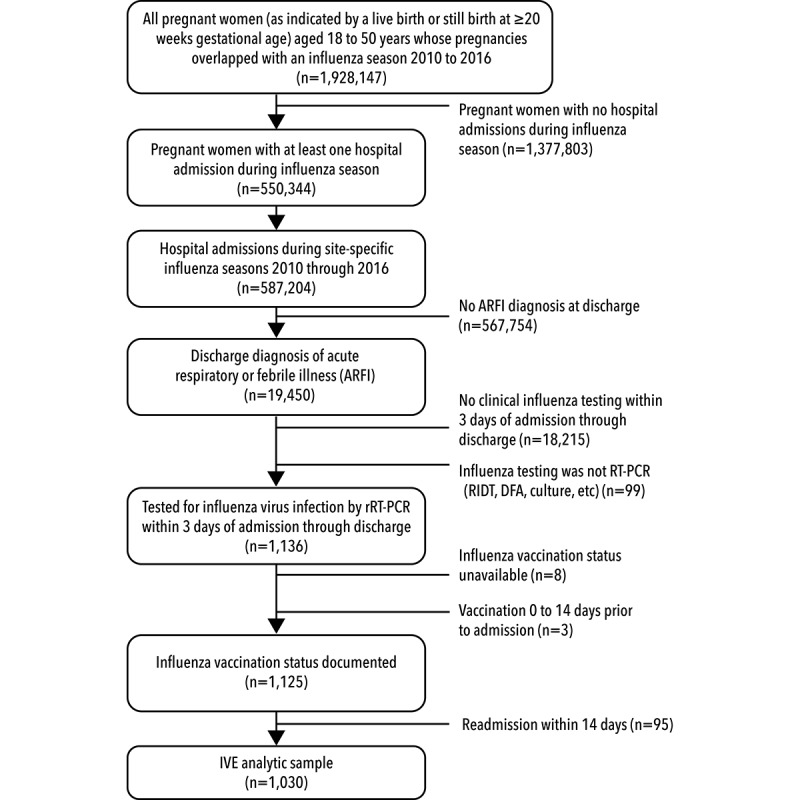
For an initial assessment of IVE, sites identified a retrospective cohort of pregnant women aged from 18 to 50 years whose pregnancies overlapped with local influenza seasons from 2010 to 2016. Pregnancies were defined as those that ended in a live birth or stillbirth of at least 20 weeks gestation. The analytic sample for the primary IVE analysis was restricted to pregnant women who were hospitalized for ARFI during site-specific influenza seasons and clinically tested for influenza virus infection using real-time reverse transcription polymerase chain reaction.
We identified approximately 2 million women whose pregnancies overlapped with influenza seasons; 550,344 had at least one hospitalization during this time. After restricting to women who were hospitalized for ARFI and tested for influenza, the IVE analytic sample included 1005 women.
In addition to addressing the primary question about the effectiveness of influenza vaccination, PREVENT data will address other important knowledge gaps including understanding the incidence, clinical course, and severity of influenza-related hospitalizations during pregnancy. The data infrastructure and international partnerships created for these analyses may be useful and informative for future influenza studies.
INTERNATIONAL REGISTERED REPORT IDENTIFIER (IRRID): DERR1-10.2196/11333.
尽管孕妇被认为患重症流感感染的风险较高,且是流感疫苗接种的目标人群,但迄今为止,尚无研究考察流感疫苗对孕期实验室确诊的流感相关住院治疗的有效性(IVE),主要是因为这一结果带来了诸多方法学上的挑战。
妊娠流感疫苗有效性网络(PREVENT)于2016年成立,是与美国疾病控制与预防中心、艾普特 associates 公司以及澳大利亚、加拿大、以色列和美国的研究站点开展的一项国际合作。这项合作的主要目标是评估IVE在预防孕期与实验室确诊的流感病毒感染相关的急性呼吸道或发热性疾病(ARFI)住院治疗方面的效果。次要目标包括:(1)描述孕期流感相关ARFI住院治疗的发病率、临床过程和严重程度;(2)比较接受流感检测的ARFI住院孕妇与未接受检测的孕妇的特征;(3)描述孕妇的流感疫苗接种覆盖率;(4)比较实验室确诊的流感相关住院孕妇与其他非流感ARFI住院孕妇的分娩结局。
为初步评估IVE,各站点确定了一个回顾性队列,队列中的孕妇年龄在18至50岁之间,其孕期与2010年至2016年的当地流感季节有重叠。妊娠定义为妊娠结局为至少妊娠20周的活产或死产。主要IVE分析的分析样本仅限于在特定站点流感季节因ARFI住院且使用实时逆转录聚合酶链反应对流感病毒感染进行临床检测的孕妇。
我们确定了约200万名孕期与流感季节有重叠的女性;其中550344人在此期间至少有一次住院治疗。在将范围限定为因ARFI住院且接受流感检测的女性后,IVE分析样本包括1005名女性。
除了解决关于流感疫苗接种有效性的主要问题外,PREVENT数据还将填补其他重要的知识空白,包括了解孕期流感相关住院治疗的发病率、临床过程和严重程度。为这些分析建立的数据基础设施和国际伙伴关系可能对未来的流感研究有用且提供信息。
国际注册报告识别码(IRRID):DERR1-10.2196/11333 。