Galvani Carla, Caramaschi Paola, Mura Paolo, Paladini Antonella, Piroli Alba, Arnaudo Elisa, De Franceschi Lucia, Evangelista Maurizio, Pari Alice, Ongaro Giovanna, Finco Gabriele, Ciannameo Anna, Carletto Antonio, Varrassi Giustino, Biasi Domenico
Rheumatology Unit, Department of Medicine, University of Verona, Verona, Italy,
Anesthesia, Intensive Care and Pain Therapy Unit, Department of Medical Science "M. Aresu", University of Cagliari, Cagliari, Italy.
J Pain Res. 2019 Jan 11;12:327-337. doi: 10.2147/JPR.S164714. eCollection 2019.
Chronic pain is a key symptom in fibromyalgia (FM), and its management is still challenging for rheumatologists in daily practice. FM patients show psychological and psychiatric manifestations, going from mood and emotional disorders to depression and alexithymia that negatively impact their quality of life, limiting their daily activities. Since pharmacological strategies have a limited efficacy in FM pain, alternative or complementary non-pharmacological approaches have been introduced in the clinical management of FM.
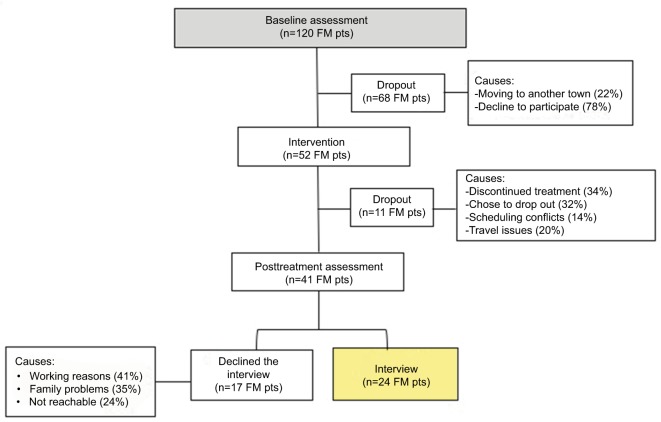
This is a retrospective study on FM patients (n=52) treated with a novel integrated postural counseling (PC) rehabilitation program carried out by a counselor physiotherapist. The clinical impact of PC was evaluated by 1) a semi-structured interview using an ad hoc modified questionnaire McGill Illness Narrative Interview (MINI) 1 to obtain data on pain management by highlighting everyday experience of living with pain and 2) an FM impact questionnaire (FIQ) total score.
Two main structures of narrative emplotment of FM illness were recognized: 1) the cumulative life narrative structure (46.15%) and 2) the broken life (53.85%) narrative structure. Baseline FIQ score was 77.38±7.77, and it was significantly reduced after PC to 39.12±13.27 (<0.0001). Although well-being still requires further definition as outcome in pain management, it is important for FM patients, dealing with pain-related sensations, thoughts and feelings and limiting their daily activities. In our study, 87.5% of interviewed FM patients reported an improvement in their well-being after PC.
Our data suggest that an integrated PC program positively impacts chronic pain and fatigue based on self-management strategies. PC allows FM patients to resume their own life and regenerate their own image. Finally, we propose the introduction of the evaluation of the ability to resume daily activities as the target of rehabilitation programs in FM.
慢性疼痛是纤维肌痛(FM)的关键症状,在日常临床实践中,其管理对风湿病学家而言仍然具有挑战性。FM患者存在心理和精神方面的表现,从情绪和情感障碍到抑郁及述情障碍,这些都会对他们的生活质量产生负面影响,限制他们的日常活动。由于药物治疗策略对FM疼痛的疗效有限,因此在FM的临床管理中引入了替代或补充性的非药物方法。
这是一项针对52例FM患者的回顾性研究,这些患者接受了由理疗师顾问实施的新型综合姿势咨询(PC)康复计划。通过以下方式评估PC的临床影响:1)使用专门修改的问卷麦吉尔疾病叙事访谈(MINI)1进行半结构化访谈,以获取有关疼痛管理的数据,重点是与疼痛共处的日常经历;2)FM影响问卷(FIQ)总分。
识别出FM疾病叙事编排的两种主要结构:1)累积生活叙事结构(46.15%)和2)破碎生活叙事结构(53.85%)。基线FIQ评分为77.38±7.77,PC治疗后显著降低至39.12±13.27(<0.0001)。尽管幸福感作为疼痛管理的结果仍需要进一步明确界定,但对于FM患者来说很重要,因为他们要应对与疼痛相关的感觉、想法和情绪,并限制日常活动。在我们的研究中,87.5%接受访谈的FM患者表示PC治疗后幸福感有所改善。
我们的数据表明,基于自我管理策略的综合PC计划对慢性疼痛和疲劳有积极影响。PC使FM患者能够重新掌控自己的生活并重塑自我形象。最后,我们建议将恢复日常活动能力的评估作为FM康复计划的目标引入。