Turku Centre for Biotechnology, University of Turku and Åbo Akademi University, 20520 Turku, Finland.
Steno Diabetes Center Copenhagen, 2820 Gentofte, Denmark.
Biomolecules. 2019 Jan 21;9(1):33. doi: 10.3390/biom9010033.
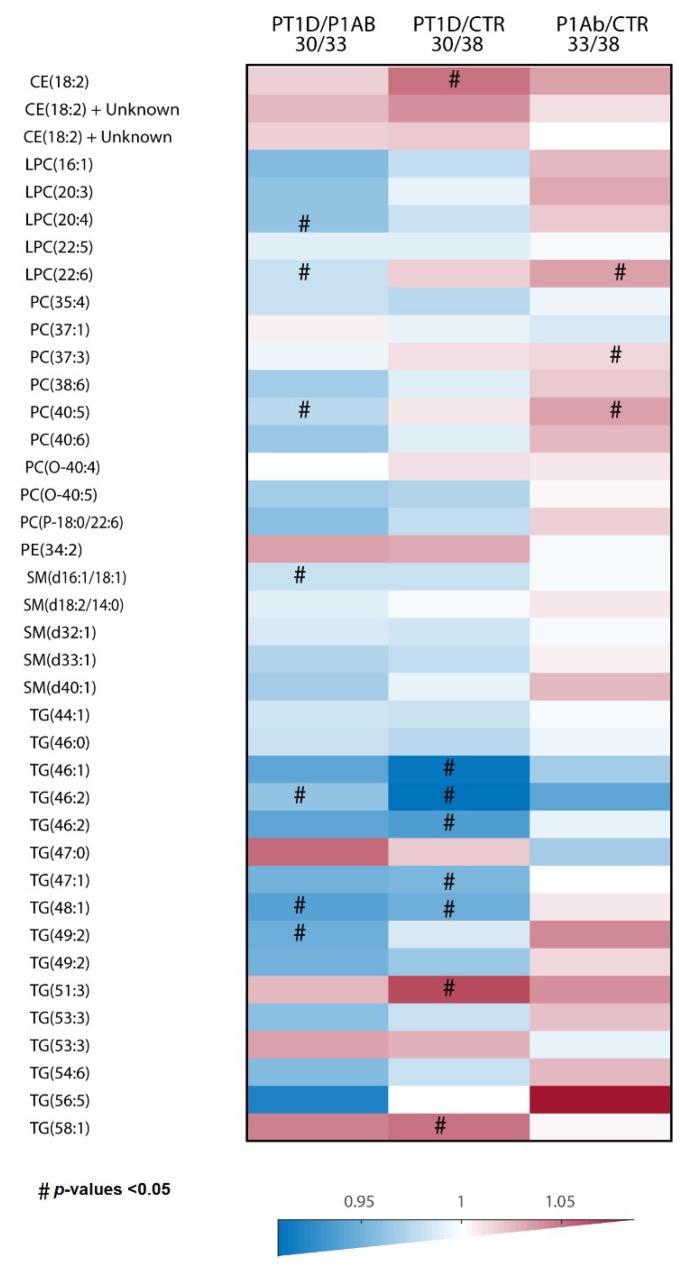
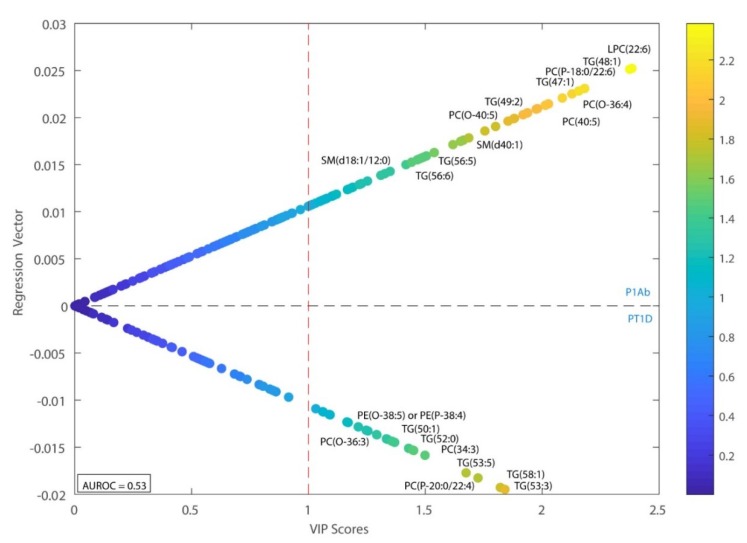
Previous studies suggest that children who progress to type 1 diabetes (T1D) later in life already have an altered serum lipid molecular profile at birth. Here, we compared cord blood lipidome across the three study groups: children who progressed to T1D (PT1D; = 30), children who developed at least one islet autoantibody but did not progress to T1D during the follow-up (P1Ab; = 33), and their age-matched controls (CTR; = 38). We found that phospholipids, specifically sphingomyelins, were lower in T1D progressors when compared to P1Ab and the CTR. Cholesterol esters remained higher in PT1D when compared to other groups. A signature comprising five lipids was predictive of the risk of progression to T1D, with an area under the receiver operating characteristic curve (AUROC) of 0.83. Our findings provide further evidence that the lipidomic profiles of newborn infants who progress to T1D later in life are different from lipidomic profiles in P1Ab and CTR.
先前的研究表明,在生命后期进展为 1 型糖尿病(T1D)的儿童在出生时已经存在血清脂质分子谱的改变。在这里,我们比较了三组脐带血脂质组学:进展为 T1D(PT1D;n = 30)的儿童、在随访期间至少发展出一种胰岛自身抗体但未进展为 T1D 的儿童(P1Ab;n = 33)和年龄匹配的对照组(CTR;n = 38)。我们发现,与 P1Ab 和 CTR 相比,PT1D 中的磷脂,特别是神经鞘磷脂含量较低。与其他组相比,胆固醇酯在 PT1D 中仍然较高。一个由五种脂质组成的特征可以预测进展为 T1D 的风险,其接受者操作特征曲线下的面积(AUROC)为 0.83。我们的研究结果进一步表明,生命后期进展为 T1D 的新生儿的脂质组学特征与 P1Ab 和 CTR 的脂质组学特征不同。