Turku Bioscience Centre, University of Turku and Åbo Akademi University, 20520 Turku, Finland.
Turku Bioscience Centre, University of Turku and Åbo Akademi University, 20520 Turku, Finland; School of Medical Sciences, Örebro University, 702 81 Örebro, Sweden.
Cell Rep Med. 2022 Oct 18;3(10):100762. doi: 10.1016/j.xcrm.2022.100762. Epub 2022 Oct 3.
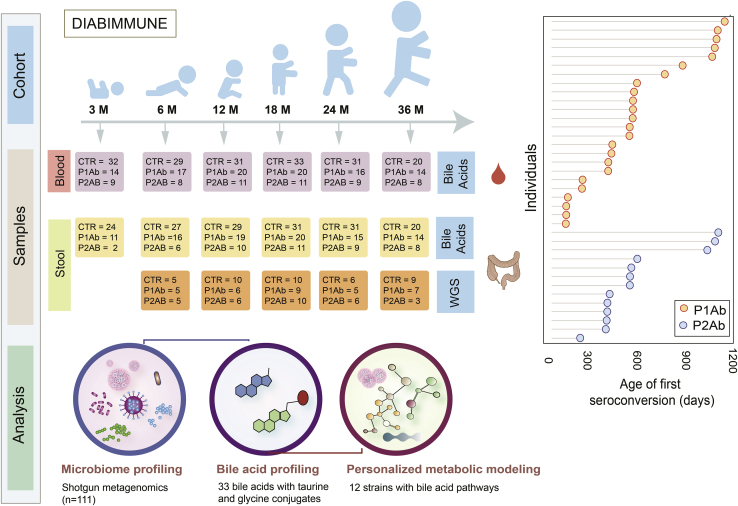
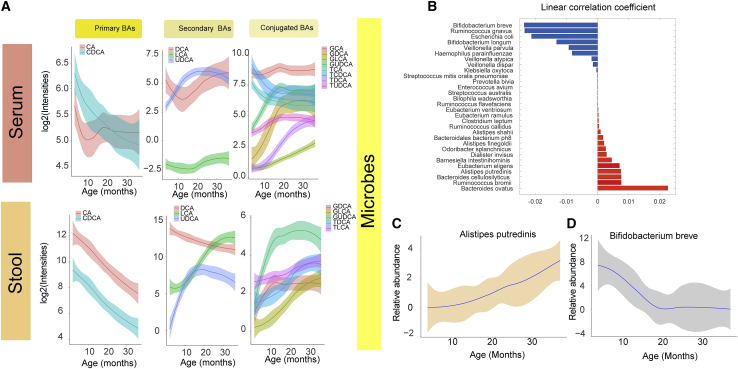
The gut microbiota is crucial in the regulation of bile acid (BA) metabolism. However, not much is known about the regulation of BAs during progression to type 1 diabetes (T1D). Here, we analyzed serum and stool BAs in longitudinal samples collected at 3, 6, 12, 18, 24, and 36 months of age from children who developed a single islet autoantibody (AAb) (P1Ab; n = 23) or multiple islet AAbs (P2Ab; n = 13) and controls (CTRs; n = 38) who remained AAb negative. We also analyzed the stool microbiome in a subgroup of these children. Factor analysis showed that age had the strongest impact on both BA and microbiome profiles. We found that at an early age, systemic BAs and microbial secondary BA pathways were altered in the P2Ab group compared with the P1Ab and CTR groups. Our findings thus suggest that dysregulated BA metabolism in early life may contribute to the risk and pathogenesis of T1D.
肠道微生物群在胆汁酸(BA)代谢的调节中起着至关重要的作用。然而,对于在向 1 型糖尿病(T1D)进展过程中胆汁酸的调节,我们知之甚少。在这里,我们分析了在儿童中从 3、6、12、18、24 和 36 个月收集的纵向样本中的血清和粪便 BA,这些儿童分别发展出了单一胰岛自身抗体(AAb)(P1Ab;n=23)或多种胰岛 AAbs(P2Ab;n=13)和保持 AAb 阴性的对照组(CTRs;n=38)。我们还分析了这些儿童亚组的粪便微生物组。因子分析表明,年龄对 BA 和微生物组谱都有最强的影响。我们发现,与 P1Ab 和 CTR 组相比,在 P2Ab 组中,系统 BA 和微生物次级 BA 途径在早期就发生了改变。因此,我们的研究结果表明,生命早期失调的 BA 代谢可能导致 T1D 的风险和发病机制。