Department of Cancer Epidemiology and Prevention Research, CancerControl Alberta, Alberta Health Services, Calgary, T2S 3C3, AB, Canada.
Bachelor of Health Sciences, Cumming School of Medicine, University of Calgary, Calgary, T2N 4N1, AB, Canada.
Nat Commun. 2019 Jan 22;10(1):383. doi: 10.1038/s41467-018-08159-w.
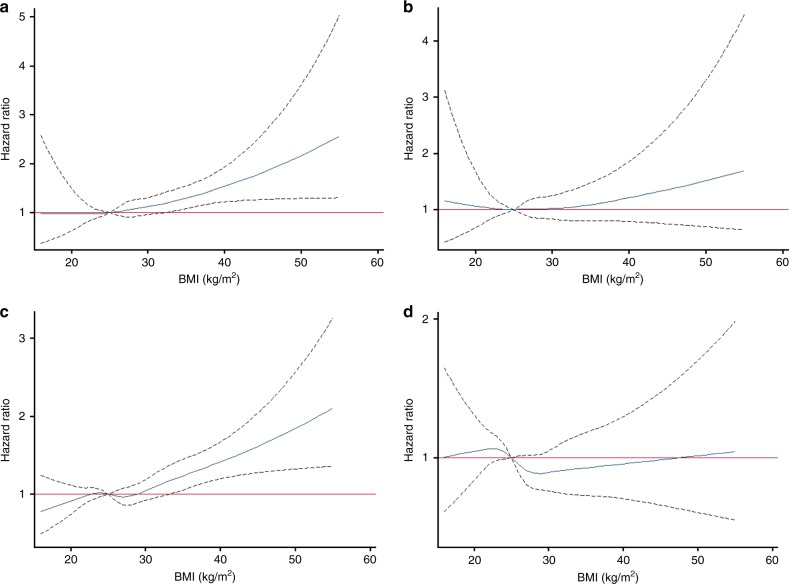
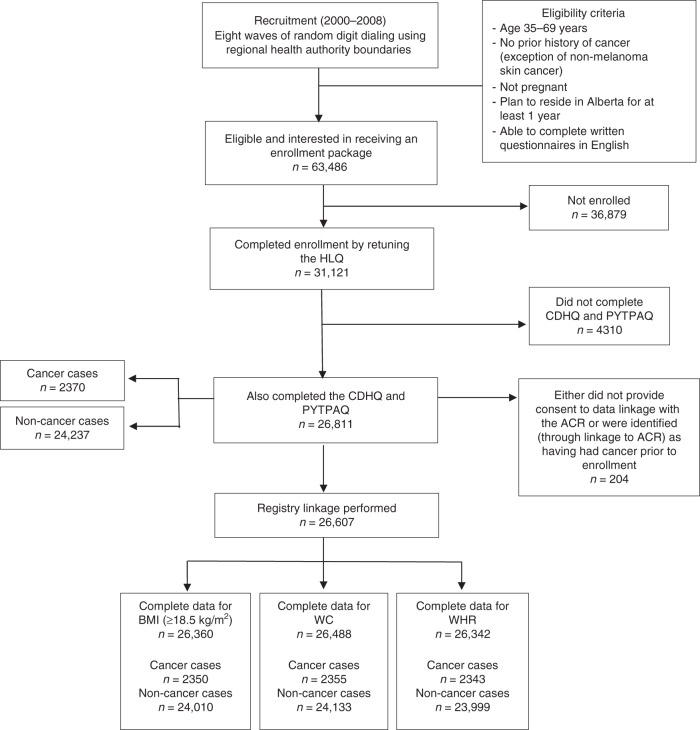
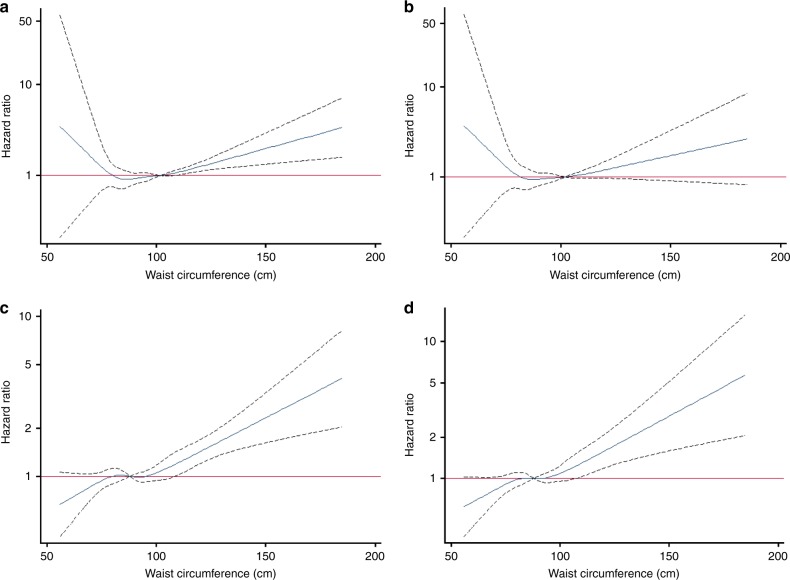
The importance of body size versus weight distribution for cancer risk is unclear. We investigated associations between measures of body size and shape and the risk of developing cancer. The study population consisted of 26,607 participants from the Alberta's Tomorrow Project cohort. Two main measures of body shape and size were examined: i) body mass index (BMI) and ii) waist circumference (WC). Incident cancers were identified via linkage to the Alberta Cancer Registry. Cox proportional hazards models were used. Males and females classified as obese (BMI ≥ 30 kg /m) have a 33% and 22% increased risk of all-cancer, respectively, than their normal weight counterparts. Similar all-cancer risk increases are observed for those above sex-specific WC guidelines. Mutual adjustment for WC attenuates the association between BMI and all-cancer risk, especially among females. Central adiposity appears to be a stronger predictor of all-cancer risk than body size.
体型与体重分布对癌症风险的重要性尚不清楚。我们研究了体型和体型指标与癌症发病风险之间的关系。该研究人群由来自艾伯塔省明日计划队列的 26607 名参与者组成。我们检查了两种主要的体型指标:i)体重指数(BMI)和 ii)腰围(WC)。通过与艾伯塔癌症登记处的链接来确定新发癌症。使用 Cox 比例风险模型。与体重正常的人相比,男性和女性中 BMI≥30kg/m2 的肥胖者的所有癌症风险分别增加了 33%和 22%。对于那些超过性别特异性 WC 指南的人,也观察到类似的全癌风险增加。WC 的相互调整减弱了 BMI 与所有癌症风险之间的关联,尤其是在女性中。中心性肥胖似乎比身体大小更能预测所有癌症的风险。