Belrose Célia, Duffaud Anais M, Dutheil Frédéric, Trichereau Julie, Trousselard Marion
Unité de Neurophysiologie du Stress, Département de Neurosciences et Sciences Cognitives, Institut de Recherche Biomédicale des Armées, Brétigny sur Orge, France.
APEMAC, EA 4360, EPSaM, Université de Lorraine, Lorraine, France.
Front Psychiatry. 2019 Jan 8;9:737. doi: 10.3389/fpsyt.2018.00737. eCollection 2018.
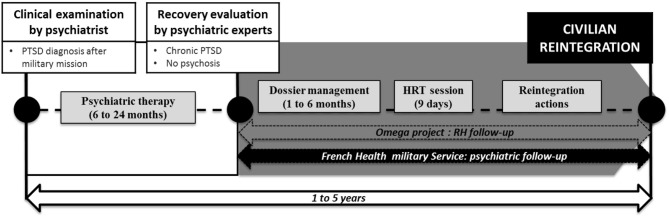
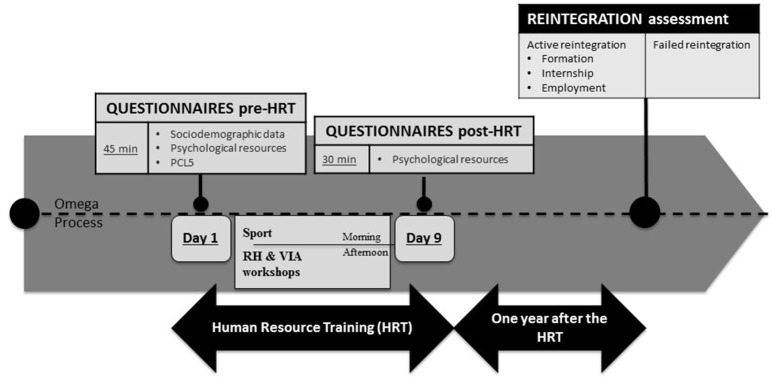
In light of the psychological changes in an individual suffering from chronic Posttraumatic Stress Disorder (PTSD), questions are being raised in order to understand and facilitate recovery and a return to work. This is particularly challenging for soldiers suffering from chronic PTSD, who are often young individuals suffering from moral conflicts. A French military rehabilitation program proposes the broadening of the relationships between recovery and reintegration by incorporating approaches from the field of positive psychology for soldiers with chronic PTSD. The aim of the study was to evaluate (i) the psychological resources which remain sustainable for these trauma exposed soldiers according to their PTSD symptoms, (ii) the dynamics of resource reappropriation after the military rehabilitation program, which focuses on values in action (VIA) as character strengths, and (iii) how these resources and their reappropriation facilitate civilian professional reintegration. We conducted a prospective study with 56 trauma exposed soldiers with a clinical diagnosis of chronic PTSD. PTSD severity and psychological resources (optimism, mindfulness, well-being, motivation, self-esteem, and VIA) were assessed before and after the rehabilitation program. After the identification of resource profiles, we analyzed the impact of the program on resource levels and successful reintegration into a civilian job. 3 profiles were identified based on the psychological resources of the soldiers. Profiles 1, 2, and 3 differed in terms of clinical severity (PCL5). Profile 1 exhibited both the highest level of resources and the lowest clinical severity of PTSD but did not modify its resources after the intervention program when compared to profile 3. Profile 3 was characterized by the lowest level of resources, the highest clinical severity of PTSD and the highest reappropriation in all VIAs. This profile was associated with the highest rate of reintegration success 1 year after the intervention. This paper aims to broaden the relationship between recovery and reintegration by incorporating approaches from the field of positive psychology for soldiers with PTSD. VIA appears to be an important factor for reintegration. Our results highlight the importance of taking into account the existing needs of the patient and the optimization of the modalities of individual, collective, and institutional rehabilitation for patients suffering from PTSD in order to better understand the dynamics of the recovery process of a chronically afflicted individual.
鉴于患有慢性创伤后应激障碍(PTSD)的个体的心理变化,人们提出了一些问题,以便了解并促进康复及重返工作岗位。这对患有慢性PTSD的士兵来说尤其具有挑战性,他们往往是面临道德冲突的年轻人。一项法国军事康复计划提议,通过将积极心理学领域的方法纳入其中,来拓宽患有慢性PTSD的士兵康复与重新融入社会之间的关系。该研究的目的是评估:(i)根据这些遭受创伤的士兵的PTSD症状,哪些心理资源对他们来说是可持续的;(ii)以行动价值观(VIA)作为性格优势的军事康复计划实施后,资源重新利用的动态变化;(iii)这些资源及其重新利用如何促进平民职业重新融入。我们对56名临床诊断为慢性PTSD的遭受创伤的士兵进行了一项前瞻性研究。在康复计划前后评估了PTSD严重程度和心理资源(乐观、正念、幸福感、动机、自尊和VIA)。在确定资源概况后,我们分析了该计划对资源水平以及成功重新融入平民工作的影响。根据士兵的心理资源确定了3种概况。概况1、2和3在临床严重程度(PCL5)方面存在差异。概况1展现出最高水平的资源以及最低的PTSD临床严重程度,但与概况3相比,在干预计划后其资源没有变化。概况3的特点是资源水平最低、PTSD临床严重程度最高,并且在所有行动价值观方面的重新利用程度最高。该概况与干预后1年最高的重新融入成功率相关。本文旨在通过将积极心理学领域的方法纳入其中,来拓宽患有PTSD的士兵康复与重新融入社会之间的关系。行动价值观似乎是重新融入社会的一个重要因素。我们的研究结果强调,考虑患者的现有需求以及优化针对患有PTSD患者的个体、集体和机构康复模式的重要性,以便更好地理解长期患病个体康复过程的动态变化。