Stavropoulos Vasilis, Adams Baxter L M, Beard Charlotte L, Dumble Emma, Trawley Steven, Gomez Rapson, Pontes Halley M
Cairnmillar Institute, Camberwell, Australia.
University of Tasmania, Sandy Bay, Australia.
Addict Behav Rep. 2019 Jan 2;9:100158. doi: 10.1016/j.abrep.2018.100158. eCollection 2019 Jun.
Videogame addiction has been suggested as a tentative disorder in 2013 by the American Psychiatric Association (APA) and was recently officially recognized as a mental health disorder by the World Health Organization (WHO). Although a few studies have identified attention deficit and hyperactivity disorder (ADHD) as a key risk factor for Internet Gaming Disorder (IGD), the interplay between ADHD and IGD symptoms with gender differences across cultures remains to be further examined.
This study examined the moderating effects of gender in the association between ADHD and IGD across two nations.
A cross-sectional online survey was developed to recruit 164 Australian (M = 23.01, = 3.35, Min = 18, Max = 31, Males = 121, 73.80%) and 457 U.S.-North American (M = 25.25 years, = 2.76, Min = 18 years, Max = 29 years, Males = 265, 57.98%) Massively Multiplayer Online (MMO) players aged between 18 and 29 years.
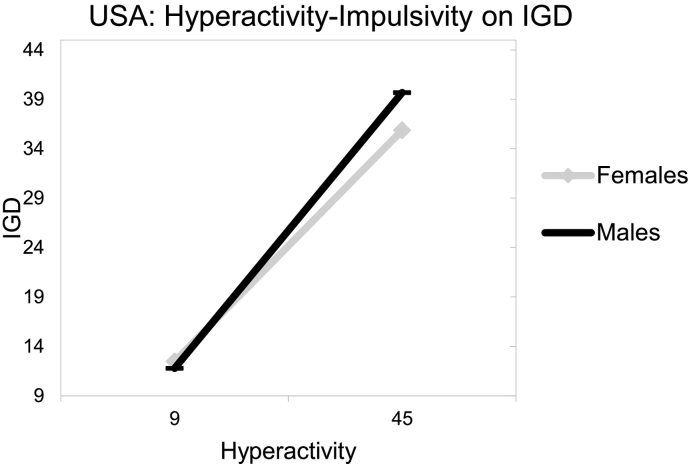
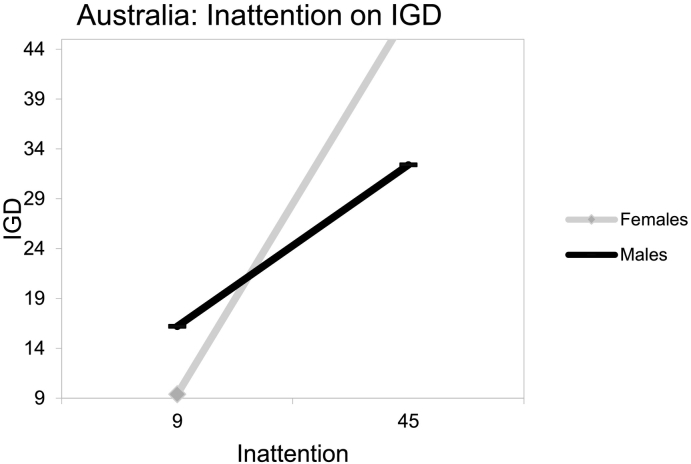
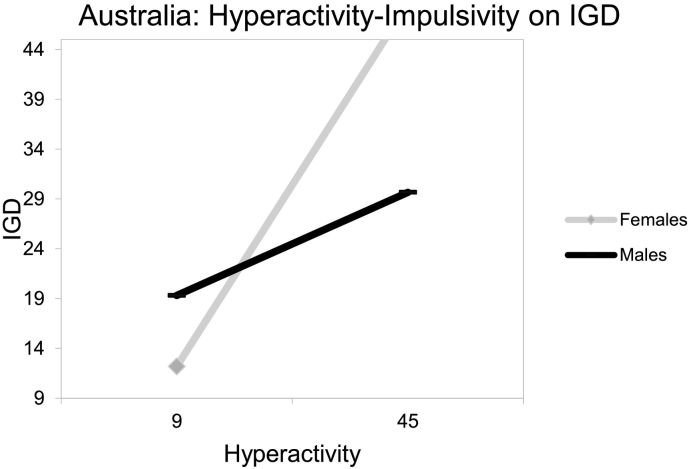
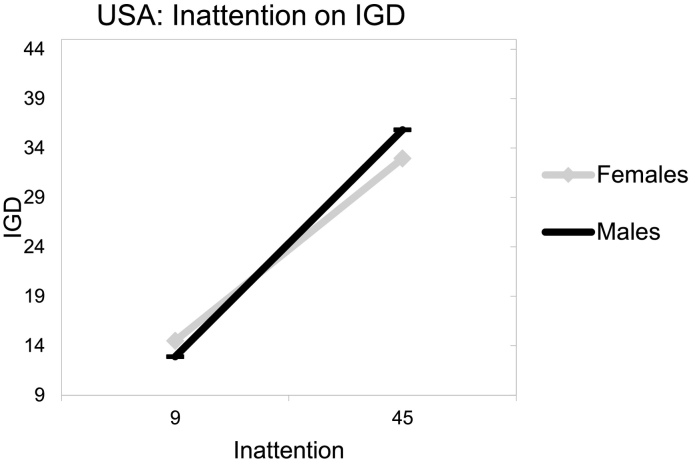
The hierarchical linear regression, moderation and moderated moderation analyses revealed that participants presenting greater inattention and hyperactivity symptoms exhibited higher levels of IGD-related behaviors in the two samples. Moreover, these associations differed across genders between the two countries. Specifically, more hyperactive-impulsive, as well as inattentive males in the USA presented higher levels of disordered gaming.
The results highlight the need for more cross-cultural and symptom-focused research in the broader IGD field.
2013年美国精神病学协会(APA)将电子游戏成瘾列为一种暂定病症,最近世界卫生组织(WHO)正式将其确认为一种精神健康障碍。尽管一些研究已将注意力缺陷多动障碍(ADHD)确定为网络游戏障碍(IGD)的一个关键风险因素,但ADHD与IGD症状之间的相互作用以及不同文化间的性别差异仍有待进一步研究。
本研究考察了性别在两个国家中ADHD与IGD关联中的调节作用。
开展了一项横断面在线调查,招募了164名澳大利亚(M = 23.01,标准差 = 3.35,最小年龄 = 18岁,最大年龄 = 31岁,男性 = 121人,占73.80%)和457名美国-北美地区(M = 25.25岁,标准差 = 2.76,最小年龄 = 18岁,最大年龄 = 29岁,男性 = 265人,占57.98%)年龄在18至29岁之间的大型多人在线(MMO)玩家。
分层线性回归、调节及调节调节分析显示,在两个样本中,表现出更多注意力不集中和多动症状的参与者表现出更高水平的与IGD相关的行为。此外,这两个国家不同性别之间的这些关联存在差异。具体而言,美国多动冲动及注意力不集中的男性表现出更高水平的游戏紊乱。
研究结果凸显了在更广泛的IGD领域开展更多跨文化和聚焦症状研究的必要性。