Department of Electrical Engineering and Computer Science, Massachusetts Institute of Technology, Cambridge, MA 02139.
David H. Koch Institute for Integrative Cancer Research, Massachusetts Institute of Technology, Cambridge, MA 02142.
Proc Natl Acad Sci U S A. 2019 Feb 5;116(6):2232-2236. doi: 10.1073/pnas.1814102116. Epub 2019 Jan 23.
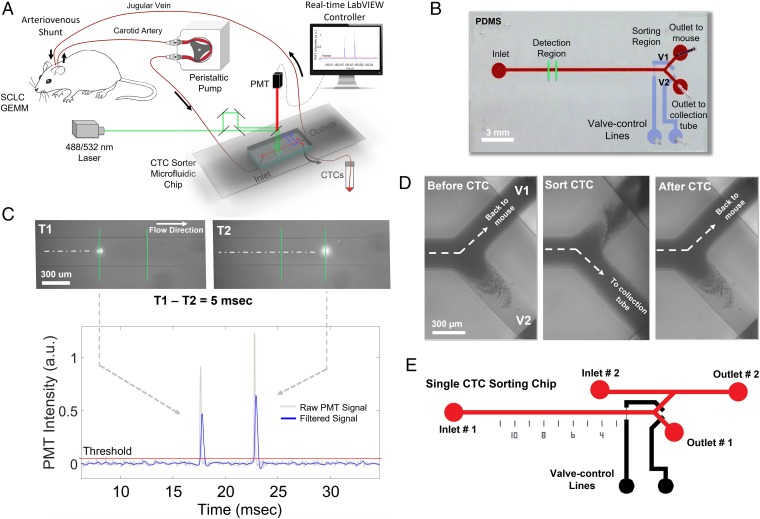
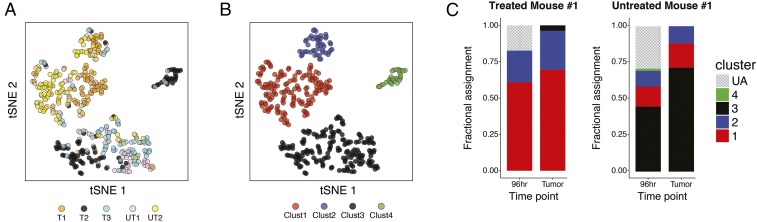
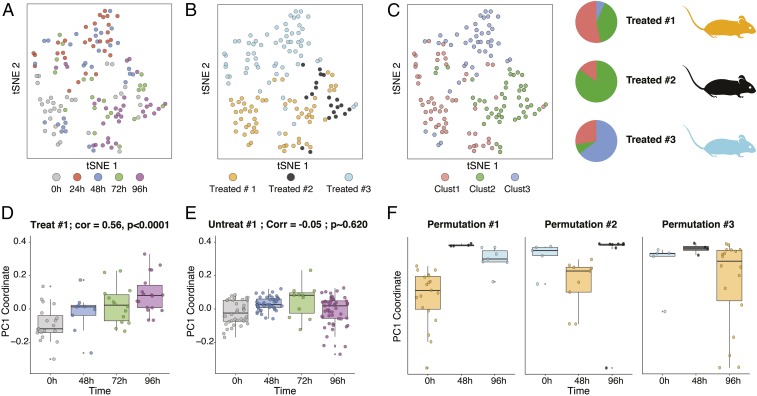
Circulating tumor cells (CTCs) play a fundamental role in cancer progression. However, in mice, limited blood volume and the rarity of CTCs in the bloodstream preclude longitudinal, in-depth studies of these cells using existing liquid biopsy techniques. Here, we present an optofluidic system that continuously collects fluorescently labeled CTCs from a genetically engineered mouse model (GEMM) for several hours per day over multiple days or weeks. The system is based on a microfluidic cell sorting chip connected serially to an unanesthetized mouse via an implanted arteriovenous shunt. Pneumatically controlled microfluidic valves capture CTCs as they flow through the device, and CTC-depleted blood is returned back to the mouse via the shunt. To demonstrate the utility of our system, we profile CTCs isolated longitudinally from animals over 4 days of treatment with the BET inhibitor JQ1 using single-cell RNA sequencing (scRNA-Seq) and show that our approach eliminates potential biases driven by intermouse heterogeneity that can occur when CTCs are collected across different mice. The CTC isolation and sorting technology presented here provides a research tool to help reveal details of how CTCs evolve over time, allowing studies to credential changes in CTCs as biomarkers of drug response and facilitating future studies to understand the role of CTCs in metastasis.
循环肿瘤细胞(CTCs)在癌症进展中起着至关重要的作用。然而,在小鼠中,由于血液体积有限且血液中 CTC 稀少,使用现有的液体活检技术对这些细胞进行长期、深入的研究受到限制。在这里,我们提出了一种光流控系统,该系统可以连续数天或数周每天从遗传工程小鼠模型(GEMM)中收集荧光标记的 CTC 数小时。该系统基于一个微流控细胞分选芯片,通过植入的动静脉分流器与未麻醉的小鼠串联。气动控制的微流控阀在 CTC 通过设备时捕获 CTC,并用分流器将 CTC 耗尽的血液返回给小鼠。为了证明我们系统的实用性,我们使用单细胞 RNA 测序(scRNA-Seq)对用 BET 抑制剂 JQ1 治疗 4 天的动物进行了纵向 CTC 分析,并表明我们的方法消除了由于在不同小鼠中收集 CTC 而导致的潜在异质性引起的偏差。这里提出的 CTC 分离和分选技术为揭示 CTC 随时间演变的细节提供了研究工具,使研究能够将 CTC 的变化作为药物反应的生物标志物,并有助于未来的研究来了解 CTC 在转移中的作用。