TCM Clinical Basis Institute, Zhejiang Chinese Medicine University, 548 Binwen Road, Hangzhou, Zhejiang, 310000, China.
Department of Integrative Traditional & Western Medicine, Medical College, Yangzhou University, Yangzhou, Jiangsu, 225001, China.
Sci Rep. 2019 Jan 23;9(1):355. doi: 10.1038/s41598-018-36314-2.
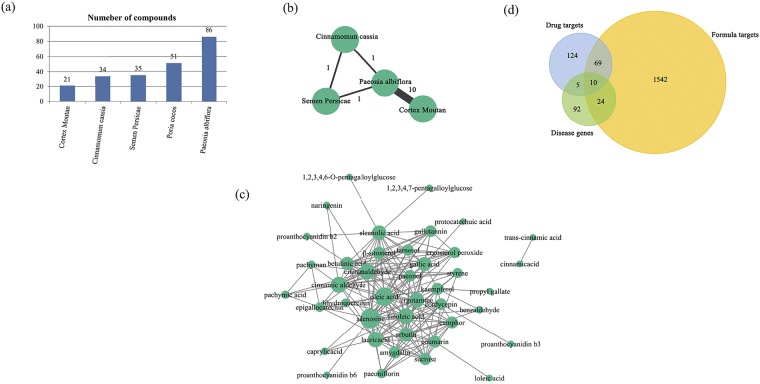
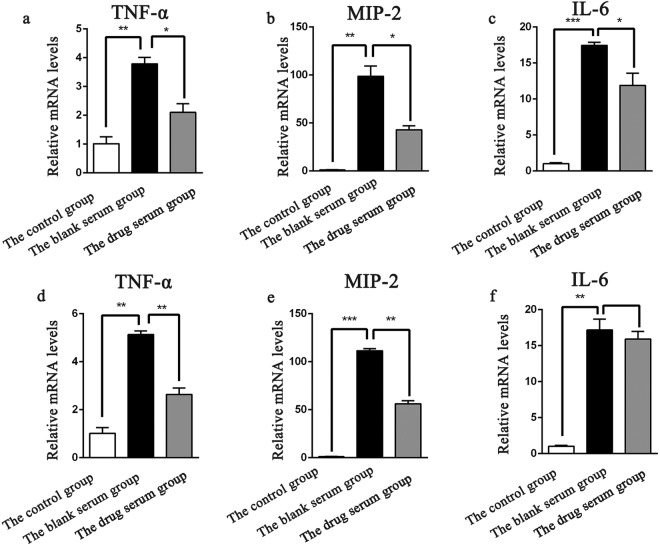
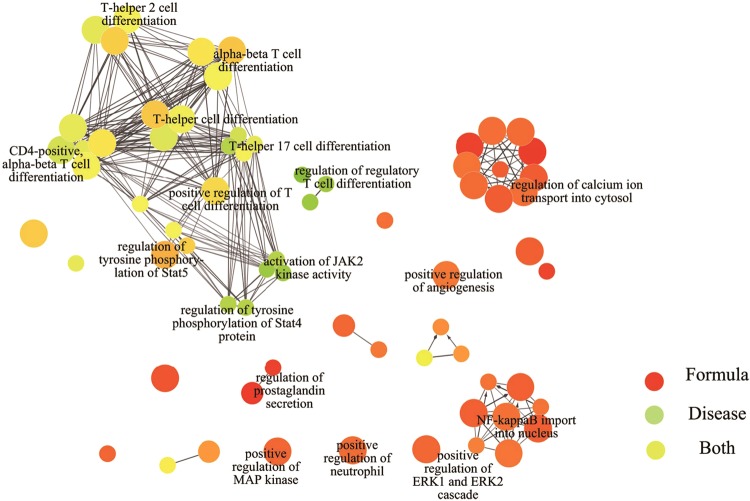
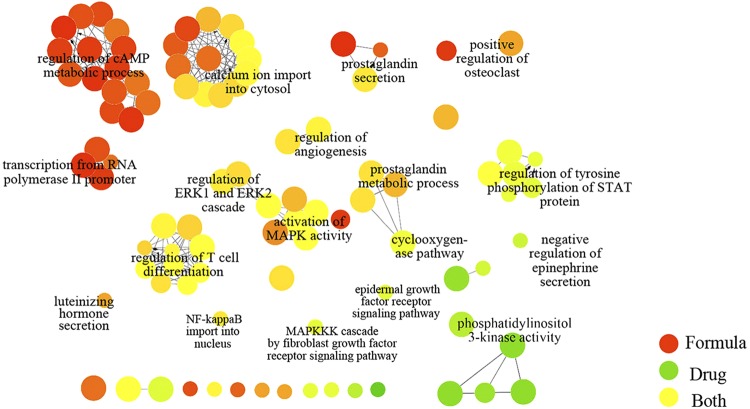
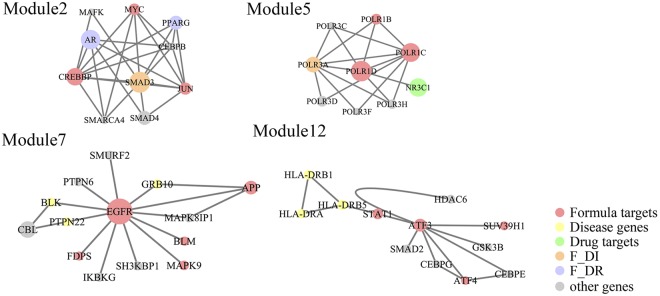
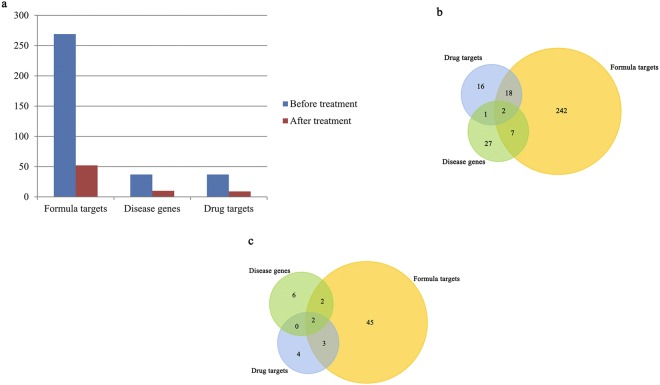
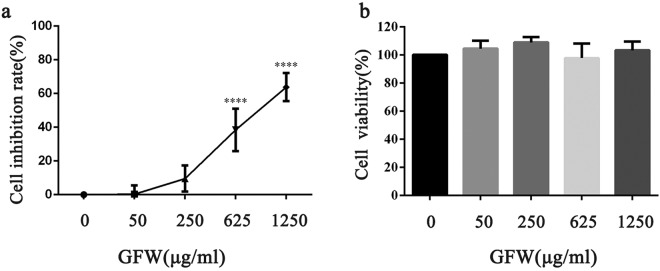
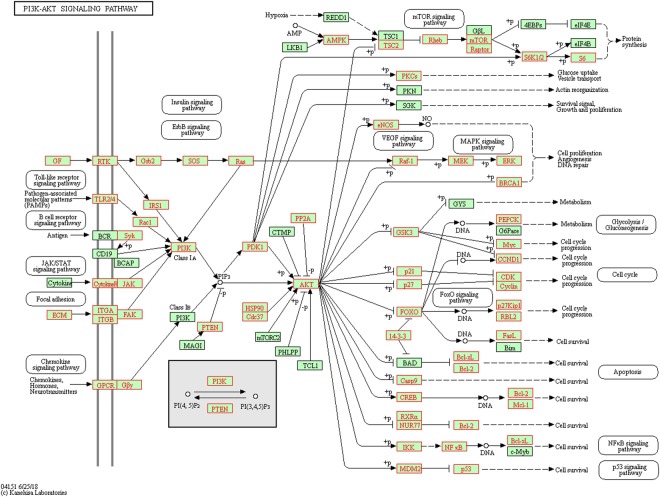
Systemic sclerosis (SSc; scleroderma) is a complicated idiopathic connective tissue disease with seldom effective treatment. GUI-ZHI-FU-LING-WAN (GFW) is a classic Traditional Chinese Medicine (TCM) formula widely used for the treatment of SSc. However, the mechanism of how the GFW affects SSc remains unclear. In this study, the system biology approach was utilized to analyze herb compounds and related targets to get the general information of GFW. The KEGG enrichment analysis of 1645 related targets suggested that the formula is involved in the VEGF signaling pathway, the Toll-like receptor signaling pathway, etc. Quantitative and qualitative analysis of the relationship among the 3 subsets (formula targets, drug targets and disease genes) showed that the formula targets overlapped with 38.0% drug targets and 26.0% proteins encoded by disease genes. Through the analysis of SSc related microarray statistics from the GEO database, we also validated the consistent expression behavior among the 3 subsets before and after treatment. To further reveal the mechanism of prescription, we constructed a network among 3 subsets and decomposed it into 24 modules to decipher how GFW interfere in the progress of SSc. The modules indicated that the intervention may come into effect through following pathogenic processes: vasculopathy, immune dysregulation and tissue fibrosis. Vitro experiments confirmed that GFW could suppress the proliferation of fibroblasts and decrease the Th1 cytokine (TNF-α, MIP-2 and IL-6) expression for lipopolysaccharide (LPS) and bleomycin (BLM) stimulation in macrophages, which is consistent with previous conclusion that GFW is able to relieve SSc. The systems biology approach provides a new insight for deepening understanding about TCM.
系统性硬化症(SSc;硬皮病)是一种复杂的特发性结缔组织疾病,治疗效果甚微。桂附茯苓丸(GFW)是一种经典的中药(TCM)配方,广泛用于治疗 SSc。然而,GFW 影响 SSc 的机制尚不清楚。在这项研究中,我们采用系统生物学方法分析草药化合物和相关靶点,以获取 GFW 的一般信息。对 1645 个相关靶点的 KEGG 富集分析表明,该配方涉及 VEGF 信号通路、Toll 样受体信号通路等。对 3 个子集(配方靶点、药物靶点和疾病基因)之间关系的定量和定性分析表明,配方靶点与 38.0%的药物靶点和 26.0%的疾病基因编码蛋白重叠。通过对 GEO 数据库中 SSc 相关微阵列统计数据的分析,我们还验证了 3 个子集在治疗前后的一致表达行为。为了进一步揭示处方的机制,我们在 3 个子集之间构建了一个网络,并将其分解为 24 个模块,以破译 GFW 如何干预 SSc 的进展。这些模块表明,干预可能通过以下发病过程发挥作用:血管病变、免疫失调和组织纤维化。体外实验证实,GFW 可抑制成纤维细胞的增殖,并降低巨噬细胞中脂多糖(LPS)和博来霉素(BLM)刺激下 Th1 细胞因子(TNF-α、MIP-2 和 IL-6)的表达,这与 GFW 能够缓解 SSc 的先前结论一致。系统生物学方法为深入了解 TCM 提供了新的视角。