Department of Genetics, Microbiology and Statistics, School of Biology and Institute of Biomedicine of the University of Barcelona (IBUB), University of Barcelona, Barcelona, Spain.
Institute for Research in Biomedicine (IRB Barcelona), The Barcelona Institute of Science and Technology, Baldiri Reixac, Barcelona, Spain.
PLoS Genet. 2019 Jan 24;15(1):e1007926. doi: 10.1371/journal.pgen.1007926. eCollection 2019 Jan.
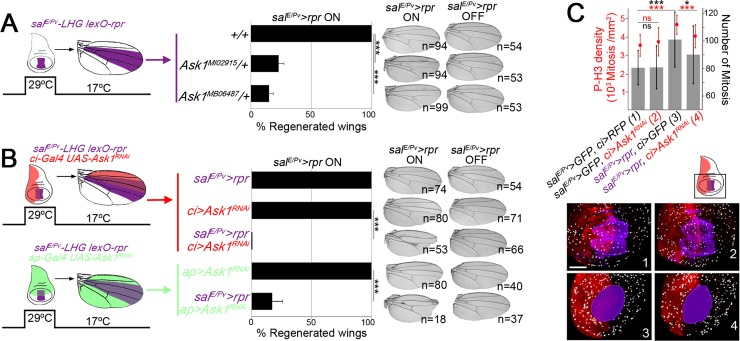
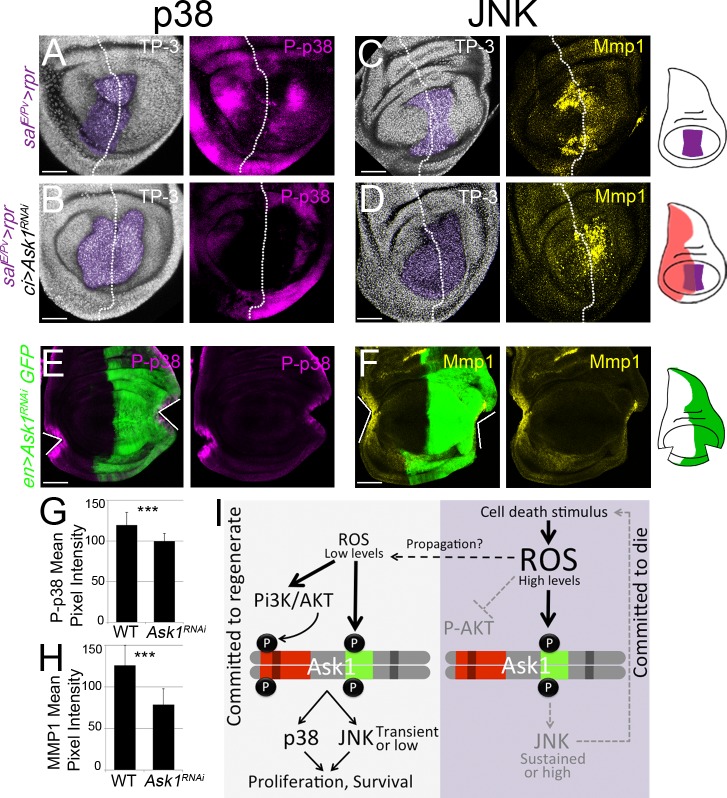
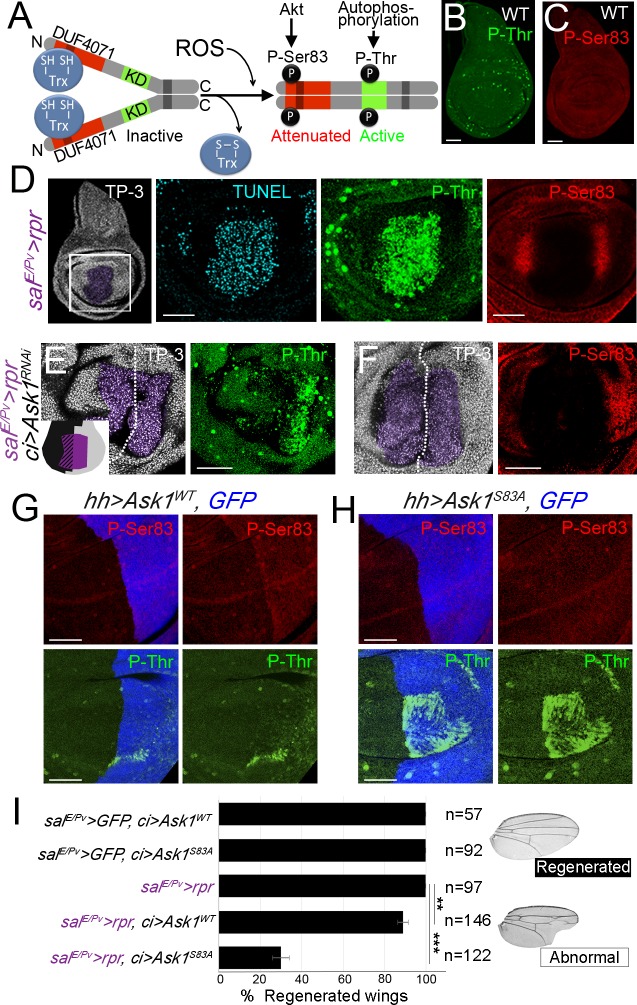
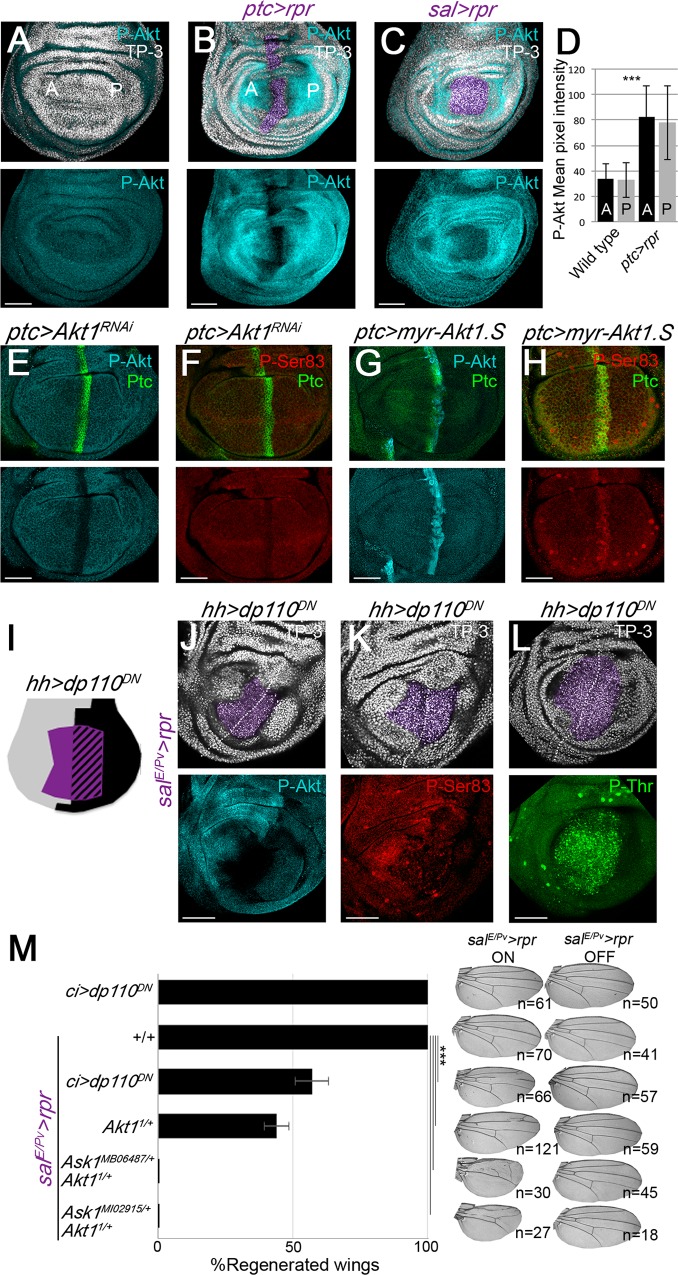
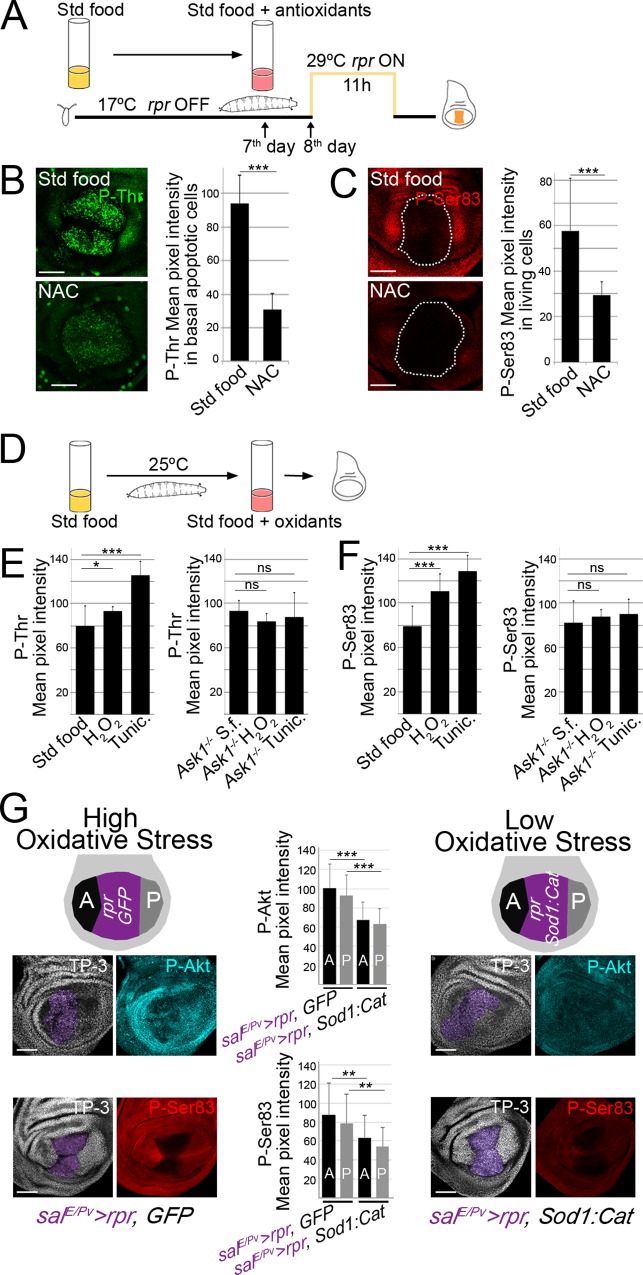
How cells communicate to initiate a regenerative response after damage has captivated scientists during the last few decades. It is known that one of the main signals emanating from injured cells is the Reactive Oxygen Species (ROS), which propagate to the surrounding tissue to trigger the replacement of the missing cells. However, the link between ROS production and the activation of regenerative signaling pathways is not yet fully understood. We describe here the non-autonomous ROS sensing mechanism by which living cells launch their regenerative program. To this aim, we used Drosophila imaginal discs as a model system due to its well-characterized regenerative ability after injury or cell death. We genetically-induced cell death and found that the Apoptosis signal-regulating kinase 1 (Ask1) is essential for regenerative growth. Ask1 senses ROS both in dying and living cells, but its activation is selectively attenuated in living cells by Akt1, the core kinase component of the insulin/insulin-like growth factor pathway. Akt1 phosphorylates Ask1 in a secondary site outside the kinase domain, which attenuates its activity. This modulation of Ask1 activity results in moderate levels of JNK signaling in the living tissue, as well as in activation of p38 signaling, both pathways required to turn on the regenerative response. Our findings demonstrate a non-autonomous activation of a ROS sensing mechanism by Ask1 and Akt1 to replace the missing tissue after damage. Collectively, these results provide the basis for understanding the molecular mechanism of communication between dying and living cells that triggers regeneration.
几十年来,细胞如何在受损后发出信号来启动再生反应一直吸引着科学家们的关注。众所周知,损伤细胞发出的主要信号之一是活性氧(ROS),它会传播到周围组织,触发缺失细胞的替换。然而,ROS 产生与再生信号通路激活之间的联系尚未完全阐明。我们在这里描述了活细胞启动其再生程序的非自主 ROS 感应机制。为此,我们使用果蝇 imaginal discs 作为模型系统,因为它在受伤或细胞死亡后具有良好的再生能力。我们通过基因诱导细胞死亡,发现凋亡信号调节激酶 1(Ask1)对于再生生长是必不可少的。Ask1 在死亡和存活细胞中都能感知 ROS,但它的激活在存活细胞中被 Akt1 选择性地减弱,Akt1 是胰岛素/胰岛素样生长因子通路的核心激酶成分。Akt1 在激酶结构域外的第二位点磷酸化 Ask1,从而减弱其活性。这种 Ask1 活性的调节导致存活组织中 JNK 信号的适度激活,以及 p38 信号的激活,这两条通路都是启动再生反应所必需的。我们的研究结果表明,Ask1 和 Akt1 通过非自主方式激活了 ROS 感应机制,以在受损后替换缺失的组织。总之,这些结果为理解触发再生的死亡细胞和存活细胞之间的分子通讯机制提供了基础。