Sigma Research, Department of Public Health, Environments and Society, London School of Hygiene and Tropical Medicine, London, UK
Communicable Diseases Division, Swiss Federal Office of Public Health, Bern, Switzerland.
Sex Transm Infect. 2019 Jun;95(4):285-291. doi: 10.1136/sextrans-2017-053363. Epub 2019 Jan 24.
There is no estimate of the current number of men who have sex with men (MSM) in Switzerland, or of their geographical distribution. We aimed to (1) estimate MSM concentration factors and population sizes for 83 Swiss postal code areas (PCA), including the nine largest Swiss cities, and (2) calculate MSM-specific local HIV prevalence and yearly rates of diagnosed HIV, hepatitis C virus (HCV), syphilis and gonorrhoea.
We triangulated data from general population estimates, MSM online surveys, published data on HIV prevalence and Swiss notification data for HIV and STDs. We compared two different formulae for the estimation of local MSM populations and calculated Bayesian 95%-credible-intervals (CrI) for each PCA.
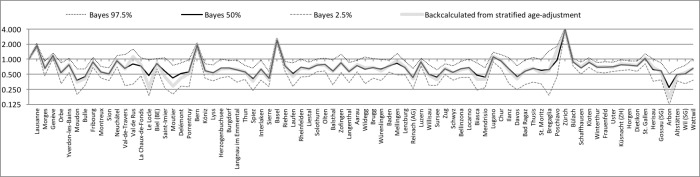
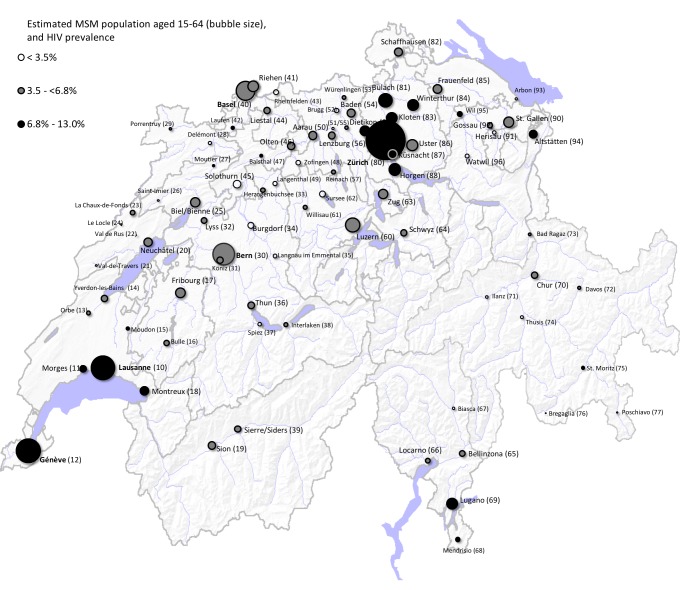
Across Switzerland, we estimate the MSM population aged 15-64 at roughly 80 000 men (95% CrI 64 000-96 000). (1) MSM in Switzerland were most concentrated in the five largest cities of Zurich, Geneva, Lausanne, Bern and Basel. (2) We estimate that in 2012, 6300 MSM, or 8.0%, were living with HIV, both diagnosed and undiagnosed and 1700 MSM, or 2.2%, had non-suppressed HIV infection. Between 2010 and 2013, average yearly rates of diagnosed HIV, HCV, syphilis and gonorrhoea were 0.3%, 0.02%, 0.4 % and 0.4 %, respectively.
Combining general population data, MSM online surveys and notification data allows the calculation of realistic estimates of local MSM populations and thus proportions of MSM with diagnosed HIV and other STIs, with implications for prevention planning, commissioning of health services and counselling MSM on HIV/STI risk. Our methodology for Switzerland is transferable to other countries with similar data sources.
目前瑞士男男性行为者(MSM)的人数及其地域分布尚不清楚。本研究旨在:(1)估计 83 个瑞士邮政编码区(PCA)的 MSM 集中因素和人口规模,包括瑞士的 9 个最大城市;(2)计算 MSM 特定的局部 HIV 流行率和每年诊断出的 HIV、丙型肝炎病毒(HCV)、梅毒和淋病的发病率。
我们综合了一般人群估计数、MSM 在线调查、HIV 流行率的已发表数据和瑞士 HIV 和性传播疾病的通报数据。我们比较了两种不同的公式来估计当地 MSM 人群,并为每个 PCA 计算了贝叶斯 95%可信区间(CrI)。
在瑞士,我们估计年龄在 15-64 岁的 MSM 约为 8 万人(95% CrI 为 6.4-9.6 万)。(1)瑞士的 MSM 主要集中在苏黎世、日内瓦、洛桑、伯尔尼和巴塞尔这 5 个最大的城市。(2)我们估计,2012 年有 6300 名 MSM(8.0%)感染 HIV,包括已确诊和未确诊的 HIV 感染者,有 1700 名 MSM(2.2%)存在未抑制的 HIV 感染。2010 年至 2013 年,每年诊断出的 HIV、HCV、梅毒和淋病的平均发病率分别为 0.3%、0.02%、0.4%和 0.4%。
综合使用一般人群数据、MSM 在线调查和通报数据,可以计算出当地 MSM 人群的真实估计值,以及诊断出 HIV 和其他性传播感染的 MSM 的比例,这对预防规划、卫生服务的委托以及为 MSM 提供 HIV/性传播感染风险咨询具有重要意义。我们在瑞士使用的方法可以推广到具有类似数据源的其他国家。