Greenblatt Rebecca E, Zhao Edward J, Henrickson Sarah E, Apter Andrea J, Hubbard Rebecca A, Himes Blanca E
1Department of Biostatistics, Epidemiology and Informatics, Perelman School of Medicine, University of Pennsylvania, Philadelphia, PA 19104 USA.
2Division of Allergy-Immunology, Children's Hospital of Philadelphia, Philadelphia, PA 19104 USA.
Asthma Res Pract. 2019 Jan 18;5:1. doi: 10.1186/s40733-019-0048-y. eCollection 2019.
Asthma is a chronic inflammatory lung disease that affects 18.7 million U.S. adults. Electronic health records (EHRs) are a unique source of information that can be leveraged to understand factors associated with asthma in real-life populations. In this study, we identify demographic factors and comorbidities associated with asthma exacerbations among adults according to EHR-derived data and compare these findings to those of epidemiological studies.
We obtained University of Pennsylvania Hospital System EHR-derived data for asthma encounters occurring between 2011 and 2014. Regression analyses were performed to model asthma exacerbation frequency as explained by age, sex, race/ethnicity, health insurance type, smoking status, body mass index (BMI) and various comorbidities. We analyzed data from the National Health and Nutrition Examination Survey (NHANES) from 2001 to 2012 to compare findings with those from the EHR-derived data.
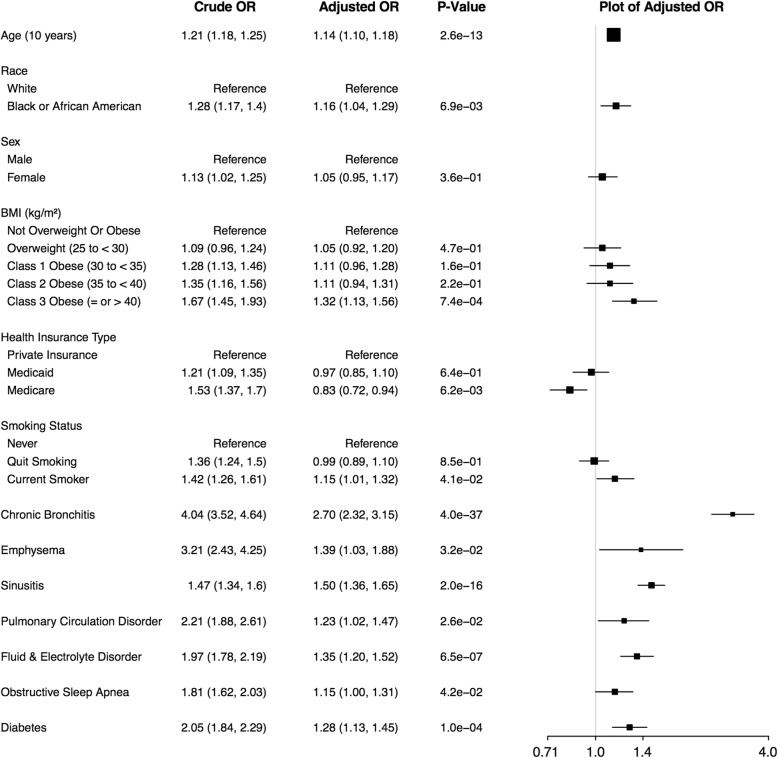
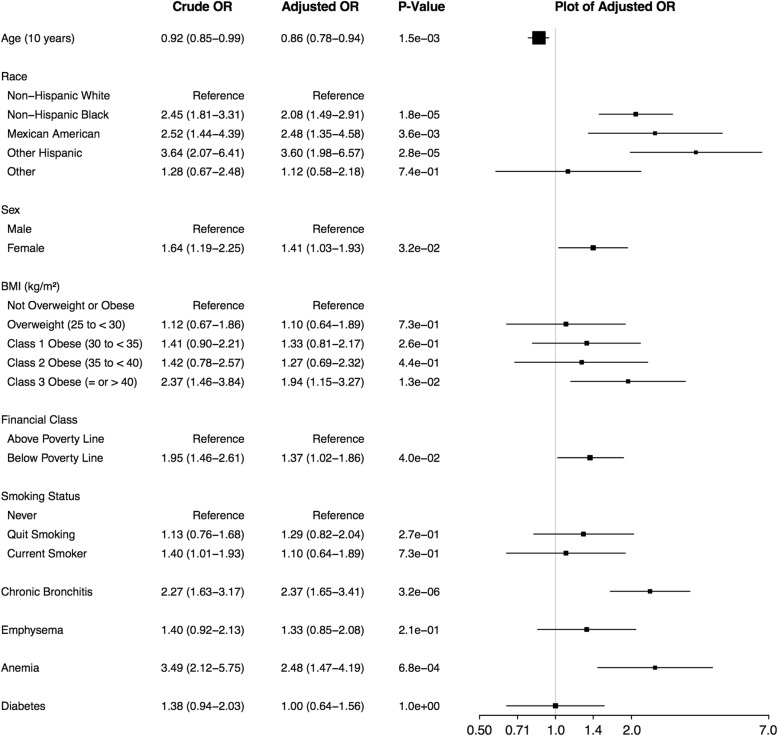
Based on data from 9068 adult patients with asthma, 33.37% had at least one exacerbation over the four-year study period. In a proportional odds logistic regression predicting number of exacerbations during the study period (levels: 0, 1-2, 3-4, 5+ exacerbations), after controlling for age, race/ethnicity, sex, health insurance type, and smoking status, the highest odds ratios (ORs) of significantly associated factors were: (2.70), (1.50), (1.39), (1.35), (1.32), and (1.28). An analysis of NHANES data showed associations for , and with exacerbation frequency in an adjusted model controlling for age, race/ethnicity, sex, financial class and smoking status.
EHR-derived data is helpful to understand exacerbations in real-life asthma patients, facilitating design of detailed studies and interventions tailored for specific populations.
哮喘是一种慢性炎症性肺部疾病,影响着1870万美国成年人。电子健康记录(EHRs)是一种独特的信息来源,可用于了解现实生活人群中与哮喘相关的因素。在本研究中,我们根据电子健康记录得出的数据,确定与成人哮喘加重相关的人口统计学因素和合并症,并将这些结果与流行病学研究结果进行比较。
我们获取了宾夕法尼亚大学医院系统2011年至2014年间哮喘就诊的电子健康记录数据。进行回归分析,以年龄、性别、种族/民族、健康保险类型、吸烟状况、体重指数(BMI)和各种合并症来模拟哮喘加重频率。我们分析了2001年至2012年国家健康和营养检查调查(NHANES)的数据,以将结果与电子健康记录得出的数据进行比较。
基于9068例成年哮喘患者的数据,在四年的研究期间,33.37%的患者至少有一次病情加重。在预测研究期间加重次数的比例优势逻辑回归分析中(水平:0次、1 - 2次、3 - 4次、5次以上加重),在控制年龄、种族/民族、性别、健康保险类型和吸烟状况后,显著相关因素的最高优势比(ORs)分别为:(2.70)、(1.50)、(1.39)、(1.35)、(1.32)和(1.28)。对NHANES数据的分析显示,在控制年龄、种族/民族、性别、经济阶层和吸烟状况的调整模型中,[具体因素]与加重频率存在关联。
电子健康记录得出的数据有助于了解现实生活中哮喘患者的病情加重情况,便于设计针对特定人群的详细研究和干预措施。