UCL Institute of Ophthalmology, University College London, London, United Kingdom.
Moorfields Eye Hospital NHS Foundation Trust, City Road, London, United Kingdom.
Invest Ophthalmol Vis Sci. 2019 Jan 2;60(1):383-396. doi: 10.1167/iovs.18-25880.
To investigate retinal structure in subjects with CNGA3-associated achromatopsia and evaluate disease symmetry and intrafamilial variability.
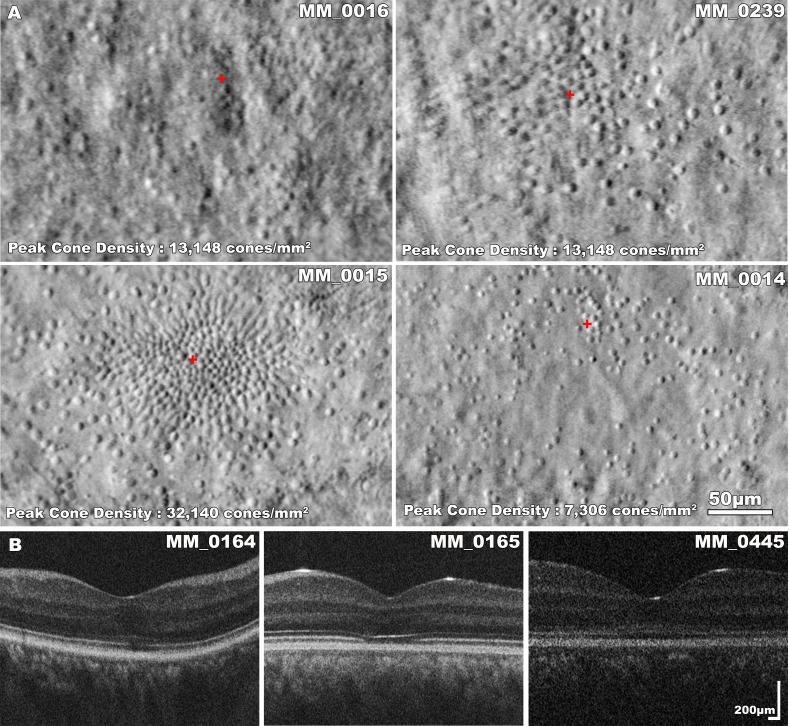
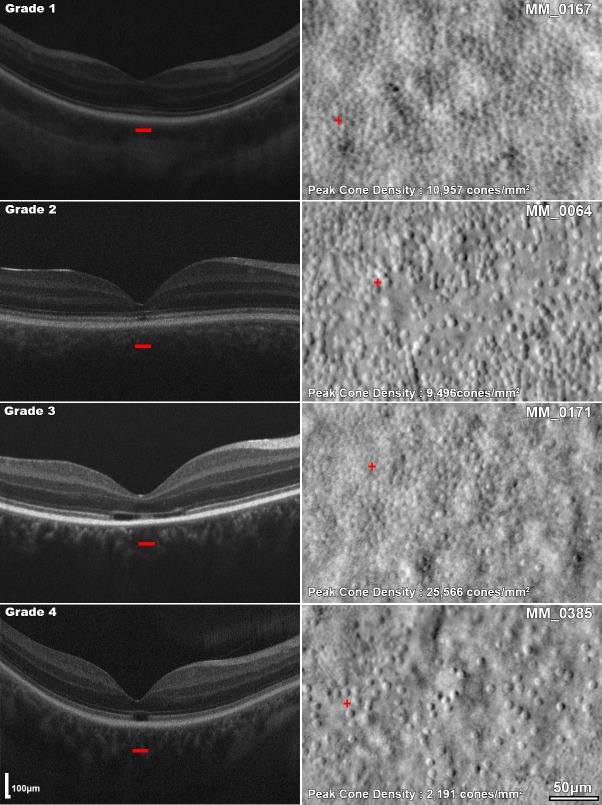
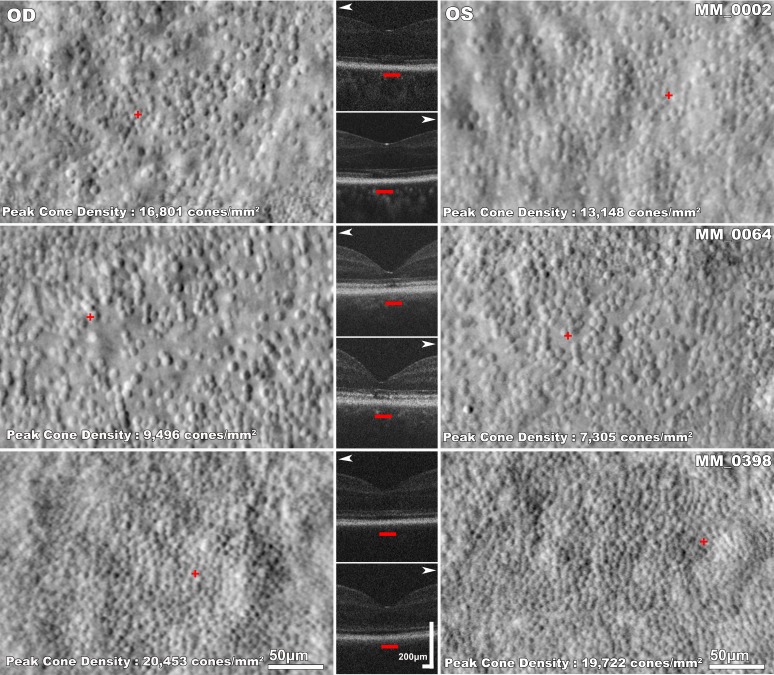
Thirty-eight molecularly confirmed subjects underwent ocular examination, optical coherence tomography (OCT), and nonconfocal split-detection adaptive optics scanning light ophthalmoscopy (AOSLO). OCT scans were used for evaluating foveal hypoplasia, grading foveal ellipsoid zone (EZ) disruption, and measuring outer nuclear layer (ONL) thickness. AOSLO images were used to quantify peak foveal cone density, intercell distance (ICD), and the coefficient of variation (CV) of ICD.
Mean (±SD) age was 25.9 (±13.1) years. Mean (± SD) best corrected visual acuity (BCVA) was 0.87 (±0.14) logarithm of the minimum angle of resolution. Examination with OCT showed variable disruption or loss of the EZ. Seven subjects were evaluated for disease symmetry, with peak foveal cone density, ICD, CV, ONL thickness, and BCVA not differing significantly between eyes. A cross-sectional evaluation of AOSLO imaging showed a mean (±SD) peak foveal cone density of 19,844 (±13,046) cones/mm2. There was a weak negative association between age and peak foveal cone density (r = -0.397, P = 0.102), as well as between EZ grade and age (P = 0.086).
The remnant cone mosaics were irregular and variably disrupted, with significantly lower peak foveal cone density than unaffected individuals. Variability was also seen among subjects with identical mutations. Therefore, subjects should be considered on an individual basis for stratification in clinical trials. Interocular symmetry suggests that both eyes have comparable therapeutic potential and the fellow eye can serve as a valid control. Longitudinal studies are needed, to further examine the weak negative association between age and foveal cone structure observed here.
研究 CNGA3 相关色盲性视锥细胞营养不良患者的视网膜结构,评估疾病的对称性和家族内变异性。
38 名经分子证实的患者接受了眼部检查、光学相干断层扫描(OCT)和非共焦分裂检测自适应光学扫描检眼镜(AOSLO)。OCT 扫描用于评估黄斑发育不良、黄斑椭圆区(EZ)分级破坏,并测量外核层(ONL)厚度。AOSLO 图像用于定量测量黄斑中心凹锥体细胞密度、细胞间距离(ICD)和 ICD 的变异系数(CV)。
平均(±SD)年龄为 25.9(±13.1)岁。平均(±SD)最佳矫正视力(BCVA)为 0.87(±0.14)对数最小分辨角。OCT 检查显示 EZ 存在不同程度的破坏或缺失。7 名患者进行了疾病对称性评估,双眼黄斑中心凹锥体细胞密度、ICD、CV、ONL 厚度和 BCVA 无显著差异。AOSLO 成像的横断面评估显示平均(±SD)黄斑中心凹锥体细胞密度为 19844(±13046)个/毫米²。年龄与黄斑中心凹锥体细胞密度之间呈弱负相关(r=-0.397,P=0.102),EZ 分级与年龄之间也呈弱负相关(P=0.086)。
残留的锥体细胞马赛克结构不规则且破坏程度不同,黄斑中心凹锥体细胞密度明显低于正常个体。具有相同突变的患者之间也存在差异。因此,应根据个体情况对临床试验中的患者进行分层。双眼的对称性表明双眼具有相当的治疗潜力,对侧眼可以作为有效的对照。需要进行纵向研究,以进一步探讨这里观察到的年龄与黄斑锥体细胞结构之间的弱负相关。