
先天性全色盲患者旁中央凹视锥细胞镶嵌的纵向成像
Longitudinal Imaging of the Parafoveal Cone Mosaic in Congenital Achromatopsia.
作者信息
Chen Nickolas, Litts Katie M, Nikezic Danica, Langlo Christopher S, Higgins Brian P, Lam Byron L, Fishman Gerald A, Collison Frederick T, Pennesi Mark E, Kay Christine N, Tarima Sergey, Carroll Joseph
机构信息
School of Medicine, Medical College of Wisconsin, Milwaukee, Wisconsin.
Department of Ophthalmology and Visual Sciences, Medical College of Wisconsin, Milwaukee, Wisconsin.
出版信息
Ophthalmol Sci. 2025 Mar 14;5(4):100765. doi: 10.1016/j.xops.2025.100765. eCollection 2025 Jul-Aug.
PURPOSE
To assess longitudinal changes in parafoveal cone density in individuals with congenital achromatopsia (ACHM).
DESIGN
Retrospective longitudinal study.
PARTICIPANTS
Nineteen individuals (7 women and 12 men) with genetically confirmed ACHM. To be eligible, each had adaptive optics scanning light ophthalmoscope (AOSLO) images of the photoreceptor mosaic from ≥2 time points.
METHODS
For each individual, follow-up AOSLO montages were aligned to their baseline montage. Notably, 100 × 100 μm regions of interest (ROIs) were extracted from the split-detection modality at locations 1°, 5°, and 10° temporal (T) from the peak cone density in each montage. All ROIs from follow-up visits were then manually aligned to their respective baseline ROI for that location. Cones were identified in each ROI by one observer, reviewed by a second observer, and confirmed together in a masked fashion. Cone density was calculated, and a linear mixed model was used to assess changes in density over time. A Wald test was performed to determine if the cone density changes were statistically significant.
MAIN OUTCOME MEASURES
Parafoveal cone spacing (at 1°, 5°, and 10° T) as a function of time.
RESULTS
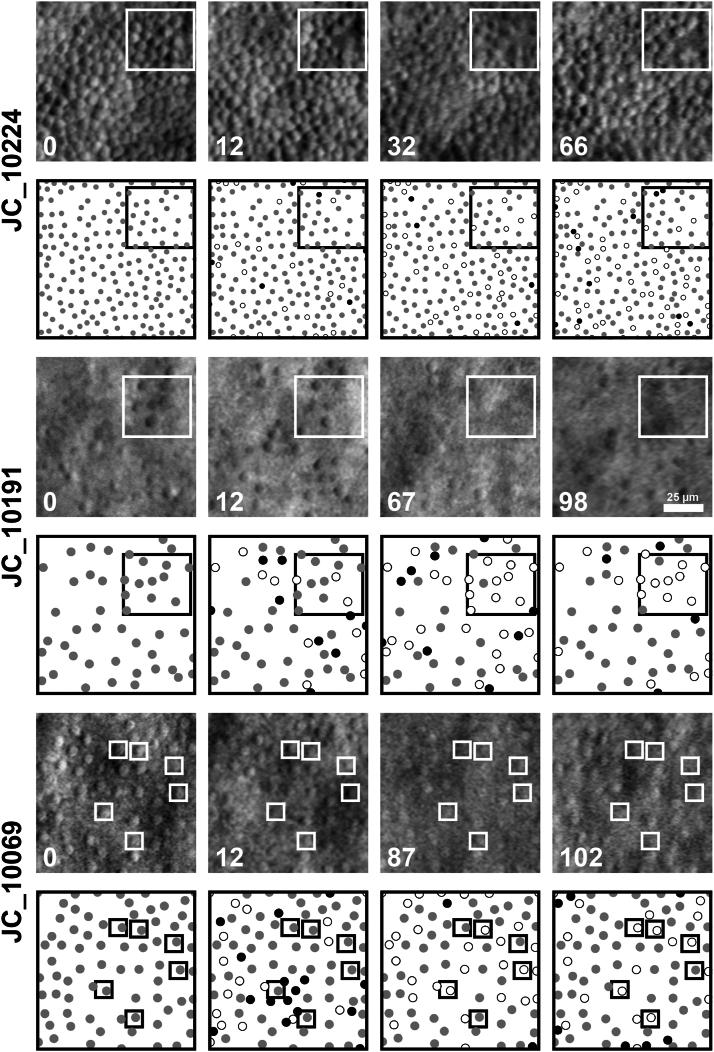
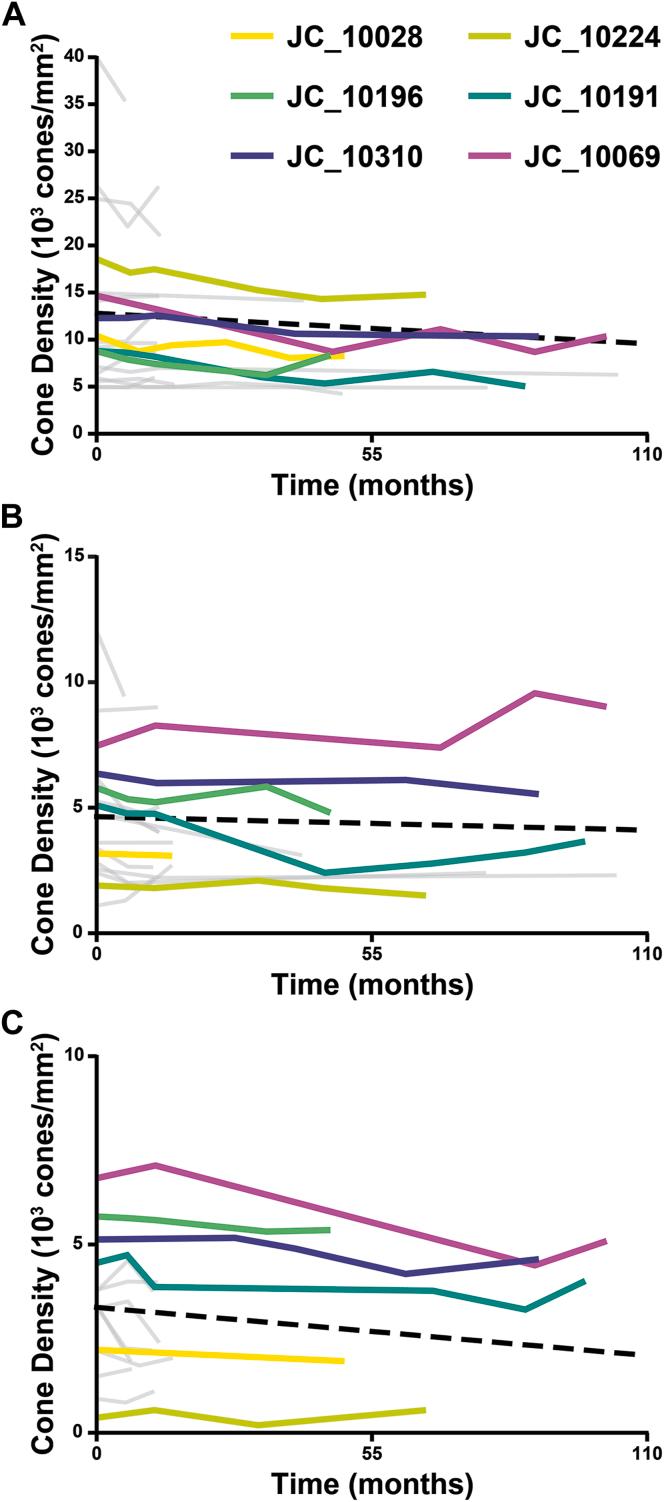
The mean (± standard deviation [SD]) age at baseline was 21.6 ± 10.7 years and the mean (±SD) follow-up period was 3.83 ± 2.93 years (range, 0.46-8.66 years). At 1° T, we observed a significant decrease of 352 cones/mm per year ( = 0.0003). At 5° T, the linear mixed model showed a nonstatistically significant decrease of 58 cones/mm per year ( = 0.504). At 10° T, we observed a significant decrease of 139 cones/mm per year ( = 0.0188). For a 100 × 100 μm ROI, these density changes correspond to a reduction of between about 0.5 and 4 cones per year, depending on the location.
CONCLUSIONS
Parafoveal cone density estimates in ACHM show a small decrease over time. These observed changes are within the previously reported longitudinal repeatability values for normal retinas, suggesting the observed average cone loss may not be clinically meaningful. Further studies with longer follow-up times and more genetically heterogeneous and age-diverse populations are needed to better understand factors contributing to changes in foveal and parafoveal cone structure in ACHM over time.
FINANCIAL DISCLOSURES
Proprietary or commercial disclosures may be found in the Footnotes and Disclosures at the end of this article.
目的
评估先天性全色盲(ACHM)患者旁中心凹视锥细胞密度的纵向变化。
设计
回顾性纵向研究。
参与者
19名经基因确诊的ACHM患者(7名女性和12名男性)。符合条件的患者均有来自≥2个时间点的自适应光学扫描激光检眼镜(AOSLO)的光感受器镶嵌图像。
方法
对于每名患者,将随访的AOSLO蒙太奇图像与基线蒙太奇图像对齐。值得注意的是,从每个蒙太奇图像中视锥细胞密度峰值颞侧1°、5°和10°处的分离检测模式中提取100×100μm的感兴趣区域(ROI)。然后将随访时的所有ROI手动与该位置各自的基线ROI对齐。由一名观察者在每个ROI中识别视锥细胞,第二名观察者进行复查,并以盲法共同确认。计算视锥细胞密度,并使用线性混合模型评估密度随时间的变化。进行Wald检验以确定视锥细胞密度变化是否具有统计学意义。
主要观察指标
旁中心凹视锥细胞间距(在颞侧1°、5°和10°处)随时间的变化。
结果
基线时的平均(±标准差[SD])年龄为21.6±10.7岁,平均(±SD)随访期为3.83±2.93年(范围为0.46 - 8.66年)。在颞侧1°处,我们观察到每年显著减少352个视锥细胞/mm²(P = 0.0003)。在颞侧5°处,线性混合模型显示每年减少58个视锥细胞/mm²,无统计学意义(P = 0.504)。在颞侧10°处,我们观察到每年显著减少139个视锥细胞/mm²(P = 0.0188)。对于100×100μm的ROI,这些密度变化对应于每年减少约0.5至4个视锥细胞,具体取决于位置。
结论
ACHM患者的旁中心凹视锥细胞密度估计值随时间略有下降。这些观察到的变化在先前报道的正常视网膜纵向重复性值范围内,表明观察到的平均视锥细胞损失可能在临床上无意义。需要对更多基因异质性和年龄多样化的人群进行更长时间的随访研究,以更好地了解导致ACHM患者中央凹和旁中心凹视锥细胞结构随时间变化的因素。
财务披露
在本文末尾的脚注和披露中可能会找到专有或商业披露信息。

 Zotero 插件