Rong Lulu, Liu Yong, Hui Zhouguang, Zhao Zitong, Zhang Yueming, Wang Bingzhi, Yuan Yanling, Li Wenbin, Guo Lei, Ying Jianming, Song Yongmei, Wang Luhua, Zhou Zhongren, Xue Liyan, Lu Ning
Department of Pathology and Resident Training Base, National Cancer Center/National Clinical Research Center for Cancer/Cancer Hospital, Chinese Academy of Medical Sciences and Peking Union Medical College, Beijing, 100021, China.
Department of Endoscopy, National Cancer Center/National Clinical Research Center for Cancer/Cancer Hospital, Chinese Academy of Medical Sciences and Peking Union Medical College, Beijing, 100021, China.
Diagn Pathol. 2019 Jan 26;14(1):6. doi: 10.1186/s13000-019-0778-4.
Programmed death ligand 1 (PD-L1) is a ligand for the inhibitory programmed cell death protein 1 (PD-1), which are targeted by several anti-PD-1 and PD-L1 drugs for a variety of human cancers. However, only a few studies have evaluated PD-L1 expression in esophageal squamous cell carcinoma (ESCC) with a large Chinese cohort. Our present study is to evaluate the association of PD-L1 expression with clinicopathological features on ESCC.
Using tissue microarray and immunohistochemistry, PD-L1 expression on tumor cells and tumor-infiltrating immune cells was studied in 378 advanced ESCC patients without neoadjuvant chemoradiotherapy. Its correlation with clinicopathological parameters was analyzed.
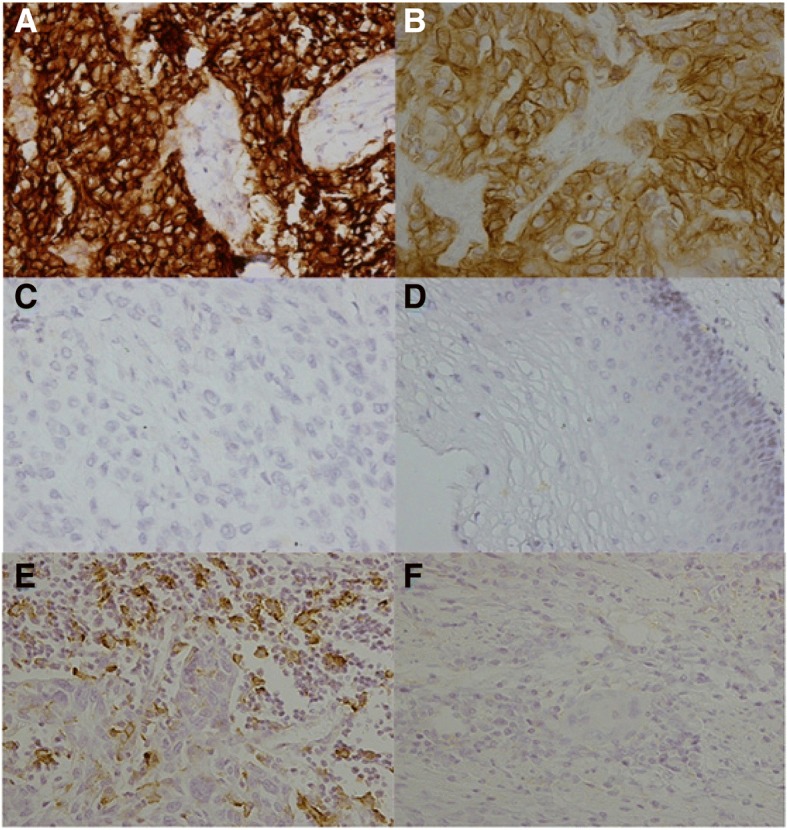
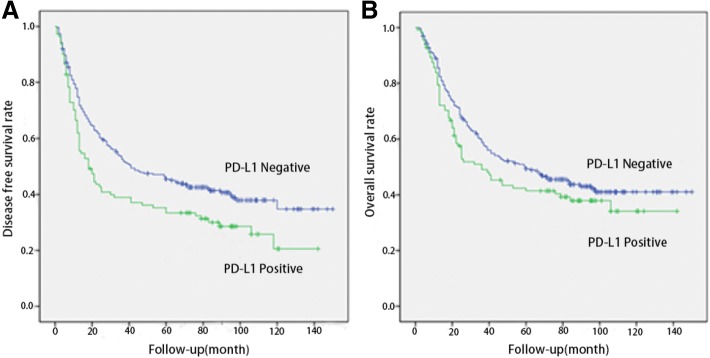
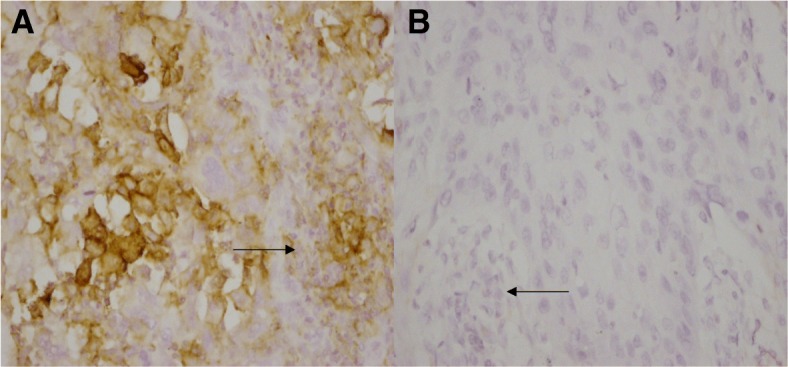
PD-L1 was expressed on 29.9% (113/378) ESCC tumor cells and 40.2% (152/378) tumor-infiltrating immune cells. PD-L1 expression in tumor cells was significantly correlated with age, degree of differentiation, T stage, N stage and metachronous hematogenous metastasis, and PD-L1 expression in tumor-infiltrating immune cells was significantly associated with N stage (P < 0.05). Patients with PD-L1 expression in tumor cells had poor disease-free survival (Hazard ratio [HR] = 1.436, P = 0.009). There was a positive association between tumor cells and tumor-infiltrating immune cells for PD-L1 expression (r = 0.16, P = 0.002). However, PD-L1 expression in tumor-infiltrating immune cells was not significantly correlated with disease-free survival and overall survival.
PD-L1 expression in tumor cells and tumor infiltrating immune cells is not only an indicator for immunotherapy, but also significantly related with age, differentiation, stage, metastasis and disease free survival.
程序性死亡配体1(PD-L1)是抑制性程序性细胞死亡蛋白1(PD-1)的配体,多种抗PD-1和PD-L1药物针对其用于治疗多种人类癌症。然而,仅有少数研究使用大型中国队列评估食管鳞状细胞癌(ESCC)中的PD-L1表达情况。我们目前的研究旨在评估PD-L1表达与ESCC临床病理特征之间的关联。
采用组织芯片和免疫组化方法,对378例未接受新辅助放化疗的晚期ESCC患者的肿瘤细胞和肿瘤浸润免疫细胞上的PD-L1表达进行研究,并分析其与临床病理参数的相关性。
29.9%(113/378)的ESCC肿瘤细胞和40.2%(152/378)的肿瘤浸润免疫细胞表达PD-L1。肿瘤细胞中的PD-L1表达与年龄、分化程度、T分期、N分期和异时性血行转移显著相关,肿瘤浸润免疫细胞中的PD-L1表达与N分期显著相关(P<0.05)。肿瘤细胞中表达PD-L1的患者无病生存期较差(风险比[HR]=1.436,P=0.009)。肿瘤细胞与肿瘤浸润免疫细胞的PD-L1表达之间存在正相关(r=0.16,P=0.002)。然而,肿瘤浸润免疫细胞中的PD-L1表达与无病生存期和总生存期无显著相关性。
肿瘤细胞和肿瘤浸润免疫细胞中的PD-L1表达不仅是免疫治疗的指标,还与年龄、分化、分期、转移和无病生存期显著相关。