Department of Obstetrics and Gynecology, Fertility Center of CHA Gangnam Medical Center, CHA University School of Medicine, Seoul, Korea.
Biomedical Science, CHA University, Seongnam, Korea.
J Korean Med Sci. 2019 Jan 10;34(4):e27. doi: 10.3346/jkms.2019.34.e27. eCollection 2019 Jan 28.
The standard morphological evaluation has been widely used for embryo selection, but it has limitations. This study aimed to investigate the correlation between morphologic grading and euploidy rate of in vitro fertilization (IVF) preimplantation genetic screening (PGS) and compare the pregnancy rates in young and old ages.
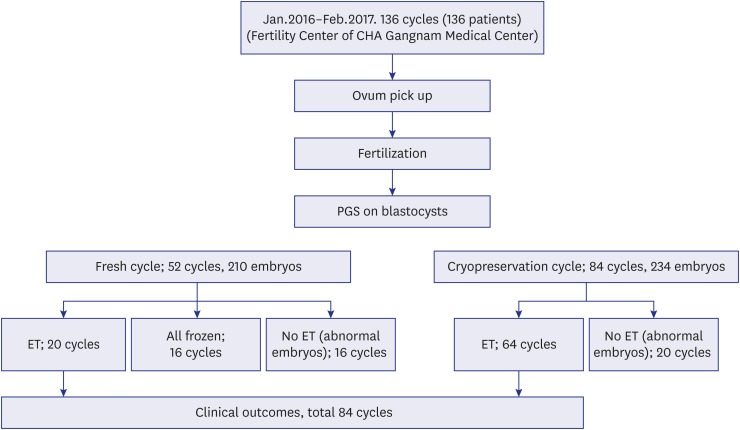
This is a retrospective study using the medical records of patients who underwent IVF procedures with PGS between January 2016 and February 2017 in a single center. The embryo grades were categorized into 4 groups: excellent, good, fair, and poor. Basic characteristics, euploidy rates, clinical pregnancy (CP) rates and ongoing pregnancy rates were analyzed.
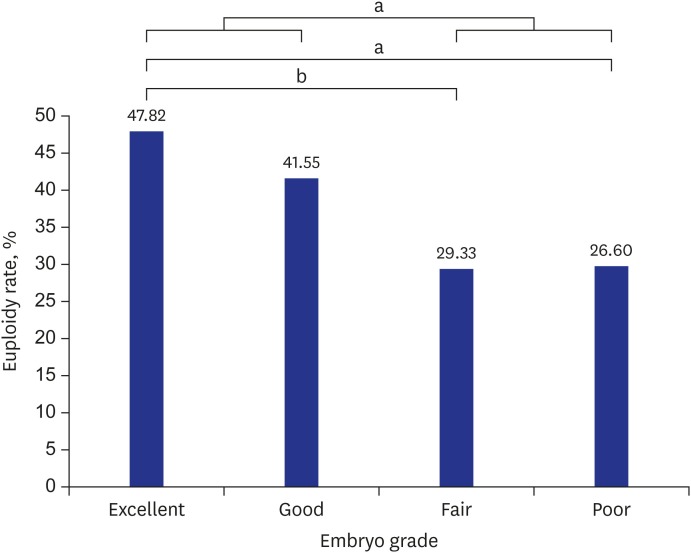
The excellent group had significantly higher rate of euploid embryos than fair group (47.82% vs. 29.33%; = 0.023) and poor group (47.82% vs. 29.60%; = 0.005). When the four groups were recategorized into two groups (excellent and good vs. fair and poor), they also showed significant difference in euploidy rates (44.52% vs. 29.53%; = 0.002). When the patients were divided into two groups by age 35, the CP rates for those under and over 35 years old were 44.74% and 47.83%, respectively, which showed no significant difference.
The significant differences among the euploidy rates of different morphologic embryo grades demonstrated the positive correlations between the morphologic grading of the embryo and the euploidy rate of PGS. Additionally, there was no significant difference between the younger and older patients' CP rates. These findings emphasize the fact that old age patients might benefit from PGS whatever the indication of PGS is.
标准形态学评估已被广泛用于胚胎选择,但存在局限性。本研究旨在探讨体外受精(IVF)植入前遗传学筛查(PGS)中胚胎形态学分级与整倍体率的相关性,并比较年轻和高龄患者的妊娠率。
这是一项回顾性研究,使用了 2016 年 1 月至 2017 年 2 月在单中心接受 IVF 与 PGS 程序的患者的病历。胚胎分级分为 4 组:优秀、良好、一般和较差。分析了基本特征、整倍体率、临床妊娠(CP)率和持续妊娠率。
优秀组的整倍体胚胎率明显高于一般组(47.82%比 29.33%; = 0.023)和较差组(47.82%比 29.60%; = 0.005)。当将这 4 组重新分为两组(优秀和良好组比一般和较差组)时,整倍体率也存在显著差异(44.52%比 29.53%; = 0.002)。当根据年龄将患者分为两组时,年龄在 35 岁以下和 35 岁以上的患者的 CP 率分别为 44.74%和 47.83%,差异无统计学意义。
不同形态胚胎分级的整倍体率差异显著,表明胚胎形态分级与 PGS 的整倍体率之间存在正相关。此外,年轻和高龄患者的 CP 率之间没有显著差异。这些发现强调了一个事实,即无论 PGS 的指征如何,高龄患者可能都受益于 PGS。