Department of Anesthesiology, Obstetrics and Gynecology Hospital Affiliated to Nanjing Medical University, Nanjing, China.
Department of Anesthesiology, The First Affiliated Hospital of Nanjing Medical University, Nanjing, China.
Biomed Res Int. 2018 Dec 31;2018:1869189. doi: 10.1155/2018/1869189. eCollection 2018.
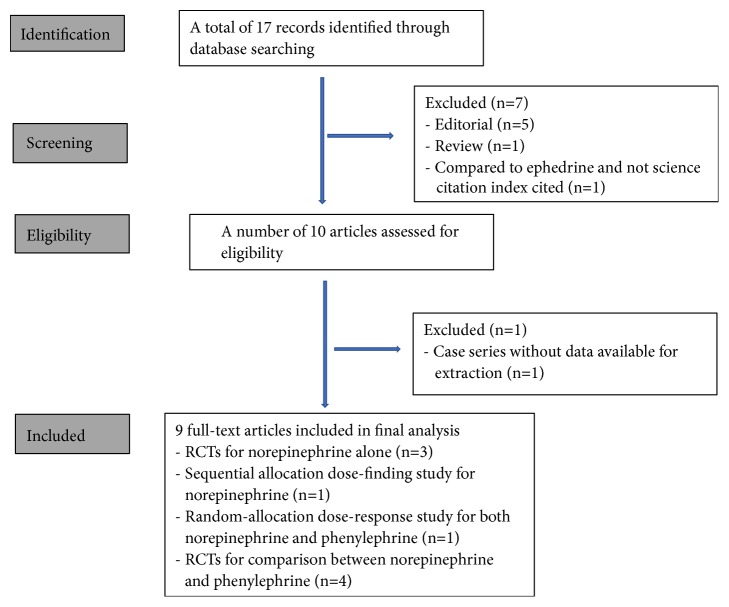
Maternal hypotension commonly occurs during spinal anesthesia for cesarean delivery, with a decrease of systemic vascular resistance recognized as a significant contributor. Accordingly, counteracting this effect with a vasopressor that constricts arterial vessels is appropriate, and the pure -adrenergic receptor agonist phenylephrine is the current gold standard for treatment. However, phenylephrine is associated with dose-dependent reflex bradycardia and decreased cardiac output, which can endanger the mother and fetus in certain circumstances. In recent years, the older, traditional vasopressor norepinephrine has attracted increasing attention owing to its mild -adrenergic effects in addition to its -adrenergic effects. We search available literature for papers directly related to norepinephrine application in spinal anesthesia for elective cesarean delivery. Nine reports were found for norepinephrine use either alone or compared to phenylephrine. Results show that norepinephrine efficacy in rescuing maternal hypotension is similar to that of phenylephrine without obvious maternal or neonatal adverse outcomes, and with a lower incidence of bradycardia and greater cardiac output. In addition, either computer-controlled closed loop feedback infusion or manually-controlled variable-rate infusion of norepinephrine provides more precise blood pressure management than equipotent phenylephrine infusion or norepinephrine bolus. Thus, based on the limited available literature, norepinephrine appears to be a promising alternative to phenylephrine; however, before routine application begins, more favorable high-quality studies are warranted.
产妇低血压在剖宫产椎管内麻醉中很常见,全身性血管阻力下降被认为是其重要原因。因此,使用缩血管的血管加压药来对抗这种作用是合适的,而纯α肾上腺素受体激动剂去氧肾上腺素是目前治疗的金标准。然而,去氧肾上腺素与剂量依赖性反射性心动过缓和心输出量降低有关,在某些情况下可能会危及母亲和胎儿。近年来,由于除了具有β肾上腺素能作用外,其α肾上腺素能作用也较温和,较老的传统血管加压药去甲肾上腺素引起了越来越多的关注。我们搜索了与去甲肾上腺素在择期剖宫产椎管内麻醉中应用直接相关的文献。发现了 9 篇关于去甲肾上腺素单独使用或与去氧肾上腺素比较的报告。结果表明,去甲肾上腺素在抢救产妇低血压方面的疗效与去氧肾上腺素相似,无明显的母亲或新生儿不良结局,且心动过缓发生率较低,心输出量较大。此外,去甲肾上腺素的计算机控制闭环反馈输注或手动控制变率输注比等效去氧肾上腺素输注或去甲肾上腺素推注提供了更精确的血压管理。因此,基于有限的可用文献,去甲肾上腺素似乎是去氧肾上腺素的一种有前途的替代药物;然而,在开始常规应用之前,需要更多有利的高质量研究。