1Welten Institute - Research Centre for Learning,Teaching,and Technology,Open University of the Netherlands,6419 AT Heerlen,The Netherlands.
3School of Medicine,Lipid Research Centre,Molecular Horizons,Illawarra Health & Medical Research Institute,University of Wollongong,Wollongong,NSW 2522,Australia.
Br J Nutr. 2019 Apr;121(7):793-808. doi: 10.1017/S0007114519000138. Epub 2019 Jan 28.
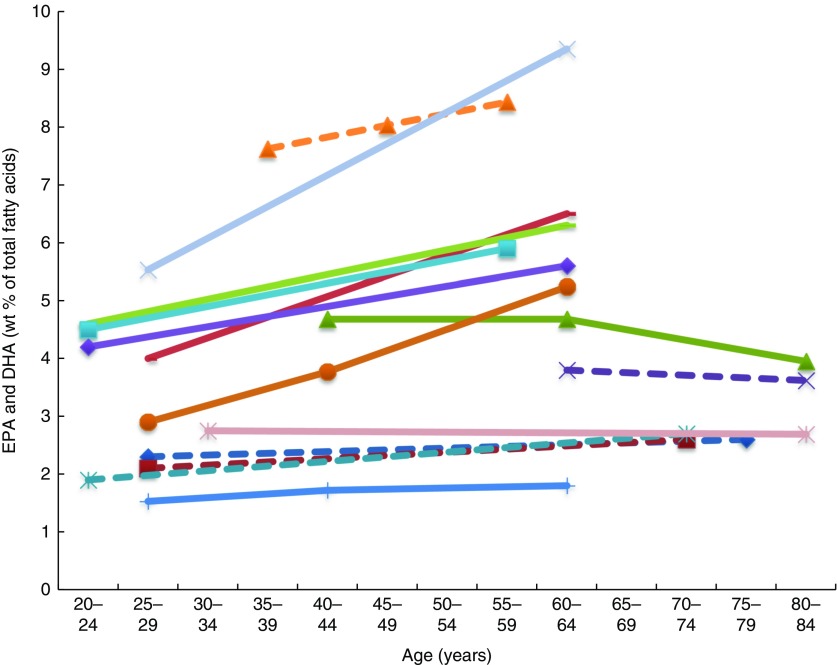
Numerous health benefits are attributed to the n-3 long-chain PUFA (n-3 LCPUFA); EPA and DHA. A systematic literature review was conducted to investigate factors, other than diet, that are associated with the n-3 LCPUFA levels. The inclusion criteria were papers written in English, carried out in adult non-pregnant humans, n-3 LCPUFA measured in blood or tissue, data from cross-sectional studies, or baseline data from intervention studies. The search revealed 5076 unique articles of which seventy were included in the qualitative synthesis. Three main groups of factors potentially associated with n-3 LCPUFA levels were identified: (1) unmodifiable factors (sex, genetics, age), (2) modifiable factors (body size, physical activity, alcohol, smoking) and (3) bioavailability factors (chemically bound form of supplements, krill oil v. fish oil, and conversion of plant-derived α-linolenic acid (ALA) to n-3 LCPUFA). Results showed that factors positively associated with n-3 LCPUFA levels were age, female sex (women younger than 50 years), wine consumption and the TAG form. Factors negatively associated with n-3 LCPUFA levels were genetics, BMI (if erythrocyte EPA and DHA levels are <5·6 %) and smoking. The evidence for girth, physical activity and krill oil v. fish oil associated with n-3 LCPUFA levels is inconclusive. There is also evidence that higher ALA consumption leads to increased levels of EPA but not DHA. In conclusion, sex, age, BMI, alcohol consumption, smoking and the form of n-3 LCPUFA are all factors that need to be taken into account in n-3 LCPUFA research.
许多健康益处归因于 n-3 长链多不饱和脂肪酸(n-3 LCPUFA);EPA 和 DHA。进行了系统的文献综述,以调查除饮食以外与 n-3 LCPUFA 水平相关的因素。纳入标准为用英语撰写、在非妊娠成人中进行的论文、血液或组织中测量的 n-3 LCPUFA、横断面研究的数据或干预研究的基线数据。搜索结果显示有 5076 篇独特的文章,其中 70 篇被纳入定性综合分析。确定了三个可能与 n-3 LCPUFA 水平相关的主要因素组:(1)不可改变的因素(性别、遗传、年龄),(2)可改变的因素(体型、身体活动、酒精、吸烟)和(3)生物利用度因素(补充剂的化学结合形式、磷虾油与鱼油,以及植物衍生的α-亚麻酸(ALA)向 n-3 LCPUFA 的转化)。结果表明,与 n-3 LCPUFA 水平呈正相关的因素是年龄、女性(年龄小于 50 岁的女性)、葡萄酒消费和 TAG 形式。与 n-3 LCPUFA 水平呈负相关的因素是遗传、BMI(如果红细胞 EPA 和 DHA 水平 <5.6%)和吸烟。与 n-3 LCPUFA 水平相关的腰围、身体活动和磷虾油与鱼油的证据尚无定论。还有证据表明,ALA 消耗增加会导致 EPA 水平升高,但 DHA 水平不会升高。总之,性别、年龄、BMI、酒精摄入、吸烟和 n-3 LCPUFA 的形式都是 n-3 LCPUFA 研究中需要考虑的因素。