Department of Head and Neck Surgical Oncology, UMC Utrecht Cancer Center, University Medical Center Utrecht, Utrecht, The Netherlands.
Department of Otolaryngology-Head and Neck Surgery, VU University Medical Center, Amsterdam, The Netherlands.
Head Neck. 2019 Jul;41(7):2100-2106. doi: 10.1002/hed.25665. Epub 2019 Jan 28.
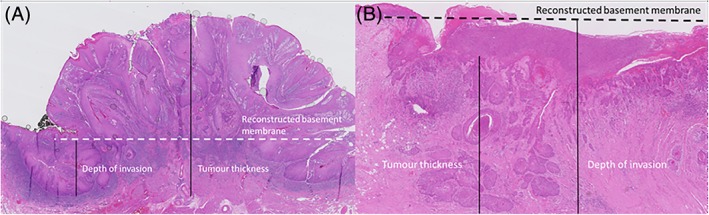
To investigate if depth of invasion (DOI) can predict occult nodal disease in patients with cT1-2N0 (7th TNM) oral squamous cell carcinoma (OSCC) staged by sentinel lymph node biopsy (SLNB).
In 199 OSCC patients, DOI measurements and SLNB were performed.
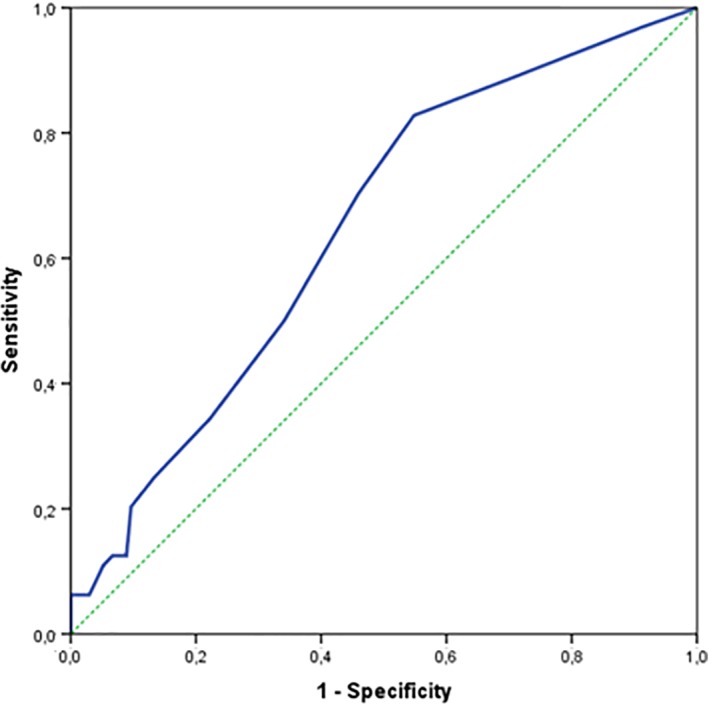
Metastases were found in 64 of 199 patients (32%). Of these 64 patients, the mean DOI was 6.6 mm compared to 4.7 mm in patients without metastases (P = .003). The ROC-curve showed an area under the curve of 0.65 with a most optimal cutoff point of 3.4 mm DOI (sensitivity 83% and specificity 47%). Regional metastases were found in 15% of patients with DOI ≤ 3.4 mm.
DOI seems to be a poor predictor for regional metastasis in patients with cT1-2N0 OSCC. Therefore, staging of the neck using SLNB in patients with early stage oral cancer should also be performed in tumors with limited DOI and probably in T3 (8th TNM) OSCC ≤4 cm diameter.
研究侵袭深度(DOI)是否可以预测接受前哨淋巴结活检(SLNB)分期的 cT1-2N0(7 版 TNM)口腔鳞状细胞癌(OSCC)患者的隐匿性淋巴结疾病。
对 199 例 OSCC 患者进行了 DOI 测量和 SLNB。
199 例患者中有 64 例(32%)发生转移。在这些转移患者中,DOI 的平均值为 6.6mm,而无转移患者的 DOI 为 4.7mm(P=.003)。ROC 曲线显示曲线下面积为 0.65,最佳截断点为 3.4mmDOI(敏感性 83%,特异性 47%)。DOI≤3.4mm 的患者中,有 15%出现区域性转移。
DOI 似乎不能很好地预测 cT1-2N0 OSCC 患者的区域性转移。因此,对于早期口腔癌患者,即使在 DOI 有限的肿瘤和可能在 T3(8 版 TNM)OSCC≤4cm 直径的肿瘤中,也应使用 SLNB 对颈部进行分期。