University of California San Francisco, Memory and Aging Center, Weill Institute for the Neurosciences, San Francisco, CA, USA.
University of California San Francisco, Weill Institute for the Neurosciences, San Francisco, CA, USA.
J Alzheimers Dis. 2019;67(3):911-921. doi: 10.3233/JAD-181145.
Recent studies reveal an association between slow-wave sleep (SWS), amyloid-β aggregation, and cognition.
This retrospective study examines whether long-term use of trazodone, an SWS enhancer, is associated with delayed cognitive decline.
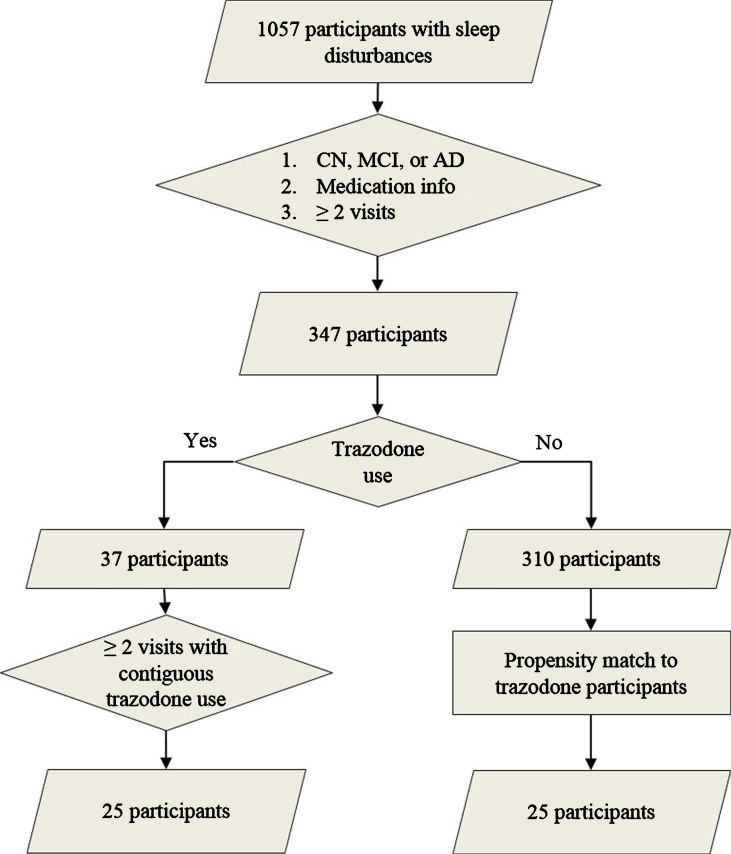
We identified 25 regular trazodone users (mean age 75.4±7.5; 9 women, 16 men) who carried a diagnosis of Alzheimer's dementia, mild cognitive impairment, or normal cognition, and 25 propensity-matched trazodone non-users (mean age 74.5±8.0; 13 women, 12 men), accounting for age, sex, education, type of sleep deficit (hypersomnia, insomnia, parasomnia), diagnosis, and baseline Mini-Mental State Examination (MMSE). Longitudinal group differences in cognitive testing were evaluated through repeated measures tests over an average inter-evaluation interval of four years.
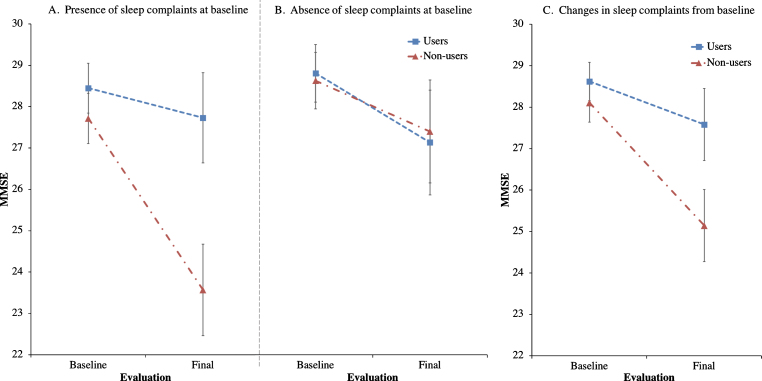
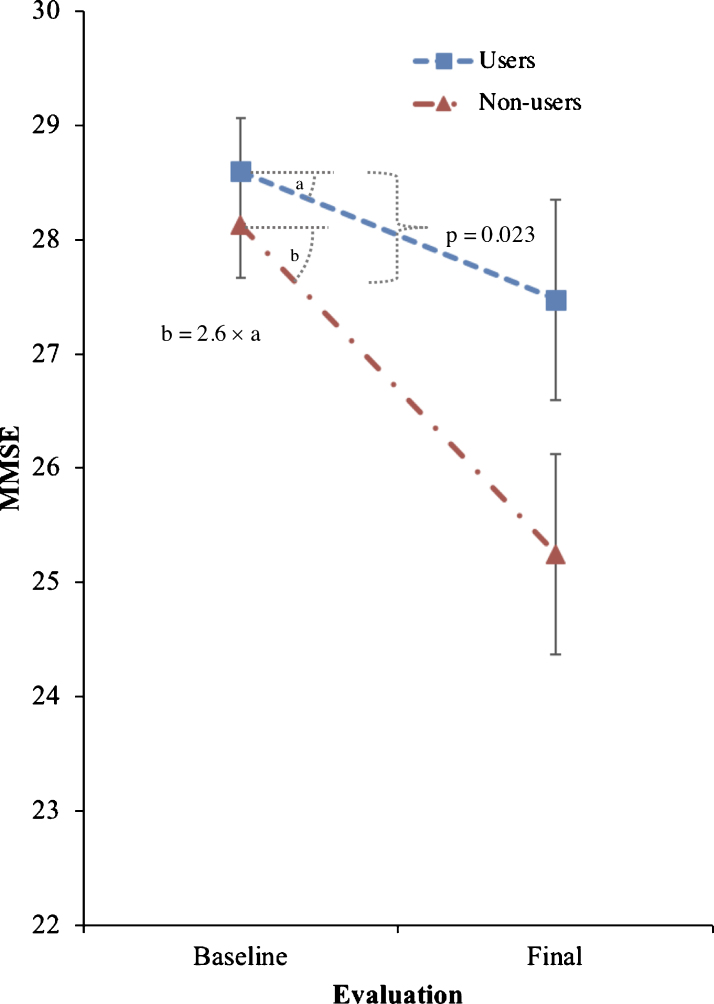
Trazodone non-users had 2.6-fold faster decline MMSE (primary outcome) compared to trazodone users, 0.27 (95% confidence interval [CI]: 0.07-0.48) versus 0.70 (95% CI: 0.50-0.90) points per year (p = 0.023). The observed effects were especially associated with subjective improvement of sleep complaints in post-hoc analyses (p = 0.0006). Secondary outcomes of other cognitive and functional scores had variable worsening in non-users and varied in significance when accounting for co-administered medications and multiple comparisons. Trazodone effects on MMSE remained significant within participants with AD-predicted pathology, with 2.4-fold faster decline in non-users (p = 0.038).
These results suggest an association between trazodone use and delayed cognitive decline, adding support for a potentially attractive and cost-effective intervention in dementia. Whether the observed relationship of trazodone to cognitive function is causal or an indirect marker of other effects, such as treated sleep disruption, and if such effects are mediated through SWS enhancement requires confirmation through prospective studies.
最近的研究揭示了慢波睡眠(SWS)、β-淀粉样蛋白聚集和认知之间的关联。
本回顾性研究旨在探讨长期使用增强 SWS 的曲唑酮是否与认知能力下降延迟有关。
我们确定了 25 名经常使用曲唑酮的患者(平均年龄 75.4±7.5 岁;9 名女性,16 名男性),他们被诊断为阿尔茨海默病痴呆、轻度认知障碍或正常认知,以及 25 名匹配的曲唑酮未使用者(平均年龄 74.5±8.0 岁;13 名女性,12 名男性),考虑到年龄、性别、教育程度、睡眠缺陷类型(嗜睡、失眠、睡眠障碍)、诊断和基线简易精神状态检查(MMSE)。通过重复测量测试评估平均随访间隔四年的认知测试中的纵向组间差异。
与曲唑酮使用者相比,曲唑酮未使用者的 MMSE(主要结局)下降速度快 2.6 倍,每年 0.27(95%置信区间 [CI]:0.07-0.48)与 0.70(95% CI:0.50-0.90)点(p=0.023)。在事后分析中,观察到的效果与睡眠抱怨主观改善尤其相关(p=0.0006)。当考虑到联合用药和多次比较时,其他认知和功能评分的次要结局在未使用者中出现不同程度的恶化,并且在统计学上存在差异。在具有 AD 预测病理的参与者中,曲唑酮对 MMSE 的影响仍然显著,未使用者的下降速度快 2.4 倍(p=0.038)。
这些结果表明曲唑酮使用与认知能力下降之间存在关联,为痴呆症的潜在有吸引力和具有成本效益的干预措施提供了支持。观察到的曲唑酮与认知功能的关系是因果关系还是其他效应(如治疗性睡眠障碍)的间接标志物,以及这种效应是否通过 SWS 增强介导,需要通过前瞻性研究来证实。