Department of Internal Medicine, Division of Allergy and Immunology, Morsani College of Medicine, University of South Florida, Tampa, Fla.
Department of Internal Medicine, Division of Allergy and Immunology, Morsani College of Medicine, University of South Florida, Tampa, Fla.
J Allergy Clin Immunol. 2019 Mar;143(3):923-926.e1. doi: 10.1016/j.jaci.2019.01.016. Epub 2019 Jan 26.
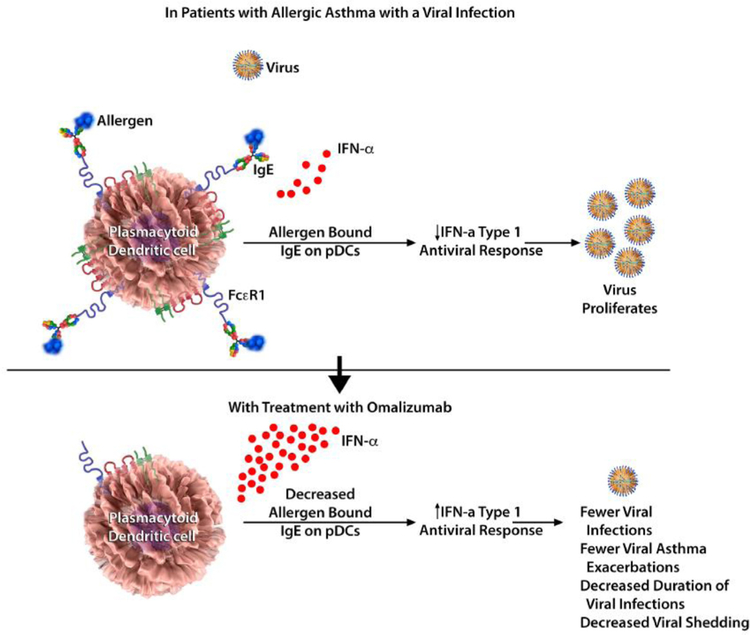
Cells that express FcεRI, including mast cells, basophils, and plasmacytoid dendritic cells (pDCs), are regulated by IgE binding to FcεRI. Omalizumab binds IgE and prevents its engagement with FcεRI, thereby downregulating its expression and modulating cell function. Because these cells are implicated in the pathobiology of many allergic and immunologic diseases, as well as host defense mechanisms, it is unsurprising that omalizumab studies continue yielding biologic insights and treatment break-throughs for many diseases. Several recent updates in the biology and use of omalizumab will be presented here, and others will be summarized in Table I, highlighting available biomarker-based personalized approaches.
表达 FcεRI 的细胞,包括肥大细胞、嗜碱性粒细胞和浆细胞样树突状细胞 (pDC),受 IgE 与 FcεRI 结合的调节。奥马珠单抗结合 IgE 并阻止其与 FcεRI 结合,从而下调其表达并调节细胞功能。由于这些细胞与许多过敏性和免疫性疾病以及宿主防御机制的病理生物学有关,因此奥马珠单抗的研究继续为许多疾病提供生物学见解和治疗突破也就不足为奇了。本文将介绍奥马珠单抗生物学和用途的最新进展,并在表 I 中总结其他内容,突出基于生物标志物的个性化方法。