Sathyanarayanan Gopinath, Vengadavaradan Ashvini, Bharadwaj Balaji
Department of Psychiatry, Jawaharlal Institute of Postgraduate Medical Education and Research, Puducherry, India.
Int J Yoga. 2019 Jan-Apr;12(1):3-28. doi: 10.4103/ijoy.IJOY_65_17.
Yoga has its origin from the ancient times. It is an integration of mind, body, and soul. Besides, mindfulness emphasizes focused awareness and accepting the internal experiences without being judgemental. These techniques offer a trending new dimension of treatment in various psychiatric disorders.
We aimed to review the studies on the efficacy of yoga and mindfulness as a treatment modality in severe mental illnesses (SMIs). SMI includes schizophrenia, major depressive disorder (MDD), and bipolar disorder (BD).
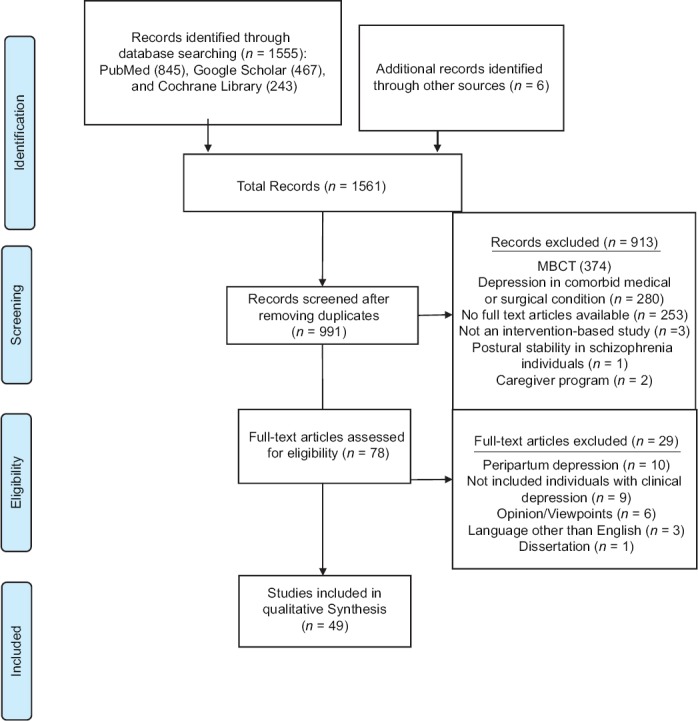
We conducted a literature search using PubMed, Google Scholar, and Cochrane Library with the search terms "yoga," "meditation," "breathing exercises," "mindfulness," "schizophrenia spectrum and other psychotic disorders," "depressive disorder," and "bipolar disorder" for the last 10-year period. We also included relevant articles from the cross-references.
We found that asanas and are the most commonly studied forms of yoga for schizophrenia. These studies found a reduction in general psychopathology ratings and an improvement in cognition and functioning. Some studies also found modest benefits in negative and positive symptoms. Mindfulness has not been extensively tried, but the available evidence has shown benefits in improving psychotic symptoms, improving level of functioning, and affect regulation. In MDD, both yoga and mindfulness have demonstrated significant benefit in reducing the severity of depressive symptoms. There is very sparse data with respect to BD.
Both yoga and mindfulness interventions appear to be useful as an adjunct in the treatment of SMI. Studies have shown improvement in the psychopathology, anxiety, cognition, and functioning of patients with schizophrenia. Similarly, both the techniques have been established as an effective adjuvant in MDD. However, more rigorously designed and larger trials may be necessary, specifically for BD.
瑜伽起源于古代。它是身心与灵魂的融合。此外,正念强调专注的觉察以及不加评判地接受内在体验。这些技巧为各种精神疾病的治疗提供了一个新的趋势维度。
我们旨在综述关于瑜伽和正念作为严重精神疾病(SMIs)治疗方式的疗效的研究。严重精神疾病包括精神分裂症、重度抑郁症(MDD)和双相情感障碍(BD)。
我们使用PubMed、谷歌学术和考克兰图书馆进行文献检索,检索词为“瑜伽”“冥想”“呼吸练习”“正念”“精神分裂症谱系及其他精神病性障碍”“抑郁症”和“双相情感障碍”,检索过去10年的文献。我们还纳入了参考文献中的相关文章。
我们发现体式和 是精神分裂症研究中最常用的瑜伽形式。这些研究发现一般精神病理学评分有所降低,认知和功能得到改善。一些研究还发现对阴性和阳性症状有适度益处。正念尚未得到广泛尝试,但现有证据表明其在改善精神病性症状、提高功能水平和情感调节方面有益处。在重度抑郁症中,瑜伽和正念在减轻抑郁症状严重程度方面均显示出显著益处。关于双相情感障碍的数据非常稀少。
瑜伽和正念干预似乎都可作为严重精神疾病治疗的辅助手段。研究表明精神分裂症患者的精神病理学、焦虑、认知和功能有所改善。同样,这两种技巧在重度抑郁症中已被确立为有效的辅助手段。然而,可能需要更严格设计和更大规模的试验,特别是针对双相情感障碍的试验。