School of Nursing, Guangzhou Medical University, 195, Dongfengxi Road, Yuexiu District, Guangzhou, Guangdong Province, 510182, China.
Hong Kong Nang Yan College of Higher Education, 325-329 Lai Chi Kok Road, Sham Shui Po, Kowloon, Hong Kong SAR, 999077, China.
BMC Complement Med Ther. 2023 Sep 8;23(1):313. doi: 10.1186/s12906-023-04141-2.
Mindfulness yoga is a type of exercise that emphasizes the integration of mindfulness or meditation into yoga. The aim of this study was to determine the effectiveness of mindfulness yoga intervention on major depressive disorder (MDD) patients.
A systematic review and meta-analysis of randomized controlled trials (RCTs) was conducted by searching nine databases, including PubMed, EMBASE, Web of Science, The Cochrane Library, MEDLINE, China National Knowledge Infrastructure (CNKI), Wanfang Data knowledge service platform, Chinese Biomedical Literature Database (CBM), and China Science and Technology Journal Database (VIP) from inception to April 2023. Primary outcomes included the severity of depression. Secondary outcomes included anxiety and rumination.
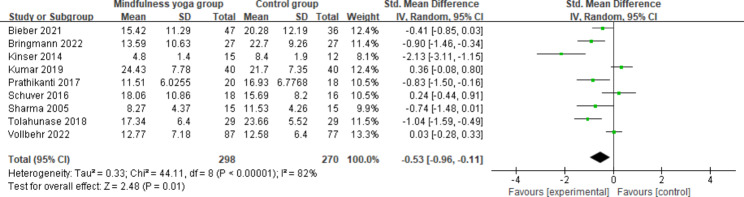
Nine RCTs met our inclusion criteria (n = 581). The meta-analysis showed that mindfulness yoga significantly has a significant effect on depression (SMD = -0.53; 95%CI = -0.96 to -0.11; P < 0.05) among MDD patients. The only two RCTs involved also showed that mindfulness yoga could alleviate the anxiety level of MDD patients after intervention (SMD = -1.08; 95%CI = -1.64 to -0.52; P < 0.05). Meta-analysis did not reveal positive effects of the mindfulness yoga groups on rumination after intervention based on three RCTs (SMD = -0.33; 95%CI = -0.89 to 0.23; P > 0.05), but found a significant difference in the follow-up period based on two RCTs (MD = -7.42; 95%CI = -11.27 to -3.56; P < 0.05), compared with the control groups.
Although we were unable to provide conclusive evidence to support the effectiveness of mindfulness yoga in improving symptoms in MDD patients, we found the literature included in this study indicated that mindfulness yoga might have a potential benefit for MDD patients and should be a feasible, acceptable, and promising intervention.
正念瑜伽是一种强调将正念或冥想融入瑜伽的运动。本研究旨在确定正念瑜伽干预对重度抑郁症(MDD)患者的有效性。
通过检索 9 个数据库,包括 PubMed、EMBASE、Web of Science、The Cochrane Library、MEDLINE、中国知网(CNKI)、万方数据知识服务平台、中国生物医学文献数据库(CBM)和中国科技期刊数据库(VIP),对截至 2023 年 4 月的随机对照试验(RCT)进行系统评价和荟萃分析。主要结局包括抑郁严重程度。次要结局包括焦虑和反刍思维。
9 项 RCT 符合纳入标准(n=581)。荟萃分析显示,正念瑜伽对 MDD 患者的抑郁有显著影响(SMD=-0.53;95%CI=-0.96 至-0.11;P<0.05)。仅两项涉及的 RCT 还表明,正念瑜伽可以减轻 MDD 患者干预后的焦虑水平(SMD=-1.08;95%CI=-1.64 至-0.52;P<0.05)。基于 3 项 RCT 的荟萃分析未显示正念瑜伽组干预后对反刍思维有积极影响(SMD=-0.33;95%CI=-0.89 至 0.23;P>0.05),但基于 2 项 RCT 的发现,在随访期间有显著差异(MD=-7.42;95%CI=-11.27 至-3.56;P<0.05),与对照组相比。
虽然我们无法提供确凿的证据支持正念瑜伽改善 MDD 患者症状的有效性,但我们发现本研究纳入的文献表明,正念瑜伽可能对 MDD 患者有益,应该是一种可行、可接受和有前途的干预措施。