Tyagi Asha, Verma Gaurav, Luthra Ankit, Lahan Shubham, Das Shukla, Rai Gargi, Sethi Ashok Kumar
Department of Anesthesiology and Critical Care, University College of Medical Sciences and GTB Hospital, New Delhi, India.
Department of Microbiology, University College of Medical Sciences and GTB Hospital, New Delhi, India.
Saudi J Anaesth. 2019 Jan-Mar;13(1):9-15. doi: 10.4103/sja.SJA_410_18.
Whether intraoperative use of hydroxyethyl starch (HES) solutions is associated with postoperative acute kidney injury (AKI) continues to be researched. Urinary neutrophil gelatinase-associated lipocalin (NGAL) is validated for early detection of AKI. Previous studies are limited and use empirically predefined volumes of HES solutions with serum creatinine as marker for AKI.
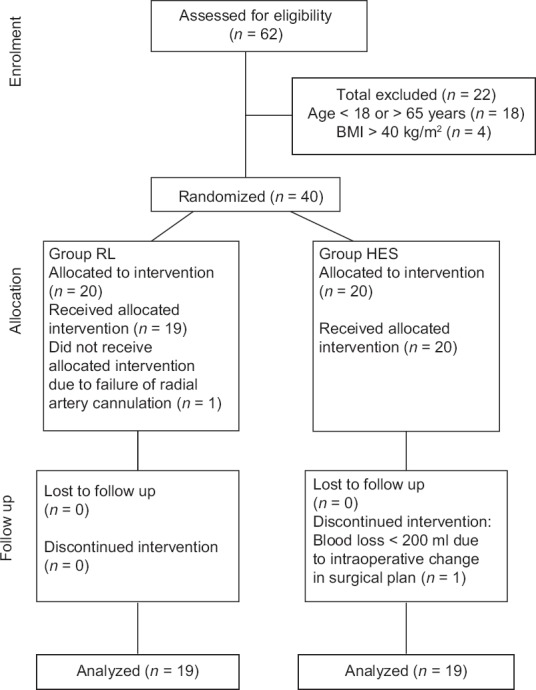
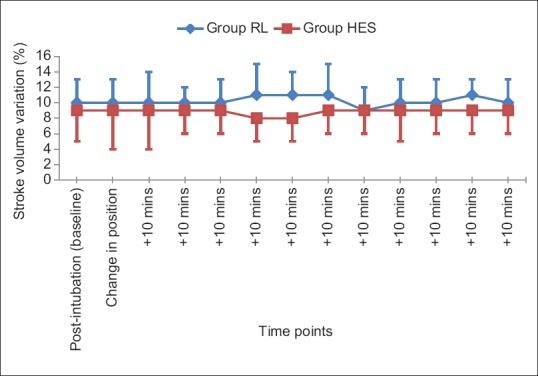
Adults scheduled for orthopedic surgery under general anesthesia with >200-300 mL blood loss expected were included; 40 were randomized to receive 6% HES 130/0.4 (tetrastarch) (group HES) or Ringer's lactate (group RL) boluses when stroke volume variation (SVV) >10% in supine or lateral position, or >14% in prone position. Incidence of early postoperative AKI using urinary NGAL (>100 ng/mL) was the primary outcome, and using derangement of serum creatinine was the secondary measure.
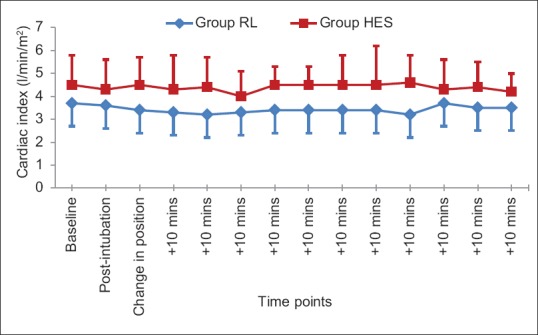
In 38 patients, intervention was completed, and incidence of AKI (postoperative urinary NGAL >100 ng/mL) among them was 0% in both groups. Patients with urinary NGAL >50 ng/mL were insignificantly higher for group RL versus group HES (6/19 vs. 4/19) ( = 0.461), as were those with incidence of AKI as per creatinine values (5/19 vs. 4/19) ( = 1.000). Group RL had significantly higher requirement of fluid (1211 ± 758 mL vs. 689 ± 394 mL) ( = 0.013) and lower cardiac index ( < 0.05) versus group HES.
SVV-guided tetrastarch and Ringer's lactate do not result in postoperative AKI diagnosed by urinary NGAL >100 ng/mL; however, an insignificant trend for better renal functions as well as significantly more efficacious volume expansion and hemodynamic stability were seen with tetrastarch instead.
术中使用羟乙基淀粉(HES)溶液是否与术后急性肾损伤(AKI)相关仍在研究中。尿中性粒细胞明胶酶相关脂质运载蛋白(NGAL)已被证实可用于早期检测AKI。以往的研究有限,且使用经验性预先定义的HES溶液用量,并以血清肌酐作为AKI的标志物。
纳入计划在全身麻醉下进行骨科手术且预计失血超过200 - 300 mL的成年人;当仰卧位或侧卧位时每搏量变异(SVV)>10%,或俯卧位时SVV>14%时,40例患者被随机分为接受6% HES 130/0.4(四淀粉)(HES组)或乳酸林格液(RL组)推注。以术后尿NGAL(>100 ng/mL)诊断的早期AKI发生率为主要结局,以血清肌酐紊乱为次要指标。
38例患者完成干预,两组中AKI(术后尿NGAL>100 ng/mL)的发生率均为0%。尿NGAL>50 ng/mL的患者中,RL组高于HES组,但差异无统计学意义(6/19 vs. 4/19)(P = 0.461),根据肌酐值诊断的AKI发生率也是如此(5/19 vs. 4/19)(P = 1.000)。与HES组相比,RL组的液体需求量显著更高(1211±758 mL vs. 689±394 mL)(P = 0.013),心脏指数更低(P<0.05)。
SVV引导下的四淀粉和乳酸林格液不会导致术后尿NGAL>100 ng/mL诊断的AKI;然而,四淀粉反而显示出肾功能有更好的不显著趋势,以及更有效的容量扩张和血流动力学稳定性。