Peng Ke, Li Jian, Cheng Hao, Ji Fu-hai
Department of Anesthesiology, First Affiliated Hospital of Soochow University, Suzhou, China.
Med Princ Pract. 2014;23(5):413-20. doi: 10.1159/000363573. Epub 2014 Jul 3.
To evaluate the influence of stroke volume variation (SVV)-based goal-directed therapy (GDT) on splanchnic organ functions and postoperative complications in orthopedic patients.
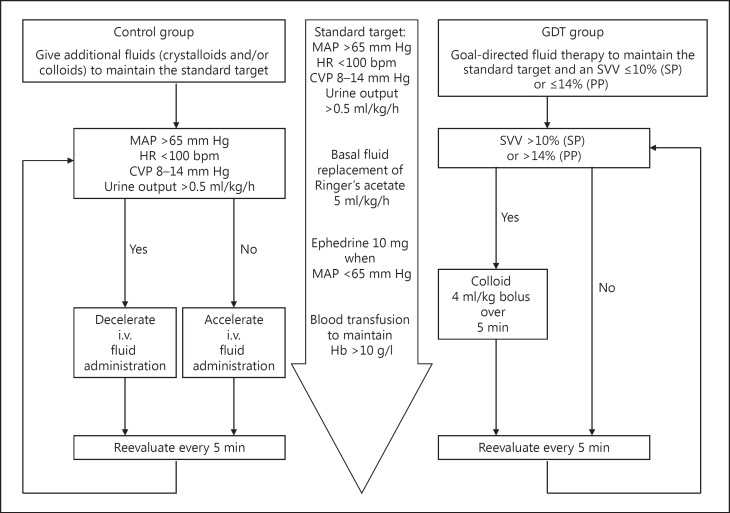
Eighty patients scheduled for major orthopedic surgery under general anesthesia were randomly allocated to one of two equal groups to receive either intraoperative volume therapy guided by SVV (GDT) or standard fluid management (control). In the SVV group, patients received colloid boluses of 4 ml/kg to maintain an SVV <10% when in the supine position or an SVV <14% if prone. In the control group, fluids were given to maintain a mean arterial pressure >65 mm Hg, a heart rate <100 bpm, a central venous pressure of 8-14 mm Hg, and a urine output >0.5 ml/kg/h. Intraoperative organ perfusion, hemodynamic data, hospitalization, postoperative complications, and mortality were recorded.
The heart rate at the end of surgery was significantly lower (p < 0.05), there were fewer hypotensive episodes (p < 0.05), the arterial and gastric intramucosal pH were higher (p < 0.05 for both), the gastric intramucosal PCO2 was lower (p < 0.05), the intraoperative infused colloids and the total infused volume were lower (p < 0.05 for both), and the postoperative time to flatus was shorter (p < 0.05) in the GDT group than in the control group. No differences in the length of hospital stay, complications, or mortality were found between the groups.
SVV-based GDT during major orthopedic surgery reduced the volume of the required intraoperative infused fluids, maintained intraoperative hemodynamic stability, and improved the perioperative gastrointestinal function.
评估基于每搏量变异度(SVV)的目标导向治疗(GDT)对骨科患者内脏器官功能及术后并发症的影响。
80例计划在全身麻醉下接受骨科大手术的患者被随机分为两组,每组40例,分别接受以SVV为导向的术中容量治疗(GDT组)或标准液体管理(对照组)。在SVV组,患者在仰卧位时接受4 ml/kg的胶体推注,以维持SVV<10%;若为俯卧位,则维持SVV<14%。对照组给予液体以维持平均动脉压>65 mmHg、心率<100次/分钟、中心静脉压8 - 14 mmHg及尿量>0.5 ml/kg/h。记录术中器官灌注、血流动力学数据、住院情况、术后并发症及死亡率。
与对照组相比,GDT组手术结束时心率显著降低(p<0.05),低血压发作次数更少(p<0.05),动脉血和胃黏膜内pH值更高(两者均p<0.05),胃黏膜内PCO2更低(p<0.05),术中输注胶体量和总输液量更低(两者均p<0.05),术后排气时间更短(p<0.05)。两组在住院时间、并发症或死亡率方面未发现差异。
骨科大手术期间基于SVV的GDT减少了术中所需输注液体量,维持了术中血流动力学稳定,并改善了围手术期胃肠功能。