Diniz M S, Teixeira-Neto F J, Celeita-Rodríguez N, Girotto C H, Fonseca M W, Oliveira-Garcia A C, López-Castañeda B
Faculdade de Medicina, Universidade Estadual Paulista, Botucatu, São Paulo, Brazil.
Faculdade de Medicina Veterinária e Zootecnia, Universidade Estadual Paulista, Botucatu, São Paulo, Brazil.
J Vet Intern Med. 2018 Mar;32(2):712-721. doi: 10.1111/jvim.14853. Epub 2018 Jan 28.
Tetrastarch can cause acute kidney injury (AKI) in humans with sepsis, but less likely to result in tissue edema than lactated Ringer's solution (LRS).
Compare effects of volume replacement (VR) with LRS and 6% tetrastarch solution (TS) on extravascular lung water (EVLW) and markers of AKI in hemorrhaged dogs.
Six healthy English Pointer dogs (19.7-35.3 kg).
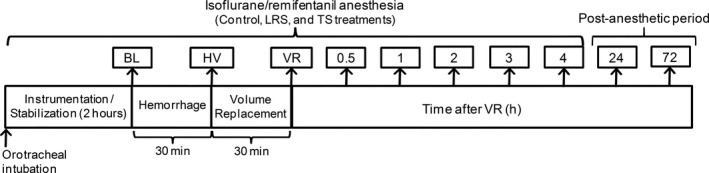
Prospective crossover study. Animals underwent anesthesia without hemorrhage (Control). Two weeks later, dogs hemorrhaged under anesthesia on 2 occasions (8-week washout intervals) and randomly received VR with LRS or TS at 3 : 1 or 1 : 1 of shed blood, respectively. Anesthesia was maintained until 4 hour after VR for EVLW measurements derived from transpulmonary thermodilution cardiac output. Neutrophil gelatinase-associated lipocalin (NGAL) and creatinine concentrations in plasma and urine were measured until 72 hour after VR.
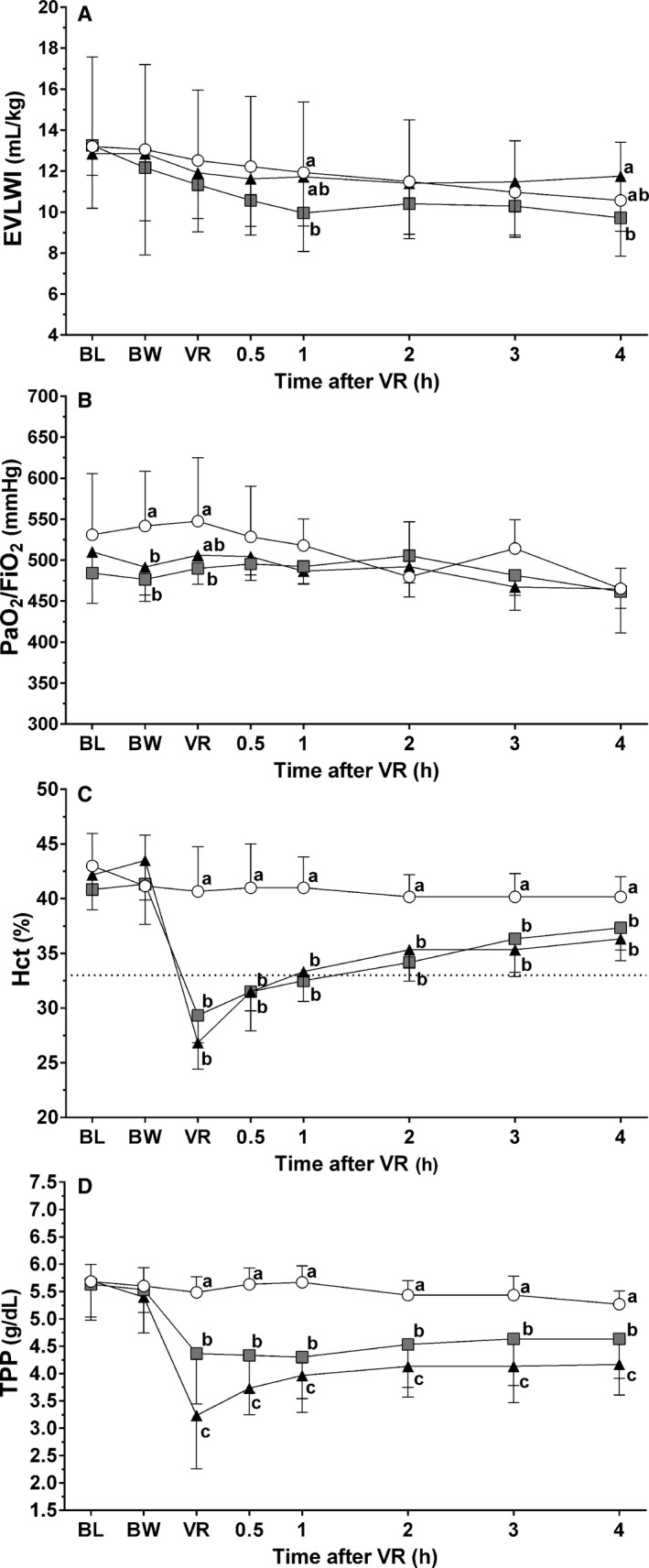
The EVLW index (mL/kg) was lower at 1 hour after TS (10.0 ± 1.9) in comparison with controls (11.9 ± 3.4, P = 0.04), and at 4 hour after TS (9.7 ± 1.9) in comparison with LRS (11.8 ± 2.7, P = 0.03). Arterial oxygen partial pressure-to-inspired oxygen fraction ratio did not differ among treatments from 0.5 to 4 hour after VR. Urine NGAL/creatinine ratio did not differ among treatments and remained below threshold for AKI (120,000 pg/mg).
Although TS causes less EVLW accumulation than LRS, neither fluid produced evidence of lung edema (impaired oxygenation). Both fluids appear not to cause AKI when used for VR after hemorrhage in healthy nonseptic dogs.
羟乙基淀粉可导致脓毒症患者发生急性肾损伤(AKI),但与乳酸林格氏液(LRS)相比,其导致组织水肿的可能性较小。
比较用LRS和6%羟乙基淀粉溶液(TS)进行容量复苏(VR)对出血性犬血管外肺水(EVLW)及AKI标志物的影响。
6只健康英国指示犬(体重19.7 - 35.3千克)。
前瞻性交叉研究。动物在未出血情况下接受麻醉(对照组)。两周后,犬在麻醉状态下出血2次(洗脱期间隔8周),并分别按失血量的3:1或1:1随机接受LRS或TS进行VR。维持麻醉直至VR后4小时,通过经肺热稀释心输出量测量EVLW。在VR后72小时内测量血浆和尿液中中性粒细胞明胶酶相关脂质运载蛋白(NGAL)和肌酐浓度。
与对照组相比,TS后1小时的EVLW指数(毫升/千克)较低(10.0±1.9),对照组为(11.9±3.4,P = 0.04);与LRS相比,TS后4小时的EVLW指数较低(9.7±1.9),LRS为(11.8±2.7,P = 0.03)。VR后0.5至4小时,各治疗组的动脉血氧分压与吸入氧分数比值无差异。各治疗组的尿NGAL/肌酐比值无差异,且均低于AKI阈值(120,000皮克/毫克)。
尽管TS导致的EVLW蓄积比LRS少,但两种液体均未产生肺水肿(氧合受损)的证据。在健康非脓毒症犬出血后用于VR时,两种液体似乎均不会引起AKI。