Sinha Chandni, Kumar Neeraj, Kumar Amarjeet, Kumar Ajeet, Kumar Anup
Department of Anaesthesia, AIIMS, Patna, Bihar, India.
Department of Anaesthesiology, AIIMS, New Delhi, India.
Saudi J Anaesth. 2019 Jan-Mar;13(1):35-39. doi: 10.4103/sja.SJA_737_17.
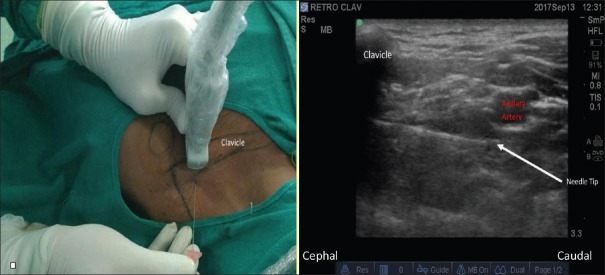
Infraclavicular approach is a common technique of brachial plexus block. The main difficulty of ultrasound guided technique is in needle visualization due to deep location of the cords. Hebbard described a retroclavicular approach wherein the needle was inserted posteriorly to the clavicle.
In this prospective randomized controlled study, we have compared the classical technique with the retroclavicular approach in terms of needle visibility, block success rate, number of needle passes, block performance time, procedure-related pain, complications, patient and operator comfort and satisfaction.
The rate of block success was similar in both the groups. The needle tip and shaft visibility was more in the retroclavicular group ( < 0.05). The number of needle passes was also less in the retroclavicular group. Time for the block procedure was less in retroclavicular group when compared to the classical coracoid group. The patients reported less pain in retroclavicular group ( < 0.05).
Retroclavicular approach is a feasible option of infraclavicular brachial plexus block in Indian Subpopulation in terms of needle visibility and block success rate.
锁骨下途径是臂丛神经阻滞的常用技术。超声引导技术的主要难点在于由于神经束位置较深,难以清晰显示穿刺针。赫巴德描述了一种锁骨后途径,即穿刺针在锁骨后方插入。
在这项前瞻性随机对照研究中,我们比较了经典技术与锁骨后途径在穿刺针可视性、阻滞成功率、穿刺针进针次数、阻滞操作时间、与操作相关的疼痛、并发症、患者和操作者的舒适度及满意度等方面的差异。
两组的阻滞成功率相似。锁骨后组穿刺针尖端和针干的可视性更高(<0.05)。锁骨后组的穿刺针进针次数也更少。与经典喙突组相比,锁骨后组的阻滞操作时间更短。锁骨后组患者报告的疼痛较轻(<0.05)。
就穿刺针可视性和阻滞成功率而言,锁骨后途径是印度亚人群锁骨下臂丛神经阻滞的一种可行选择。