Fabri João Henrique Tadini Marilhano, Godoy Naiane Lima, Rocha Marina Campos, Munshi Mansa, Cocio Tiago Alexandre, von Zeska Kress Marcia Regina, Fill Taicia Pacheco, da Cunha Anderson Ferreira, Del Poeta Maurizio, Malavazi Iran
Departamento de Genética e Evolução, Centro de Ciências Biológicas e da Saúde, Universidade Federal de São Carlos, São Carlos, Brazil.
Department of Molecular Genetics and Microbiology, Stony Brook University, Stony Brook, NY, United States.
Front Microbiol. 2019 Jan 14;9:3347. doi: 10.3389/fmicb.2018.03347. eCollection 2018.
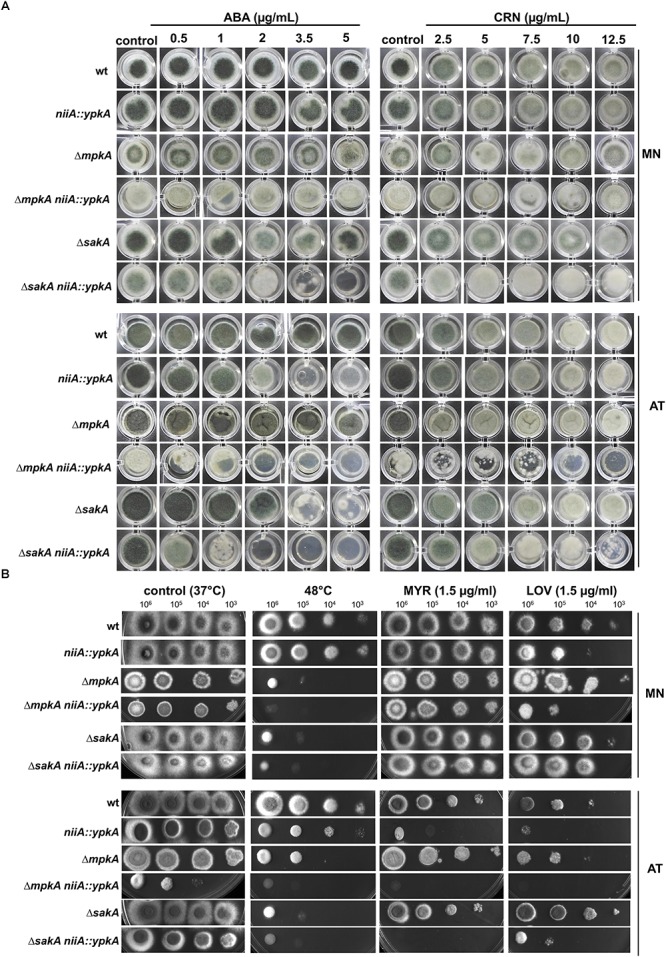
Sphingolipids (SL) are complex lipids and components of the plasma membrane which are involved in numerous cellular processes, as well as important for virulence of different fungal pathogens. In yeast, SL biosynthesis is regulated by the "AGC kinases" Ypk1 and Ypk2, which also seem to connect the SL biosynthesis with the cell wall integrity (CWI) and the High Osmolarity Glycerol (HOG) pathways. Here, we investigate the role of in SL biosynthesis and its relationship with the CWI and the HOG pathways in the opportunistic human pathogen . We found that is important for fungal viability, since the Δ strain presented a drastically sick phenotype and complete absence of conidiation. We observed that under repressive condition, the conditional mutant exhibited vegetative growth defects, impaired germination and thermosensitivity. In addition, the loss of function caused a decrease in glycosphingolipid (GSL) levels, especially the metabolic intermediates belonging to the neutral GSL branch including dihydroceramide (DHC), ceramide (Cer), and glucosylceramide (GlcCer), but interestingly a small increase in ergosterol content. Genetic analyzes showed that genetically interacts with the MAP kinases of CWI and HOG pathways, and , respectively, while only SakA physically interacts with YpkA. Our results suggest that YpkA is important for fungal survival through the regulation of GSL biosynthesis and cross talks with MAP kinase pathways.
鞘脂(SL)是复杂的脂质,也是质膜的组成成分,参与众多细胞过程,对不同真菌病原体的毒力也很重要。在酵母中,SL生物合成受“AGC激酶”Ypk1和Ypk2调控,它们似乎还将SL生物合成与细胞壁完整性(CWI)和高渗甘油(HOG)途径联系起来。在此,我们研究了[具体物质]在机会性人类病原体[具体病原体]的SL生物合成中的作用及其与CWI和HOG途径的关系。我们发现[具体物质]对真菌的生存能力很重要,因为Δ[具体物质]菌株呈现出严重的病态表型且完全不产分生孢子。我们观察到在抑制条件下,条件性突变体[具体突变体]表现出营养生长缺陷、萌发受损和热敏感性。此外,[具体物质]功能丧失导致糖鞘脂(GSL)水平降低,尤其是属于中性GSL分支的代谢中间体,包括二氢神经酰胺(DHC)、神经酰胺(Cer)和葡萄糖神经酰胺(GlcCer),但有趣的是麦角固醇含量略有增加。遗传分析表明,[具体物质]分别与CWI和HOG途径的MAP激酶[具体激酶1]和[具体激酶2]发生遗传相互作用,而只有SakA与YpkA发生物理相互作用。我们的结果表明,YpkA通过调节GSL生物合成以及与MAP激酶途径的相互作用对真菌存活很重要。