Department of Nutritional Science and Food Management, Ewha Womans University, Seoul, Republic of Korea.
Department of Family Medicine, Seoul Metropolitan Government-Seoul National University Boramae Medical Center, Seoul, Republic of Korea.
Oxid Med Cell Longev. 2018 Dec 31;2018:8601028. doi: 10.1155/2018/8601028. eCollection 2018.
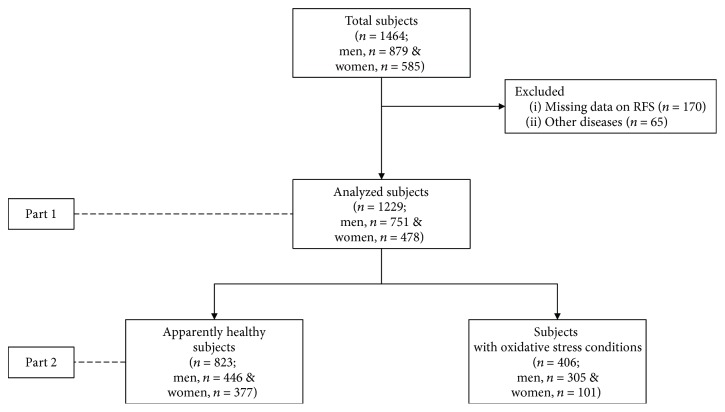
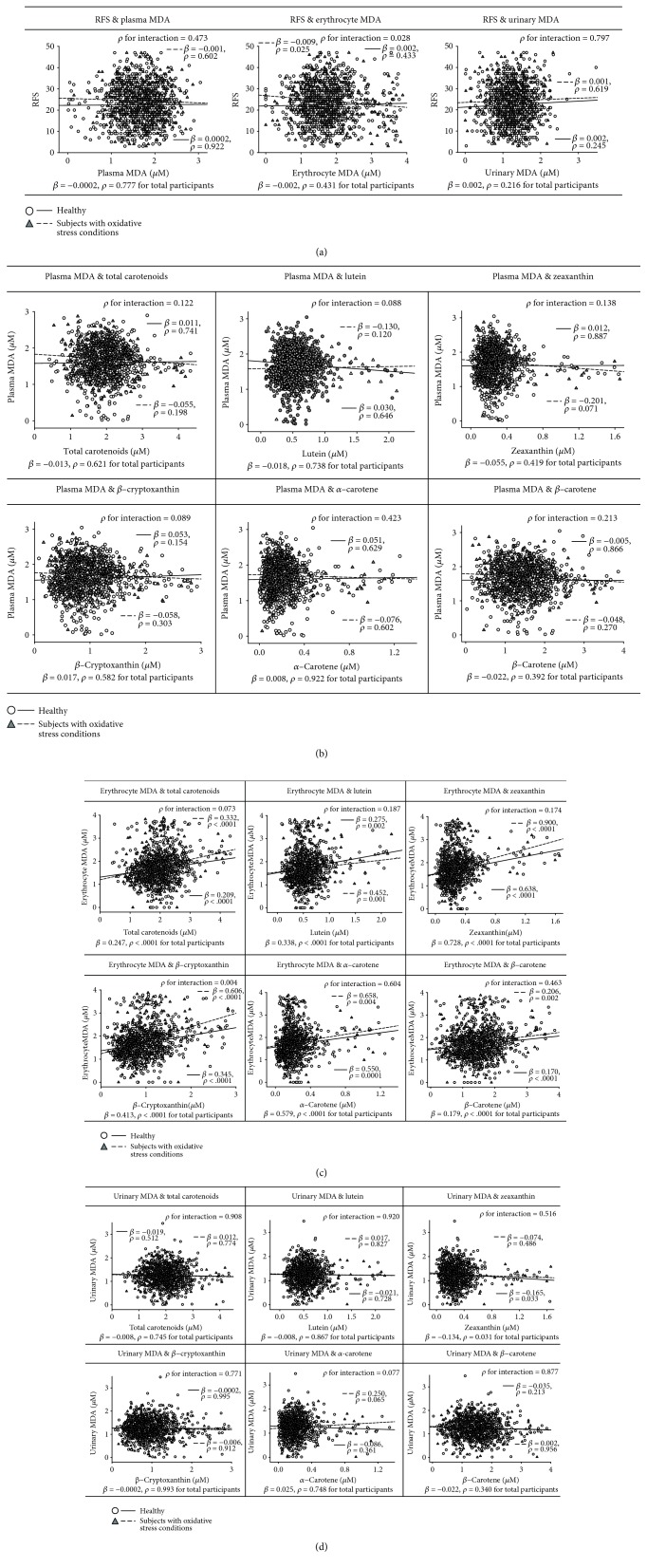
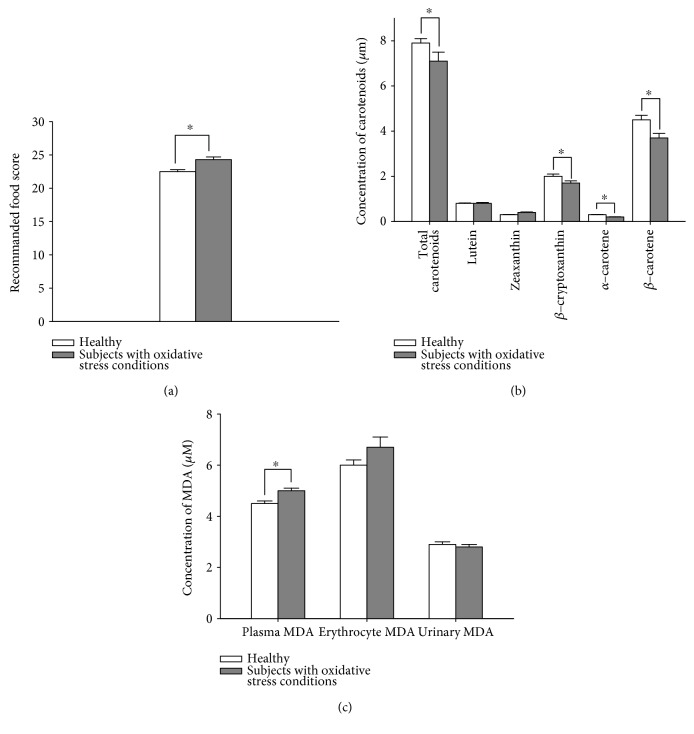
It is important to understand the association between oxidative stress-related parameters and to evaluate their status in advance of chronic disease development. Further development towards disease can then be prevented by dietary antioxidants. The present study was aimed at assessing the relationship between diet quality, blood antioxidants, and oxidative damage to determine whether the association between these markers differs by oxidative stress status. For a cross-sectional analysis, we used data and samples of baseline information from a prospective cohort study. A total of 1229 eligible adults were classified into apparently healthy subjects (66.5%) and those with oxidative stress conditions (35.5%). Diet quality was assessed using the recommended food score (RFS). Plasma carotenoids (blood antioxidants) and blood/urinary malondialdehyde (MDA; oxidative damage) were determined by high-performance liquid chromatography. We found that the healthy group was younger, and they had a lower RFS and plasma MDA level and higher plasma carotenoids compared to the oxidative stress condition group. This result is probably due to the quenching of the oxidative response in the tissues of those people. A positive association of RFS with plasma carotenoids (total and -carotene) was found in both groups, suggesting that carotenoids are a robust reflection of diet quality. Negative associations were observed between plasma MDA and RFS in the oxidative stress condition group and between urinary MDA and plasma zeaxanthin in the healthy group. Erythrocyte MDA was positively associated with plasma carotenoids (total, lutein, zeaxanthin, -cryptoxanthin, and - and -carotene), regardless of health condition, probably also as a result of the use of carotenoids as antioxidants. In conclusion, these results indicate that the above three factors may be associated with the oxidative stress response and depend on the oxidative status. Furthermore, it was also suggested that erythrocytes are important in the oxidative stress response and the quenching of this response is represented in plasma carotenoids.
了解氧化应激相关参数之间的关联,并在慢性疾病发展之前评估其状态非常重要。然后,可以通过饮食抗氧化剂来预防疾病的进一步发展。本研究旨在评估饮食质量、血液抗氧化剂和氧化损伤之间的关系,以确定这些标志物之间的关联是否因氧化应激状态而异。为了进行横断面分析,我们使用了前瞻性队列研究的基线信息数据和样本。共有 1229 名符合条件的成年人被分为明显健康的受试者(66.5%)和具有氧化应激状态的受试者(35.5%)。饮食质量使用推荐的食物评分(RFS)进行评估。通过高效液相色谱法测定血浆类胡萝卜素(血液抗氧化剂)和血液/尿液丙二醛(MDA;氧化损伤)。我们发现健康组年龄较小,RFS 和血浆 MDA 水平较低,血浆类胡萝卜素水平较高,与氧化应激状态组相比。这一结果可能是由于组织中氧化反应的淬灭。在两组中,RFS 与血浆类胡萝卜素(总类胡萝卜素和β-胡萝卜素)呈正相关,表明类胡萝卜素是饮食质量的有力反映。在氧化应激状态组中,血浆 MDA 与 RFS 呈负相关,在健康组中,尿液 MDA 与血浆玉米黄质呈负相关。红细胞 MDA 与血浆类胡萝卜素(总类胡萝卜素、叶黄素、玉米黄质、β-隐黄质和β-、-胡萝卜素)呈正相关,无论健康状况如何,这可能也是由于类胡萝卜素作为抗氧化剂的使用。总之,这些结果表明,上述三个因素可能与氧化应激反应有关,并且取决于氧化状态。此外,还表明红细胞在氧化应激反应中很重要,并且这种反应的淬灭在血浆类胡萝卜素中得到体现。