Zhang Jiahui, Ye Xibiao, Wu Cuie, Fu Hua, Xu Wei, Hu Pingzhao
Division of Biostatistics, Dalla Lana School of Public Health, University of Toronto, Toronto, ON, Canada.
Department of Community Health Science, Rady Faculty of Health Sciences, Max Rady College of Medicine, University of Manitoba, Winnipeg, MB, Canada.
Front Oncol. 2019 Jan 14;8:657. doi: 10.3389/fonc.2018.00657. eCollection 2018.
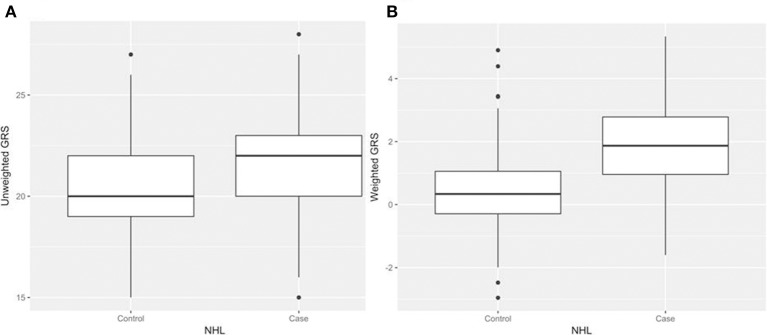
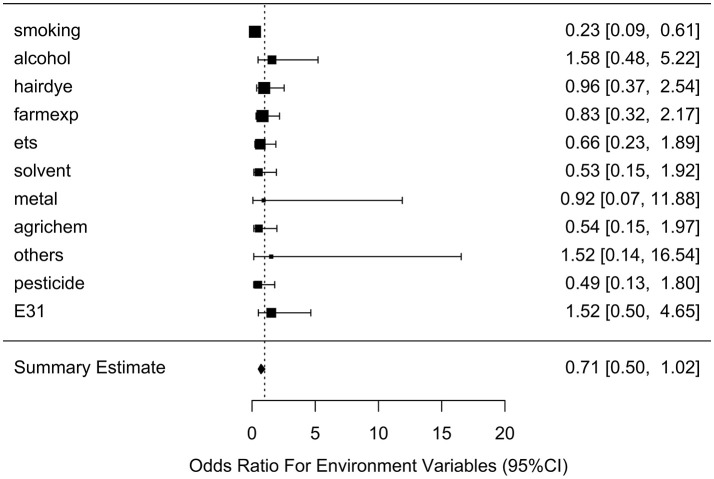
Non-hodgkin lymphoma (NHL) is one of the most common and deadly cancers. There is limited analysis of gene-environment interactions for the risk of NHL. This study intends to explore the interactions between genetic variants and environmental factors, and how they contribute to NHL risk. A case-control study was performed in Shanghai, China. The cases were diagnosed between 2003 and 2008 with patients aged 18 years or older. Samples and SNPs which did not satisfy quality control were excluded from the analysis. Weighted and unweighted genetic risk scores (GRS) and environmental risk scores were generated using clustering analysis algorithm. Univariate and multivariable logistic regression analyses were conducted. Moreover, genetics and environment interactions (G × E) were tested on the NHL cases and controls. After quality control, there are 22 SNPs, 11 environmental variables and 5 demographical variables to be explored. For logistic regression analyses, 5 SNPs (rs1800893, rs4251961, rs1800630, rs13306698, rs1799931) and environmental tobacco smoking showed statistically significant associations with the risk of NHL. Odds ratio (OR) and 95% confidence interval (CI) was 10.82 (4.34-28.88) for rs13306698, 2.84 (1.66-4.95) for rs1800893, and 2.54 (1.43-4.58) for rs4251961. For G × E analysis, the interaction between smoking and dichotomized weighted GRS showed statistically significant association with NHL (OR = 0.23, 95% CI = [0.09, 0.61]). Several genetic and environmental risk factors and their interactions associated with the risk of NHL have been identified. Replication in other cohorts is needed to validate the results.
非霍奇金淋巴瘤(NHL)是最常见且致命的癌症之一。关于NHL风险的基因 - 环境相互作用的分析有限。本研究旨在探索基因变异与环境因素之间的相互作用,以及它们如何影响NHL风险。在中国上海进行了一项病例对照研究。病例为2003年至2008年间确诊的18岁及以上患者。分析中排除了不符合质量控制的样本和单核苷酸多态性(SNP)。使用聚类分析算法生成加权和非加权基因风险评分(GRS)以及环境风险评分。进行了单变量和多变量逻辑回归分析。此外,对NHL病例和对照进行了基因与环境相互作用(G×E)测试。质量控制后,有22个SNP、11个环境变量和5个人口统计学变量有待探索。对于逻辑回归分析,5个SNP(rs1800893、rs4251961、rs1800630、rs13306698、rs1799931)和环境烟草烟雾暴露与NHL风险显示出统计学上的显著关联。rs13306698的比值比(OR)和95%置信区间(CI)为10.82(4.34 - 28.88),rs1800893为2.84(1.66 - 4.95),rs4251961为2.54(1.43 - 4.58)。对于G×E分析,吸烟与二分加权GRS之间的相互作用与NHL显示出统计学上的显著关联(OR = 0.23,95% CI = [0.09, 0.61])。已确定了几个与NHL风险相关的遗传和环境风险因素及其相互作用。需要在其他队列中进行重复验证结果。