Ye Xibiao, Zhao Kaiqiong, Wu Cuie, Hu Pingzhao, Fu Hua
Department of Community Health Sciences, College of Medicine, Faculty of Health Sciences, University of Manitoba, Canada.
Vaccine and Drug Evaluation Centre, University of Manitoba, Canada.
Oncotarget. 2017 Feb 7;8(6):10450-10457. doi: 10.18632/oncotarget.14426.
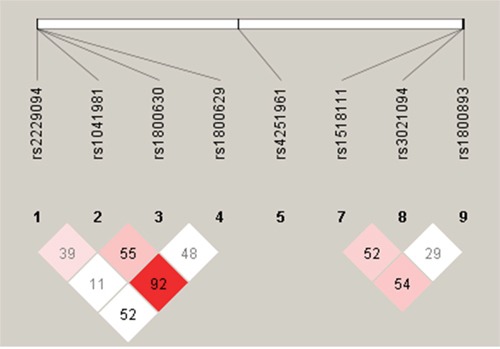
We undertook a hospital-based case-control study to examine the associations between single nucleotide polymorphisms (SNPs) in selected immunoregulatory genes and non-Hodgkin lymphoma (NHL) risk in a Chinese population. One hundred and sixty-nine NHL patients diagnosed according to the World Health Organization (WHO) 2001 standard and 421 controls were recruited. Nine SNPs in three genes (IL-10, IL-1RN, and TNF-α) were selected based on predicted functions and previous study findings. Genetic association analysis was performed using the Cochran-Armitage trend test and multiple logistic regression. Four SNPs were associated with an increased risk of overall NHL: odds ratio per minor allele [ORper-minor-allele] and 95% confidence interval [CI] were 2.64 (1.75-3.98) for IL-10 rs1800893, 2.67 (1.72-4.16) for IL-1RN rs4251961, 1.80 (1.24-2.63) for TNF- α rs1800630, and 1.55 (1.02-2.37) for TNF- α rs2229094. These SNPs were also associated with an increased risk of diffuse large B-cell lymphoma (DLBCL). In addition, another SNP (TNF- α rs1041981) was associated with an increased risk of DLBCL (ORper-minor-allele=1.73, 95% CI 1.14-2.61). The findings provide evidence on the role of these immunoregulatory gene variants in NHL etiology.
我们开展了一项基于医院的病例对照研究,以探讨特定免疫调节基因中的单核苷酸多态性(SNP)与中国人群中非霍奇金淋巴瘤(NHL)风险之间的关联。招募了169例根据世界卫生组织(WHO)2001标准确诊的NHL患者和421名对照。基于预测功能和既往研究结果,在三个基因(IL-10、IL-1RN和TNF-α)中选择了9个SNP。使用 Cochr an-Armitage趋势检验和多因素逻辑回归进行遗传关联分析。4个SNP与总体NHL风险增加相关:IL-10 rs1800893每小等位基因的比值比[OR per-minor-allele]和95%置信区间[CI]为2.64(1.75-3.98),IL-1RN rs4251961为2.67(1.72-4.16),TNF-α rs1800630为1.80(1.24-2.63),TNF-α rs2229094为1.55(1.02-2.37)。这些SNP也与弥漫性大B细胞淋巴瘤(DLBCL)风险增加相关。此外,另一个SNP(TNF-α rs1041981)与DLBCL风险增加相关(OR per-minor-allele=1.73,95%CI 1.14-2.61)。这些发现为这些免疫调节基因变异在NHL病因学中的作用提供了证据。