
ROS 诱导的 DNA 损伤反应导致有丝分裂后耳蜗细胞进入衰老样状态:对听力保护的意义。
ROS-Induced Activation of DNA Damage Responses Drives Senescence-Like State in Postmitotic Cochlear Cells: Implication for Hearing Preservation.
机构信息
INSERM - UMR 1051, Institut des Neurosciences de Montpellier, 80 rue Augustin Fliche, 34295, Montpellier, France.
Université Montpellier, 34295, Montpellier, France.
出版信息
Mol Neurobiol. 2019 Aug;56(8):5950-5969. doi: 10.1007/s12035-019-1493-6. Epub 2019 Jan 28.
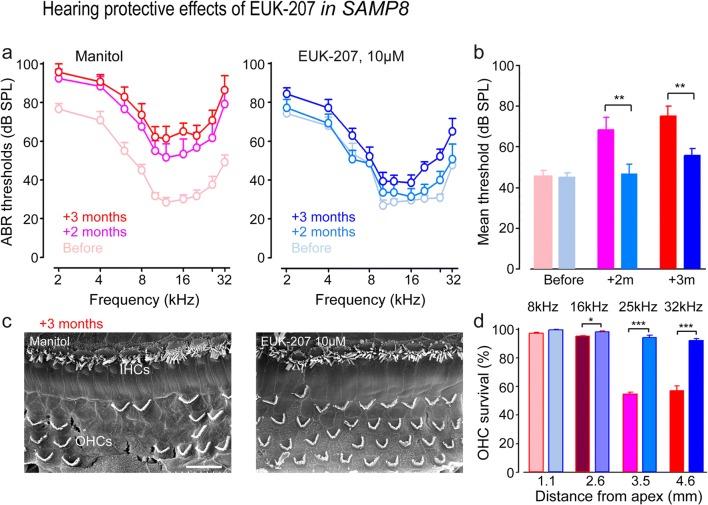
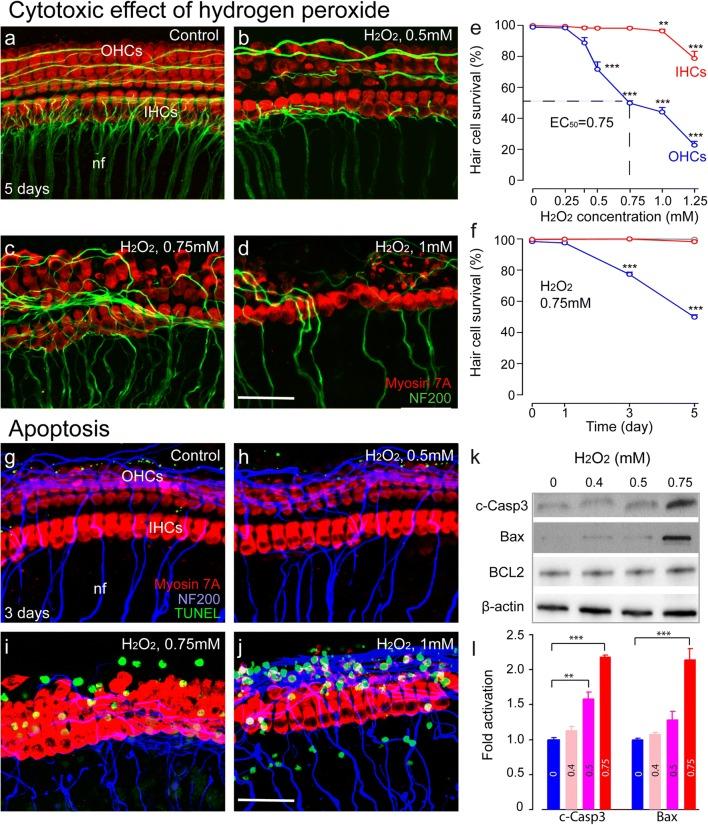
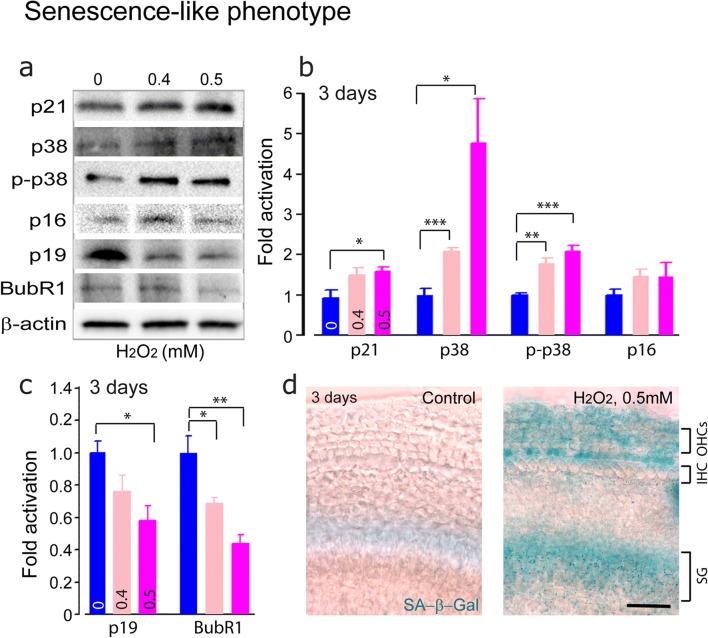
In our aging society, age-related hearing loss (ARHL) has become a major socioeconomic issue. Reactive oxygen species (ROS) may be one of the main causal factors of age-related cochlear cell degeneration. We examined whether ROS-induced DNA damage response drives cochlear cell senescence and contributes to ARHL from the cellular up to the system level. Our results revealed that sublethal concentrations of hydrogen peroxide (HO) exposure initiated a DNA damage response illustrated by increased γH2AX and 53BP1 expression and foci formation mainly in sensory hair cells, together with increased levels of p-Chk2 and p53. Interestingly, postmitotic cochlear cells exposed to HO displayed key hallmarks of senescent cells, including dramatically increased levels of p21, p38, and p-p38 expression, concomitant with decreased p19 and BubR1 expression and positive senescence-associated β-galactosidase labeling. Importantly, the synthetic superoxide dismutase/catalase mimetic EUK-207 attenuated HO-induced DNA damage and senescence phenotypes in cochlear cells in vitro. Furthermore, systemic administration of EUK-207 reduced age-related loss of hearing and hair cell degeneration in senescence-accelerated mouse-prone 8 (SAMP8) mice. Altogether, these findings highlight that ROS-induced DNA damage responses drive cochlear cell senescence and contribute to accelerated ARHL. EUK-207 and likely other antioxidants with similar mechanisms of action could potentially postpone cochlear aging and prevent ARHL in humans.
在老龄化社会中,与年龄相关的听力损失(ARHL)已成为一个主要的社会经济问题。活性氧(ROS)可能是与年龄相关的耳蜗细胞变性的主要原因之一。我们研究了 ROS 诱导的 DNA 损伤反应是否会导致耳蜗细胞衰老,并从细胞水平到系统水平为 ARHL 做出贡献。我们的结果表明,亚致死浓度的过氧化氢(HO)暴露会引发 DNA 损伤反应,表现为 γH2AX 和 53BP1 的表达增加以及焦点形成,主要发生在感觉毛细胞中,同时还伴有 p-Chk2 和 p53 的水平升高。有趣的是,暴露于 HO 的有丝分裂后耳蜗细胞表现出衰老细胞的关键特征,包括 p21、p38 和 p-p38 的表达水平显著增加,同时 p19 和 BubR1 的表达水平降低,衰老相关的β-半乳糖苷酶标记呈阳性。重要的是,合成超氧化物歧化酶/过氧化氢酶模拟物 EUK-207 在体外减弱了 HO 诱导的耳蜗细胞中的 DNA 损伤和衰老表型。此外,EUK-207 的全身给药减少了加速衰老小鼠品系 8(SAMP8)小鼠中与年龄相关的听力损失和毛细胞变性。总之,这些发现强调了 ROS 诱导的 DNA 损伤反应会导致耳蜗细胞衰老,并加速 ARHL 的发生。EUK-207 以及可能具有类似作用机制的其他抗氧化剂可能会延缓耳蜗衰老并预防人类的 ARHL。




 Zotero 插件