Wang Shanshan, Lv Shaowei, Hu Junhao, Shi Yunfan, Li Yu, Zhang Jianyun, Tan Xiaohua, Chen Rong, Hong Yu
School of Public Health, Hangzhou Normal University, Hangzhou 311121, China.
Int J Mol Sci. 2025 Apr 14;26(8):3709. doi: 10.3390/ijms26083709.
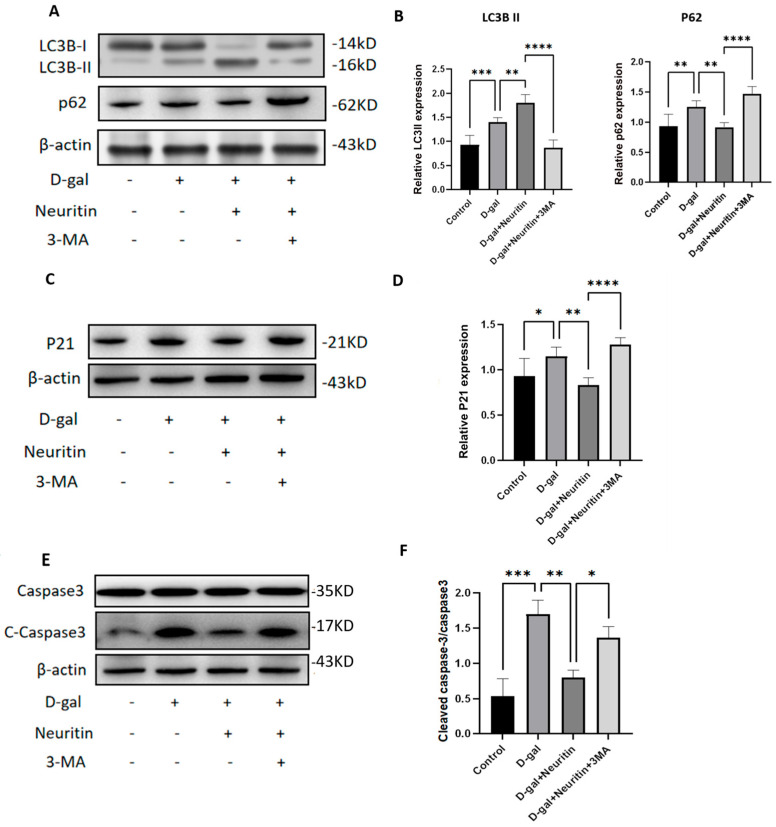
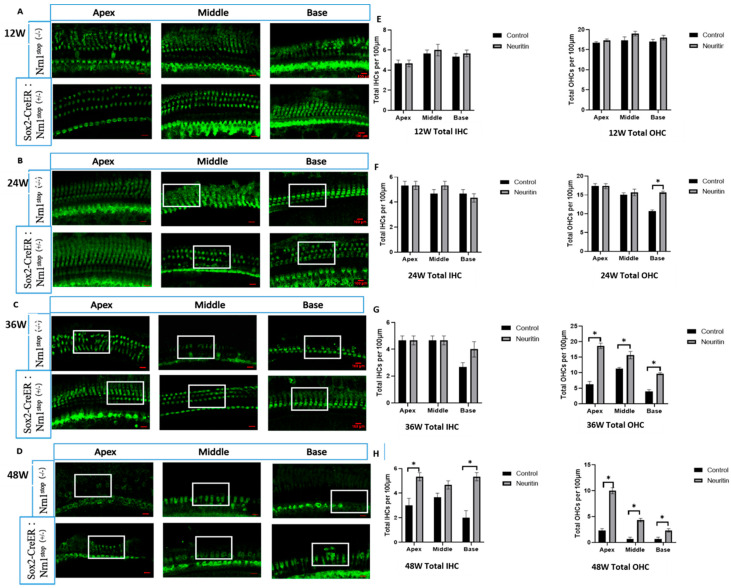
Age-related hearing loss (ARHL) is a highly prevalent, burdensome sensorineural hearing loss closely associated with impaired autophagic influx. Our previous studies revealed that neuritin, a neurotrophic factor primarily expressed in the central nervous system, could alleviate drug-induced damages in hair cells (HCs) and spiral ganglion neurons. However, its effects on ARHL and whether these effects are closely related to autophagy remain unclear. Using the Nrn1 knock-in mice and cultured cochlear basilar membrane (CBM) of the neonatal mouse, we show that neuritin could restore aging-associated hearing loss and alleviate senescence-associated damage in the cochlea. Overexpression of neuritin in support cells (SCs) alleviates the loss of cochlear HCs and nerve fibers, reducing the damage to spiral ganglion neurons and the shifts in ABR's high-frequency threshold. Furthermore, conditional overexpression of neuritin in SCs improves autophagic influx by upregulating the expression of microtubule-associated protein 1 light chain 3 type B (LCB3) protein and downregulating the expression of p21 protein. In cultured neonatal mouse CBM, neuritin administration significantly inhibits D-galactose-induced HC loss, cellular apoptosis, and ROS production and promotes autophagic influx. These effects were weakened when the autophagy inhibitor 3-MA was added. In summary, our results confirm the therapeutic potential of neuritin treatment for ARHL.
年龄相关性听力损失(ARHL)是一种高度普遍且负担沉重的感音神经性听力损失,与自噬流入受损密切相关。我们之前的研究表明,神经生长素(neuritin)是一种主要在中枢神经系统表达的神经营养因子,可减轻药物诱导的毛细胞(HCs)和螺旋神经节神经元损伤。然而,其对ARHL的影响以及这些影响是否与自噬密切相关仍不清楚。利用Nrn1基因敲入小鼠和新生小鼠培养的耳蜗基底膜(CBM),我们发现神经生长素可恢复与衰老相关的听力损失,并减轻耳蜗中的衰老相关损伤。支持细胞(SCs)中神经生长素的过表达减轻了耳蜗HCs和神经纤维的损失,减少了对螺旋神经节神经元的损伤以及听性脑干反应(ABR)高频阈值的变化。此外,SCs中神经生长素的条件性过表达通过上调微管相关蛋白1轻链3 B型(LCB3)蛋白的表达和下调p21蛋白的表达来改善自噬流入。在培养的新生小鼠CBM中,给予神经生长素可显著抑制D-半乳糖诱导的HC损失、细胞凋亡和活性氧(ROS)产生,并促进自噬流入。当加入自噬抑制剂3-甲基腺嘌呤(3-MA)时,这些作用减弱。总之,我们的结果证实了神经生长素治疗ARHL的潜在治疗价值。