Sleep-Wake Disorders Center, Montefiore Medical Center, Bronx, NY.
Department of Psychiatry, Sleep and Alertness Clinic, Sleep Research Laboratory, Toronto Western Hospital, University of Toronto, Toronto, Ontario, Canada.
Ann Neurol. 2019 Mar;85(3):359-370. doi: 10.1002/ana.25423.
Solriamfetol (JZP-110) is a selective dopamine and norepinephrine reuptake inhibitor with wake-promoting effects. This phase 3 study (NCT02348593) evaluated the safety and efficacy of solriamfetol in narcolepsy.
Patients with narcolepsy with mean sleep latency <25 minutes on the Maintenance of Wakefulness Test (MWT), Epworth Sleepiness Scale (ESS) score ≥10, and usual nightly sleep ≥6 hours were randomized to solriamfetol 75, 150, or 300 mg, or placebo for 12 weeks. Coprimary endpoints were change from baseline to week 12 in MWT and ESS. Improvement on the Patient Global Impression of Change (PGI-C) was the key secondary endpoint.
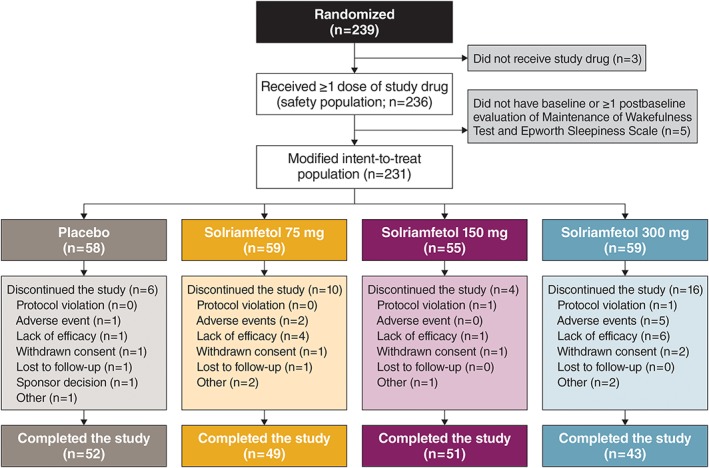
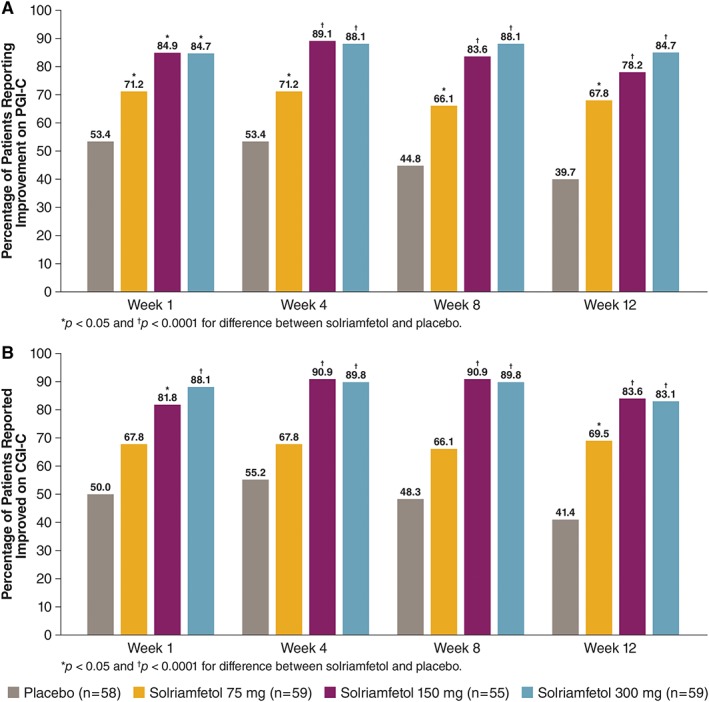
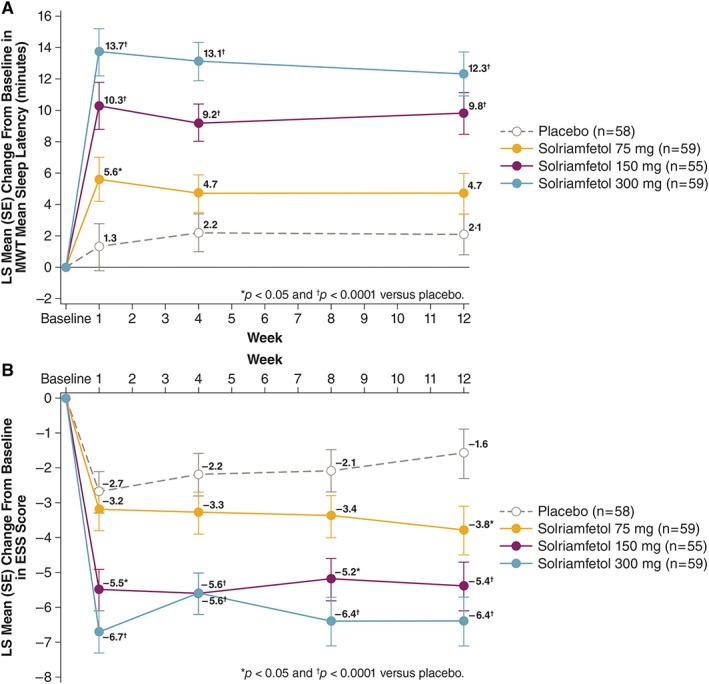
Safety and modified intention-to-treat populations included 236 and 231 patients, respectively. Solriamfetol 300 and 150 mg were positive on both coprimary endpoints. Least squares mean (standard error [SE]) changes from baseline were 12.3 (SE = 1.4) and 9.8 (SE = 1.3) minutes for solriamfetol 300 and 150 mg on the MWT, respectively, versus 2.1 (SE = 1.3) minutes for placebo, and -6.4 (SE = 0.7) for 300 mg and -5.4 (SE = 0.7) for 150 mg on the ESS versus -1.6 (SE = 0.7) for placebo (all p < 0.0001). At week 12, higher percentages of patients treated with solriamfetol 150 mg (78.2%) and 300 mg (84.7%) reported PGI-C improvement relative to placebo (39.7%; both p < 0.0001). Adverse events ≥5% across all solriamfetol doses included headache (21.5%), nausea (10.7%), decreased appetite (10.7%), nasopharyngitis (9.0%), dry mouth (7.3%), and anxiety (5.1%).
Solriamfetol has the potential to be an important therapeutic option for the treatment of impaired wakefulness and excessive sleepiness in patients with narcolepsy. ANN NEUROL 2019;85:359-370.
索里昂费特(JZP-110)是一种具有促醒作用的选择性多巴胺和去甲肾上腺素再摄取抑制剂。这项 3 期研究(NCT02348593)评估了索里昂费特在嗜睡症中的安全性和疗效。
平均睡眠潜伏期<25 分钟的嗜睡症患者,维持觉醒试验(MWT),嗜睡量表(ESS)评分≥10,每晚通常睡眠≥6 小时,随机分为索里昂费特 75、150 或 300mg,或安慰剂 12 周。主要终点是从基线到第 12 周 MWT 和 ESS 的变化。患者整体变化印象(PGI-C)的改善是关键次要终点。
安全性和改良意向治疗人群分别包括 236 例和 231 例患者。索里昂费特 300mg 和 150mg 在两个主要终点上均为阳性。与安慰剂相比,索里昂费特 300mg 和 150mg 的最小二乘均数(标准误差[SE])变化分别为 12.3(SE=1.4)和 9.8(SE=1.3)分钟,而安慰剂为 2.1(SE=1.3)分钟;300mg 和 150mg 的 ESS 分别为-6.4(SE=0.7)和-5.4(SE=0.7),而安慰剂为-1.6(SE=0.7)(均<0.0001)。在第 12 周时,接受索里昂费特 150mg(78.2%)和 300mg(84.7%)治疗的患者报告 PGI-C 改善的比例高于安慰剂(39.7%;均<0.0001)。所有索里昂费特剂量组发生率≥5%的不良反应包括头痛(21.5%)、恶心(10.7%)、食欲下降(10.7%)、鼻咽炎(9.0%)、口干(7.3%)和焦虑(5.1%)。
索里昂费特有可能成为治疗嗜睡症患者觉醒障碍和过度嗜睡的重要治疗选择。