NIHR Academic Clinical Fellow, Section of Anaesthetics, Pain Medicine and Intensive Care, Imperial College London, London, UK.
Foundation Doctor, North West Anglia NHS Foundation Trust, Peterborough, UK.
BMJ Open. 2019 Jan 28;9(1):e021854. doi: 10.1136/bmjopen-2018-021854.
To examine the association between financial performance as measured by operating margin (surplus/deficit as a proportion of turnover) and clinical outcomes in English National Health Service (NHS) trusts.
Longitudinal, observational study in 149 acute NHS trusts in England between the financial years 2011 and 2016.
Our analysis focused on outcomes at individual NHS Trust-level (composed of one or more acute hospitals).
Outcome measures included readmissions, inpatient satisfaction score and the following process measures: emergency department (Accident and Emergency (A&E)) waiting time targets, cancer referral and treatment targets and delayed transfers of care (DTOCs).
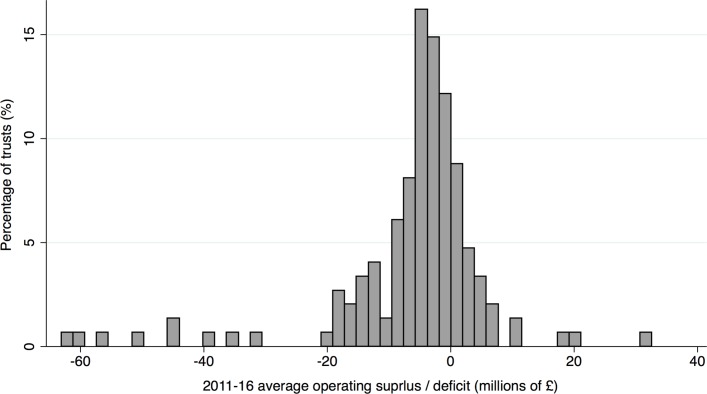
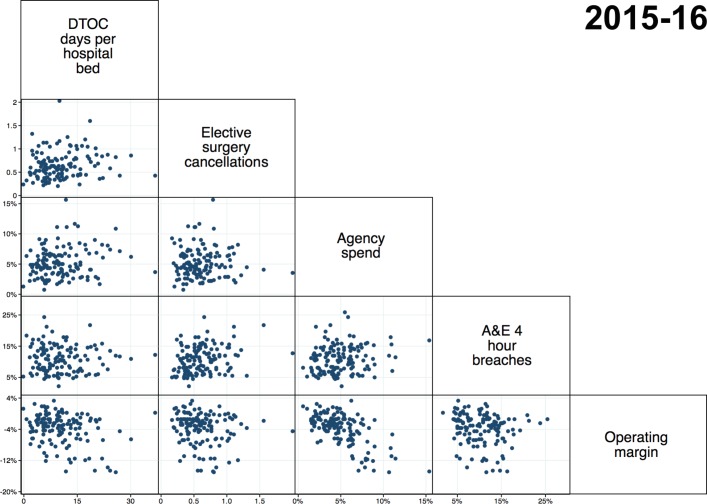
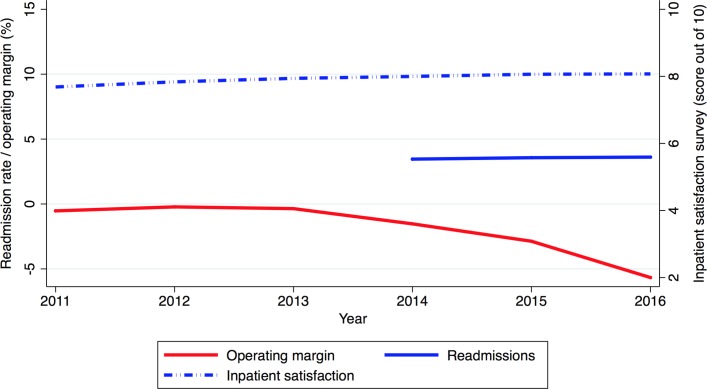
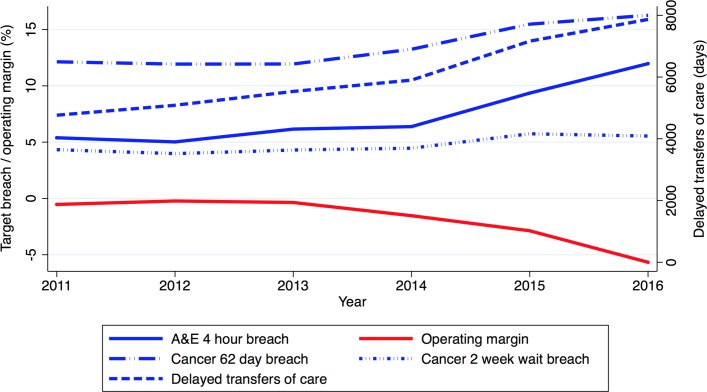
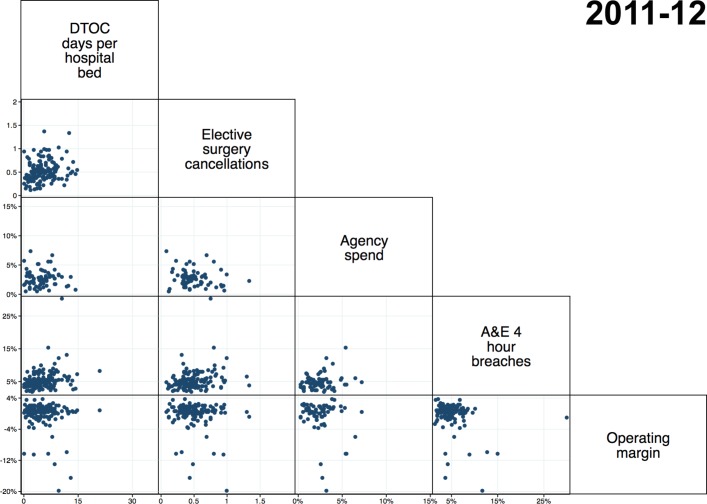
There was a progressive increase in the proportion of trusts in financial deficit: 22% in 2011, 27% in 2012, 28% in 2013, 51% in 2014, 68% in 2015 and 91% in 2016. In linear regression analyses, there was no significant association between operating margin and clinical outcomes (readmission rate or inpatient satisfaction score). There was, however, a significant association between operating margin and process measures (DTOCs, A&E breaches and cancer waiting time targets). Between the best and worst financially performing Trusts, there was an approximately 2-fold increase in A&E breaches and DTOCs overall although this variation decreased over the 6 years. Between the best and worst performing trusts on cancer targets, the magnitude of difference was smaller (1.16 and 1.15-fold), although the variation slowly rose during the 6 years.
Operating margins in English NHS trusts progressively worsened during 2011-2016, and this change was associated with poorer performance on several process measures but not with hospital readmissions or inpatient satisfaction. Significant variation exists between the best and worst financially performing Trusts. Further research is needed to examine the causal nature of relationships between financial performance, process measures and outcomes.
研究以运营利润率(营业额的盈余/亏损比例)衡量的财务表现与英国国民保健服务(NHS)信托机构的临床结果之间的关联。
2011 年至 2016 年期间,在英格兰 149 家急性 NHS 信托机构中进行了一项纵向观察性研究。
我们的分析主要集中在 NHS 信托机构层面的结果上(由一家或多家急性医院组成)。
结果衡量标准包括再入院率、住院患者满意度评分以及以下过程衡量标准:急诊部门(急症室(A&E))等待时间目标、癌症转诊和治疗目标以及延迟转移护理(DTOC)。
财务亏损的信托机构比例呈逐步上升趋势:2011 年为 22%,2012 年为 27%,2013 年为 28%,2014 年为 51%,2015 年为 68%,2016 年为 91%。在线性回归分析中,运营利润率与临床结果(再入院率或住院患者满意度评分)之间没有显著关联。然而,运营利润率与过程衡量标准(DTOC、A&E 违规和癌症等待时间目标)之间存在显著关联。在财务表现最好和最差的信托机构之间,A&E 违规和 DTOC 总体上增加了约两倍,尽管这种差异在 6 年内有所减少。在癌症目标表现最好和最差的信托机构之间,差异幅度较小(1.16 倍和 1.15 倍),尽管这种差异在 6 年内缓慢上升。
2011 年至 2016 年期间,英国 NHS 信托机构的运营利润率逐渐恶化,这种变化与多项过程衡量标准的表现不佳有关,但与医院再入院率或住院患者满意度无关。财务表现最好和最差的信托机构之间存在显著差异。需要进一步研究以检查财务绩效、过程衡量标准和结果之间的关系的因果性质。