Department of Orthopedics, The Second Affiliated Hospital and Yuying Children's Hospital of Wenzhou Medical University, Wenzhou, China.
Department of the Second School of Medicine, Wenzhou Medical University, Wenzhou, China.
BMJ Open. 2019 Jan 28;9(1):e024110. doi: 10.1136/bmjopen-2018-024110.
The optimal treatment for burst fractures of the thoracolumbar spine is controversial. The addition of screws in the fractured segment has been shown to improve construct stiffness, but can aggravate the trauma to the fractured vertebra. Therefore, optimised placement of two pedicle screws at the fracture level is required for the treatment of thoracolumbar burst fractures. This randomised controlled study is the first to examine the efficacy of diverse orders of pedicle screw placement and will provide recommendations for the treatment of patients with thoracolumbar burst fractures.
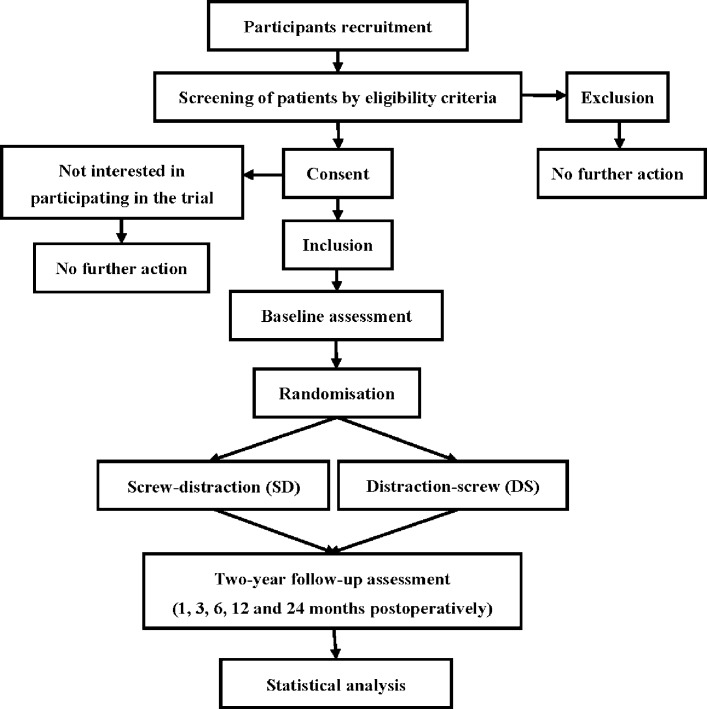
A randomised controlled trial with blinding of patients and the statistician, but not the clinicians and researchers, will be conducted. A total of 70 patients with single AO type A3 or A4 thoracolumbar fractures who are candidates for application of short-segment pedicle screws at the fractured vertebral level will be allocated randomly to the distraction-screw and screw-distraction groups at a ratio of 1:1. The primary clinical outcome measures will be the percentage loss of vertebral body height, screw depth in the injured vertebrae and kyphosis (Cobb angle). Secondary clinical outcome measures will be complications, Visual Analogue Scale scores for back and leg pain, neurological function, operation time, intraoperative blood loss, Japanese Orthopaedic Association score and Oswestry Disability Index. These parameters will be evaluated preoperatively, intraoperatively, on postoperative day 3, and at 1, 3, 6, 12 and 24 months postoperatively.
The Institutional Review Board of the Second Affiliated Hospital and Yuying Children's Hospital of Wenzhou Medical University have reviewed and approved this study (batch: LCKY2018-05). The results will be presented in peer-reviewed journals and at an international spine-related meeting after completion of the study.
NCT03384368; Pre-results.
胸腰椎爆裂骨折的最佳治疗方法仍存在争议。研究表明,在骨折节段增加螺钉可以提高结构刚度,但会加重骨折椎体的创伤。因此,需要在骨折水平优化放置两根椎弓根螺钉来治疗胸腰椎爆裂骨折。这是第一项研究不同椎弓根螺钉放置顺序的随机对照研究,将为胸腰椎爆裂骨折患者的治疗提供建议。
将进行一项随机对照试验,对患者和统计学家进行盲法,但不对临床医生和研究人员进行盲法。总共将 70 名符合短节段椎弓根螺钉应用标准的单 AO 型 A3 或 A4 胸腰椎骨折患者随机分为撑开螺钉组和螺钉撑开组,比例为 1:1。主要临床结局指标为椎体高度丢失百分比、伤椎螺钉深度和后凸(Cobb 角)。次要临床结局指标为并发症、腰背腿痛视觉模拟评分、神经功能、手术时间、术中出血量、日本矫形协会评分和 Oswestry 功能障碍指数。这些参数将在术前、术中、术后第 3 天以及术后 1、3、6、12 和 24 个月进行评估。
温州医科大学附属第二医院和育英儿童医院的机构审查委员会已审查并批准了这项研究(批次:LCKY2018-05)。研究完成后,将在同行评议的期刊和国际脊柱相关会议上公布结果。
NCT03384368;预结果。