Zhang Yan-Yan, Li Yan, Qin Meng, Cai Yan, Jin Ying, Pan Ling-Ya
Department of Obstetrics and Gynecology, Peking Union Medical College Hospital, Chinese Academy of Medical Sciences & Peking Union Medical College, Beijing, China,
Cancer Manag Res. 2019 Jan 17;11:831-837. doi: 10.2147/CMAR.S187849. eCollection 2019.
The aim of this study was to evaluate the factors associated with progress-free survival (PFS) and overall survival (OS) in patients with high-grade endometrial stromal sarcoma (HG-ESS).
A total of 40 patients were enrolled in this study at the Peking Union Medical College Hospital, Beijing, China, from 2006 to 2016. The study retrospectively analyzed clinical and pathological data, and associations of these variables with PFS and OS were evaluated.
The age of the patients at the time of diagnosis ranged from 16 to 73 years. Abnormal vaginal bleeding was the most commonly observed symptom. The tumor size ranged from 2 to 19 cm. The tumor locations were as follows: vulva (1 case), ovary (2 cases), broad ligament (2 cases), cervix (7 cases), and uterus (28 cases). A total of 34 (85%) and 6 (15%) patients underwent complete and ovarian preservation surgery, respectively. Notably, 33 (82.5%), 13 (32.5%), and 5 (12.5%) patients received adjuvant chemotherapy, radiation therapy, and hormone treatment, respectively. Lymph node dissection was performed in 15 (37.5%) patients (positive rate: 7.4%), 16 (40%) patients underwent omentectomy (positive rate: 10%), and 12 (30%) patients underwent peritoneal lavage cytology (positive rate: 0%). Eighteen (45%) patients had lymphovascular space invasion, 13 (32.5%) patients had uterine fibroids, and 11 (27.5%) patients were diagnosed with endometriosis. Moreover, the levels of CA125 in the serum were measured prior to and following treatment. The median PFS and OS were 9 and 24 months, respectively. Eventually, 29 (72.5%) patients experienced relapse and 19 (47.5%) patients expired due to the disease.
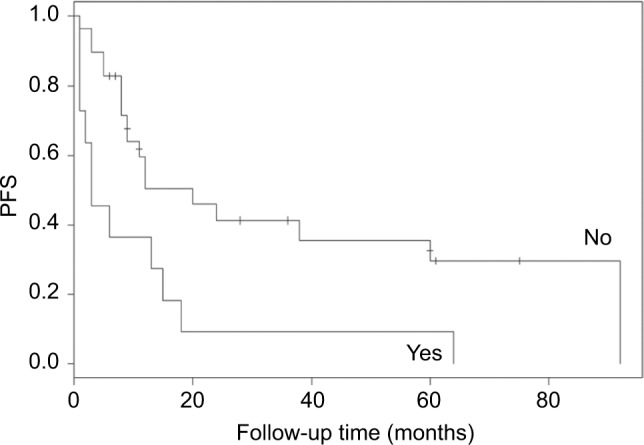
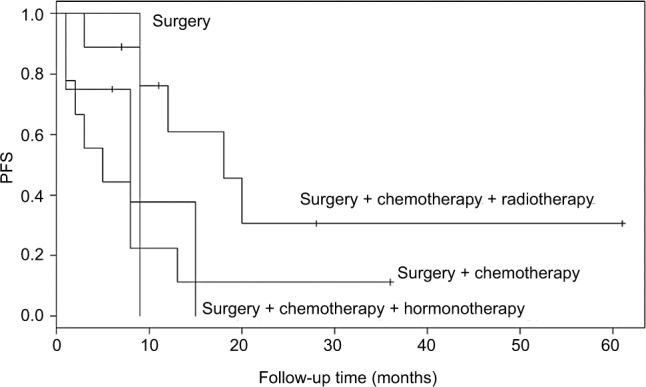
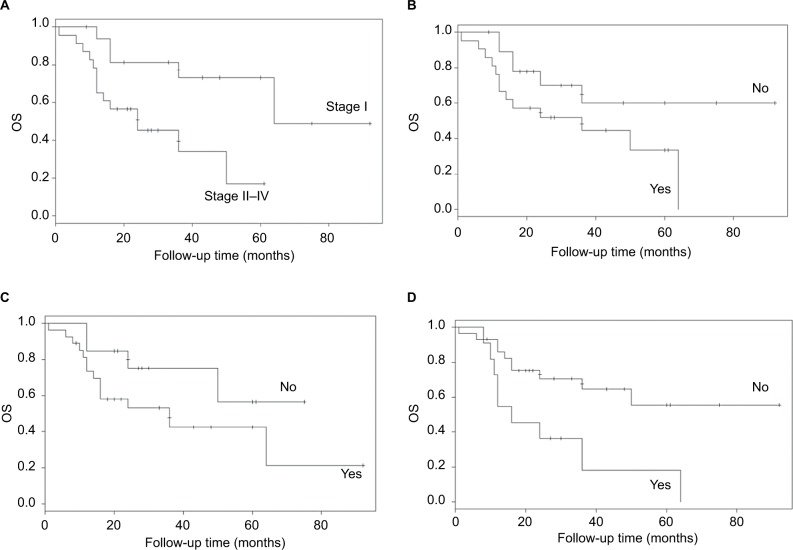
Patients with advanced HG-ESS (stage II-IV) were associated with poor prognosis. The minimum value of CA125 and endometriosis were independent risk factors for PFS. The stage of disease, size of the tumor, minimum and average values of CA125, menopause, history of uterine leiomyoma, and endometriosis were independent risk factors for OS. The combination of surgery with radiotherapy and chemotherapy may improve the PFS of patients in the early stage of the disease.
本研究旨在评估与高级别子宫内膜间质肉瘤(HG-ESS)患者无进展生存期(PFS)和总生存期(OS)相关的因素。
2006年至2016年期间,共有40例患者在北京协和医院入组本研究。该研究回顾性分析了临床和病理数据,并评估了这些变量与PFS和OS的相关性。
患者诊断时的年龄范围为16至73岁。异常阴道出血是最常见的症状。肿瘤大小范围为2至19厘米。肿瘤位置如下:外阴(1例)、卵巢(2例)、阔韧带(2例)、宫颈(7例)和子宫(28例)。分别有34例(85%)和6例(15%)患者接受了根治性手术和保留卵巢手术。值得注意的是,分别有33例(82.5%)、13例(32.5%)和5例(12.5%)患者接受了辅助化疗、放疗和激素治疗。15例(37.5%)患者进行了淋巴结清扫(阳性率:7.4%),16例(40%)患者进行了大网膜切除术(阳性率:10%),12例(30%)患者进行了腹腔灌洗细胞学检查(阳性率:0%)。18例(45%)患者有脉管间隙浸润,13例(32.5%)患者有子宫肌瘤,11例(27.5%)患者被诊断为子宫内膜异位症。此外,在治疗前后测量了血清CA125水平。PFS和OS的中位数分别为9个月和24个月。最终,29例(72.5%)患者复发,19例(47.5%)患者因病死亡。
晚期HG-ESS(II-IV期)患者预后较差。CA125最小值和子宫内膜异位症是PFS的独立危险因素。疾病分期、肿瘤大小、CA125最小值和平均值、绝经状态、子宫肌瘤病史和子宫内膜异位症是OS的独立危险因素。手术联合放疗和化疗可能改善疾病早期患者的PFS。