Carrasco-Escobar Gabriel, Castro Marcia C, Barboza Jose Luis, Ruiz-Cabrejos Jorge, Llanos-Cuentas Alejandro, Vinetz Joseph M, Gamboa Dionicia
Laboratorio ICEMR-Amazonia, Laboratorios de Investigación y Desarrollo, Facultad de Ciencias y Filosofía, Universidad Peruana Cayetano Heredia, Lima, Peru.
Division of Infectious Diseases, Department of Medicine, University of California, San Diego, La Jolla, CA, United States of America.
PeerJ. 2019 Jan 22;7:e6298. doi: 10.7717/peerj.6298. eCollection 2019.
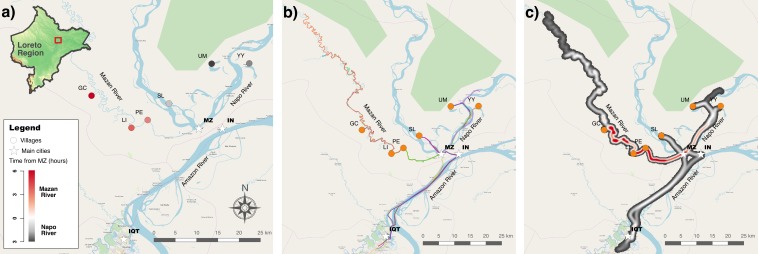
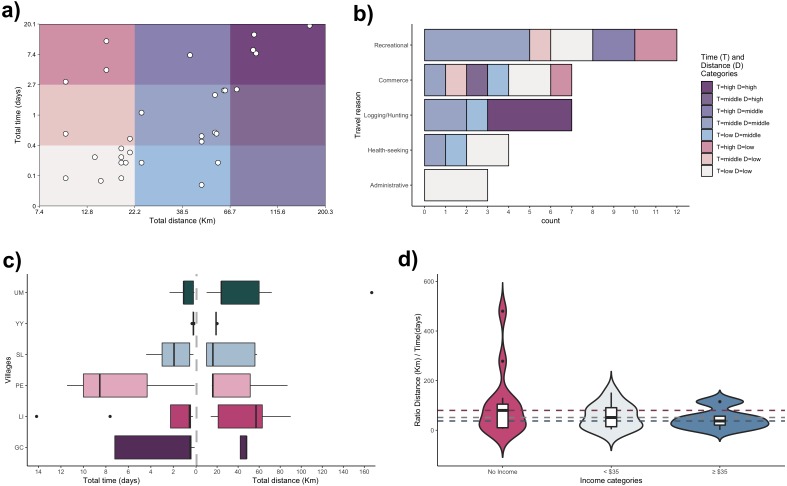
Infectious disease dynamics are affected by human mobility more powerfully than previously thought, and thus reliable traceability data are essential. In rural riverine settings, lack of infrastructure and dense tree coverage deter the implementation of cutting-edge technology to collect human mobility data. To overcome this challenge, this study proposed the use of a novel open mobile mapping tool, GeoODK. This study consists of a purposive sampling of 33 participants in six villages with contrasting patterns of malaria transmission that demonstrates a feasible approach to map human mobility. The self-reported traceability data allowed the construction of the first human mobility framework in rural riverine villages in the Peruvian Amazon. The mobility spectrum in these areas resulted in travel profiles ranging from 2 hours to 19 days; and distances between 10 to 167 km. Most Importantly, occupational-related mobility profiles with the highest displacements (in terms of time and distance) were observed in commercial, logging, and hunting activities. These data are consistent with malaria transmission studies in the area that show villages in watersheds with higher human movement are concurrently those with greater malaria risk. The approach we describe represents a potential tool to gather critical information that can facilitate malaria control activities.
传染病动态受人类流动的影响比之前认为的更为强烈,因此可靠的溯源数据至关重要。在农村河流地区,基础设施的匮乏和茂密的树木覆盖阻碍了采用前沿技术来收集人类流动数据。为克服这一挑战,本研究提议使用一种新型的开放式移动测绘工具——地理开源数据工具包(GeoODK)。本研究对六个疟疾传播模式不同的村庄中的33名参与者进行了目的抽样,展示了一种绘制人类流动情况的可行方法。自我报告的溯源数据使得秘鲁亚马逊地区农村河流村庄的首个人类流动框架得以构建。这些地区的流动范围导致出行时间从2小时到19天不等,出行距离在10至167公里之间。最重要的是,在商业、伐木和狩猎活动中观察到了与职业相关的、位移最大(在时间和距离方面)的流动模式。这些数据与该地区的疟疾传播研究一致,研究表明人类活动较多的流域中的村庄同时也是疟疾风险较高的村庄。我们所描述的方法是一种收集关键信息的潜在工具,可促进疟疾防控活动。