Zhao Guang-Jian, Wang Zi-Ran, Lin Fan-Zhen, Cui Yan-Sen, Xu Shun-Liang
Department of Neurology, Linyi People's Hospital Affiliated to Shandong University, Linyi, Shandong, China.
General Medicine, Linyi People's Hospital Affiliated to Shandong University, Linyi, Shandong, China.
Braz J Med Biol Res. 2019 Jan 24;52(2):e7739. doi: 10.1590/1414-431X20187739.
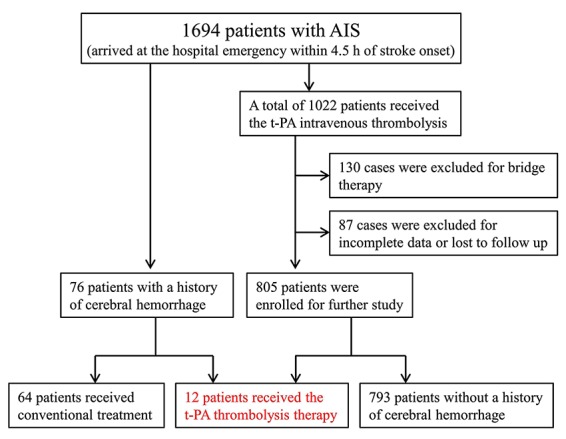
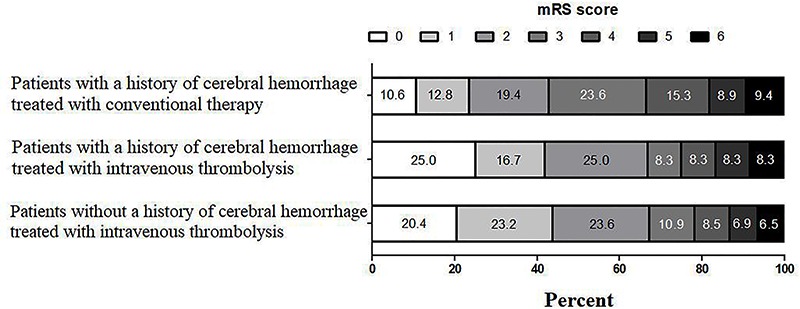
Alteplase (tPA) intravenous thrombolysis is an effective treatment for acute ischemic stroke (AIS) when administered within 4.5 h of initial stroke symptoms. Here, its safety and efficacy were evaluated among AIS patients with a previous history of cerebral hemorrhage. Patients who arrived at the hospital within 4.5 h of initial stroke symptoms and who were treated with tPA intravenous thrombolysis or conventional therapies were analyzed. The 90-day modified Rankin scale (90-d mRS) was used alongside mortality and incidence of symptomatic intracerebral hemorrhage (SICH) rates to evaluate the curative effect of these therapies. Among 1,694 AIS patients, 805 patients were treated with intravenous thrombolysis, including patients with (n=793) or without (n=12) a history of cerebral hemorrhage, and the rate of incidence of SICH significantly differed between them (8.3 vs 4.3%, P=0.039). No significant difference was found in 90-d mRS measurements (41.7 vs 43.6%, P=0.530) and 90-d mortality rates (8.3 vs 6.5%, P=0.946). A total of 76 AIS patients with a history of cerebral hemorrhage received tPA thrombolytic therapy (n=12) or conventional therapy (n=64), and a significant difference was noted in the 90-d mRS scores between the two groups (41.7 vs 23.4%, P=0.029), while no significant difference was found in SICH measurements (8.3 vs 4.6%, P=0.610) and 90-d mortality rates (8.3 vs 9.4%, P=0.227). A history of cerebral hemorrhage is not an absolute contraindication for thrombolytic therapy; tPA intravenous thrombolysis does not increase SICH measurements and mortality rates in patients with a history of cerebral hemorrhage, and they may benefit from thrombolytic therapy.
阿替普酶(tPA)静脉溶栓是急性缺血性卒中(AIS)在首次出现卒中症状4.5小时内进行治疗的有效方法。在此,对既往有脑出血病史的AIS患者进行了其安全性和有效性评估。分析了在首次出现卒中症状4.5小时内到达医院并接受tPA静脉溶栓或传统治疗的患者。采用90天改良Rankin量表(90-d mRS)以及死亡率和症状性脑出血(SICH)发生率来评估这些治疗方法的疗效。在1694例AIS患者中,805例接受了静脉溶栓治疗,其中包括有(n = 793)或无(n = 12)脑出血病史的患者,两组间SICH发生率显著不同(8.3%对4.3%,P = 0.039)。在90-d mRS测量值(41.7%对43.6%,P = 0.530)和90天死亡率(8.3%对6.5%,P = 0.946)方面未发现显著差异。共有76例有脑出血病史的AIS患者接受了tPA溶栓治疗(n = 12)或传统治疗(n = 64),两组间90-d mRS评分存在显著差异(41.7%对23.4%,P = 0.029),而在SICH测量值(8.3%对4.6%,P = 0.610)和90天死亡率(8.3%对9.4%,P = 0.227)方面未发现显著差异。脑出血病史并非溶栓治疗的绝对禁忌证;tPA静脉溶栓不会增加有脑出血病史患者的SICH测量值和死亡率,他们可能从溶栓治疗中获益。