Lymphoma Research Group, Medical Oncology Department, Instituto de Investigación Sanitaria Puerta de Hierro-Segovia de Arana, Madrid, Spain.
Centro de Investigación Biomédica en Red de Cáncer (CIBERONC), Madrid, Spain.
Sci Rep. 2019 Jan 30;9(1):975. doi: 10.1038/s41598-018-37389-7.
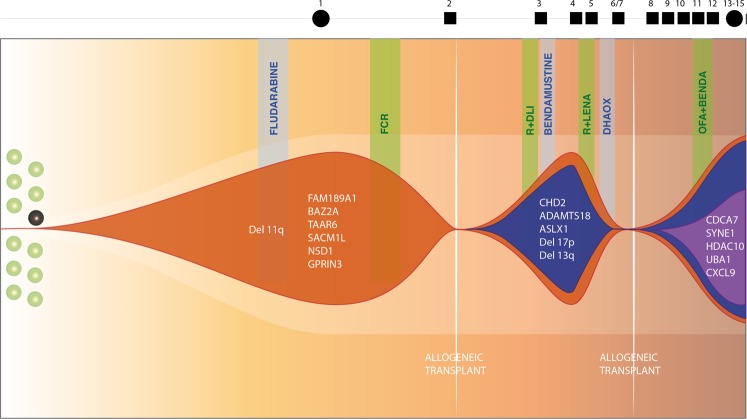
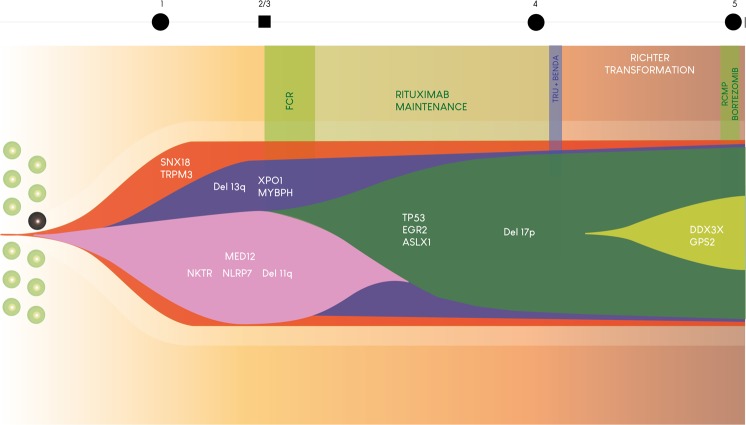
Chronic lymphocytic leukaemia is the most prevalent leukaemia in Western countries. It is an incurable disease characterized by a highly variable clinical course. Chronic lymphocytic leukaemia is an ideal model for studying clonal heterogeneity and dynamics during cancer progression, response to therapy and/or relapse because the disease usually develops over several years. Here we report an analysis by deep sequencing of sequential samples taken at different times from the affected organs of two patients with 12- and 7-year disease courses, respectively. One of the patients followed a linear pattern of clonal evolution, acquiring and selecting new mutations in response to salvage therapy and/or allogeneic transplantation, while the other suffered loss of cellular tumoral clones during progression and histological transformation.
慢性淋巴细胞白血病是西方国家最常见的白血病。它是一种无法治愈的疾病,其临床病程高度多变。慢性淋巴细胞白血病是研究癌症进展、对治疗的反应和/或复发过程中克隆异质性和动态变化的理想模型,因为该疾病通常会在几年内发展。在这里,我们报告了对两名分别患有 12 年和 7 年病程的患者的病变器官在不同时间采集的连续样本进行深度测序的分析结果。其中一名患者的克隆进化呈线性模式,在接受挽救性治疗和/或同种异体移植后获得并选择新的突变,而另一名患者在进展和组织学转化过程中则失去了肿瘤细胞克隆。