van den Hoogen Lotus L, Walk Jona, Oulton Tate, Reuling Isaie J, Reiling Linda, Beeson James G, Coppel Ross L, Singh Susheel K, Draper Simon J, Bousema Teun, Drakeley Chris, Sauerwein Robert, Tetteh Kevin K A
Department of Immunology and Infection, London School of Hygiene & Tropical Medicine, London, United Kingdom.
Department of Medical Microbiology, Radboud University Medical Center, Nijmegen, Netherlands.
Front Microbiol. 2019 Jan 16;9:3300. doi: 10.3389/fmicb.2018.03300. eCollection 2018.
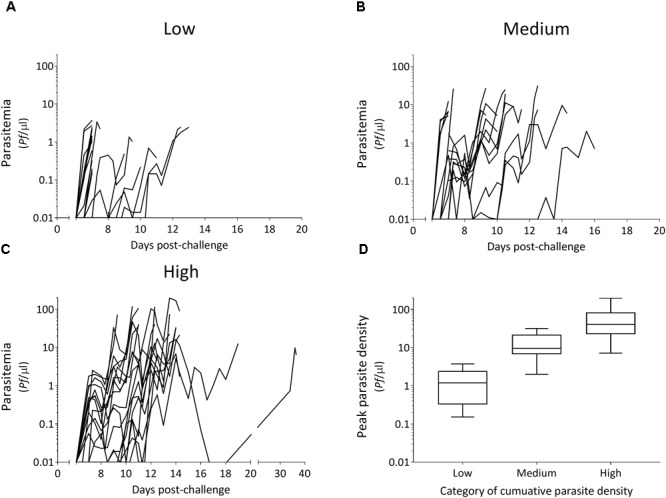
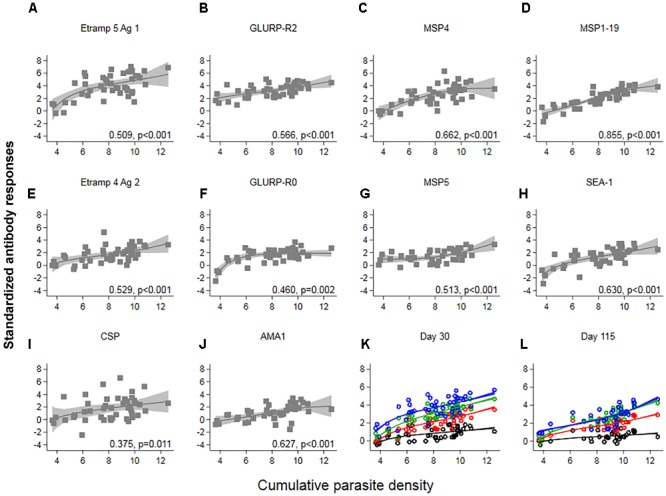
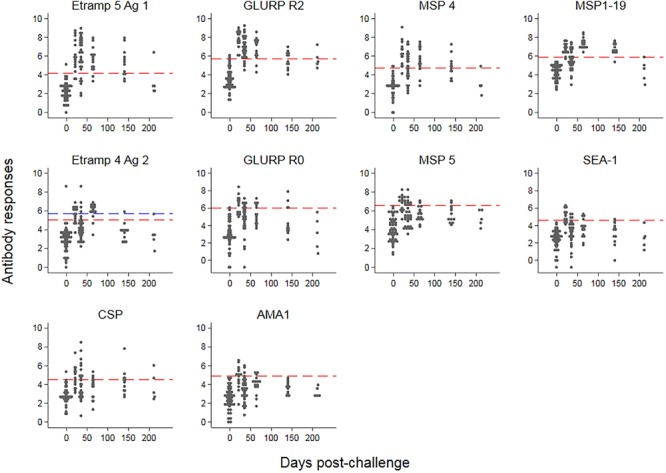
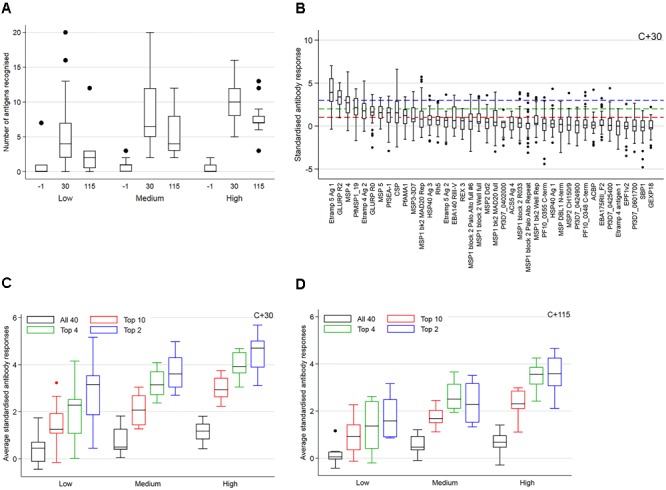
The majority of malaria infections in low transmission settings remain undetectable by conventional diagnostics. A powerful model to identify antibody responses that allow accurate detection of recent exposure to low-density infections is controlled human malaria infection (CHMI) studies in which healthy volunteers are infected with the parasite. We aimed to evaluate antibody responses in malaria-naïve volunteers exposed to a single CHMI using a custom-made protein microarray. All participants developed a blood-stage infection with peak parasite densities up to 100 parasites/μl in the majority of participants (50/54), while the remaining four participants had peak densities between 100 and 200 parasites/μl. There was a strong correlation between parasite density and antibody responses associated with the most reactive blood-stage targets 1 month after CHMI (Etramp 5, GLURP-R2, MSP4 and MSP1-19; Spearman's ρ = 0.82, < 0.001). Most volunteers developed antibodies against a potential marker of recent exposure: Etramp 5 (37/45, 82%). Our findings justify validation in endemic populations to define a minimum set of antigens needed to detect exposure to natural low-density infections.
在低传播环境中,大多数疟疾感染通过传统诊断方法仍无法检测到。一种用于识别能够准确检测近期低密度感染暴露的抗体反应的强大模型是受控人类疟疾感染(CHMI)研究,即让健康志愿者感染疟原虫。我们旨在使用定制的蛋白质微阵列评估初次接触疟疾的志愿者在单次CHMI后的抗体反应。所有参与者都出现了血液阶段感染,大多数参与者(50/54)的寄生虫密度峰值高达100个寄生虫/微升,而其余四名参与者的峰值密度在100至200个寄生虫/微升之间。CHMI后1个月,寄生虫密度与与反应最强的血液阶段靶点相关的抗体反应之间存在很强的相关性(Etramp 5、GLURP-R2、MSP4和MSP1-19;Spearman's ρ = 0.82,<0.001)。大多数志愿者产生了针对近期暴露潜在标志物的抗体:Etramp 5(37/45,82%)。我们的研究结果证明在流行人群中进行验证是合理的,以确定检测自然低密度感染暴露所需的最小抗原集。