Metzler-Zebeli Barbara U, Siegerstetter Sina-Catherine, Magowan Elizabeth, Lawlor Peadar G, Petri Renée M, O Connell Niamh E, Zebeli Qendrim
Institute of Animal Nutrition and Functional Plant Compounds, Department for Farm Animals and Veterinary Public Health, University of Veterinary Medicine Vienna, Vienna, Austria.
Agriculture Branch, Hillsborough, Agri-Food and Biosciences Institute, Belfast, Northern Ireland, United Kingdom.
mSystems. 2019 Jan 29;4(1). doi: 10.1128/mSystems.00261-18. eCollection 2019 Jan-Feb.
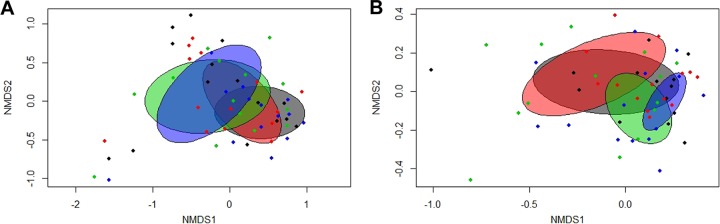
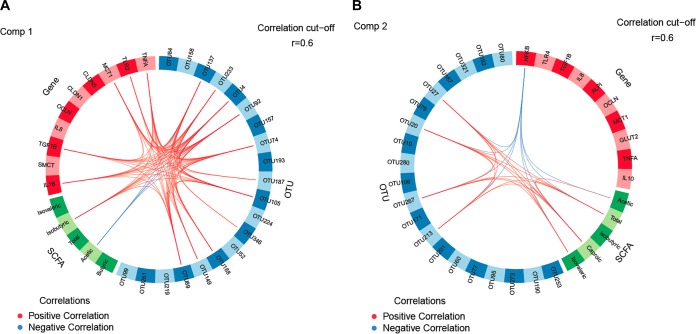
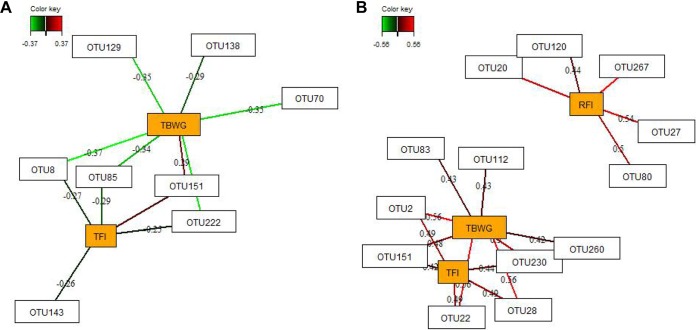
Differences in chickens' feed intake may be the underlying factor influencing feed-efficiency (FE)-associated variation in intestinal microbiota and physiology. In chickens eating the same amount of feed, quantitative feed restriction may create similar intestinal conditions and help clarify this cause-and-effect relationship. This study investigated the effect of versus restrictive feeding (85% of ) on ileal and cecal microbiota, concentrations of short-chain fatty acids, visceral organ size, intestinal morphology, permeability, and expression of genes related to nutrient uptake, barrier function, and innate immune response in broiler chickens with divergent residual feed intake (RFI; metric for FE). On day 30 posthatch, 28 low-RFI (good FE) and 29 high-RFI (poor FE) chickens across both feeding-level groups (=112) were selected. Supervised multigroup data integration and relevance network analyses showed that especially (negative) in ileal digesta, (positive) in cecal digesta, and (positive) in both intestinal segments depended on chicken's feed intake, whereas the level of in cecal digesta was most discriminative for high RFI. Moreover, shallower crypts and fewer goblet cells in ceca indicated host-related energy-saving mechanisms with low RFI, whereas greater tissue resistance suggested a stronger jejunal barrier function in low-RFI chickens. Values corresponding to feed intake level × RFI interactions indicated larger pancreas and lower levels of ileal and cecal short-chain fatty acids in restrictively fed high-RFI chickens than in the other 3 groups, suggesting host physiological adaptations to support greater energy and nutrient needs of high-RFI chickens compensating for the restricted feeding. The impact of the FE-associated differences in feed intake on intestinal bacterial and host physiological parameters has so far not been clarified. Understanding the underlying principles is essential for the development of cost-effective strategies to improve FE in chicken production. Under conditions of quantitative feed restriction, low- and high-RFI chickens ate the same amount of feed. Therefore, this research helps in distinguishing intestinal bacterial taxa and functions that were highly reliant on feed intake from those that were associated with physiological adaptations to RFI-associated differences in host nutritional needs and intestinal nutrient availability. This work provides a background for further research to assess manipulation of the intestinal microbiota, host physiology, and FE in chickens by dietary intervention.
鸡采食量的差异可能是影响饲料效率(FE)相关的肠道微生物群和生理学变化的潜在因素。在采食相同量饲料的鸡中,定量限饲可能会创造相似的肠道条件,并有助于阐明这种因果关系。本研究调查了自由采食与限饲(自由采食量的85%)对具有不同剩余采食量(RFI,FE的衡量指标)的肉鸡回肠和盲肠微生物群、短链脂肪酸浓度、内脏器官大小、肠道形态、通透性以及与营养吸收、屏障功能和先天免疫反应相关基因表达的影响。在孵化后第30天,从两个饲喂水平组中挑选出28只低RFI(良好FE)和29只高RFI(较差FE)的鸡(n = 112)。监督多组数据整合和相关性网络分析表明,特别是回肠食糜中的乙酸(阴性)、盲肠食糜中的丙酸(阳性)以及两个肠道段中的丁酸(阳性)取决于鸡的采食量,而盲肠食糜中丙酸的水平对高RFI最具区分性。此外,盲肠中隐窝较浅和杯状细胞较少表明低RFI鸡存在与宿主相关的节能机制,而较低的组织阻力表明低RFI鸡的空肠屏障功能更强。与采食量水平×RFI相互作用相对应的值表明,限饲的高RFI鸡的胰腺比其他3组更大,回肠和盲肠短链脂肪酸水平更低,这表明宿主的生理适应性是为了支持高RFI鸡对更多能量和营养的需求,以弥补限饲的影响。到目前为止,与FE相关的采食量差异对肠道细菌和宿主生理参数的影响尚未阐明。了解其潜在原理对于制定提高鸡肉生产中FE的经济有效策略至关重要。在定量限饲条件下,低RFI和高RFI鸡采食相同量的饲料。因此,本研究有助于区分高度依赖采食量的肠道细菌分类群和功能与那些与宿主营养需求和肠道营养可用性的RFI相关差异的生理适应性相关的分类群和功能。这项工作为进一步研究通过饮食干预来评估鸡肠道微生物群、宿主生理学和FE的调控提供了背景。