Audio Acoustics Group, LIMSI, CNRS, Université Paris-Saclay, Orsay, France.
Dyson School of Design Engineering, Imperial College London, London, UK.
Sci Rep. 2019 Jan 31;9(1):1063. doi: 10.1038/s41598-018-37873-0.
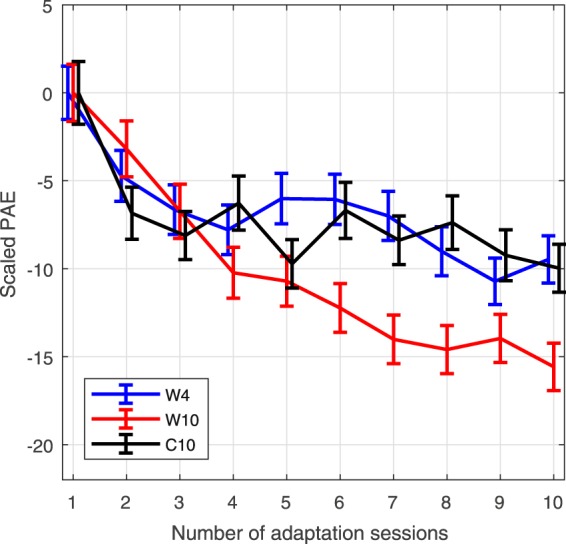
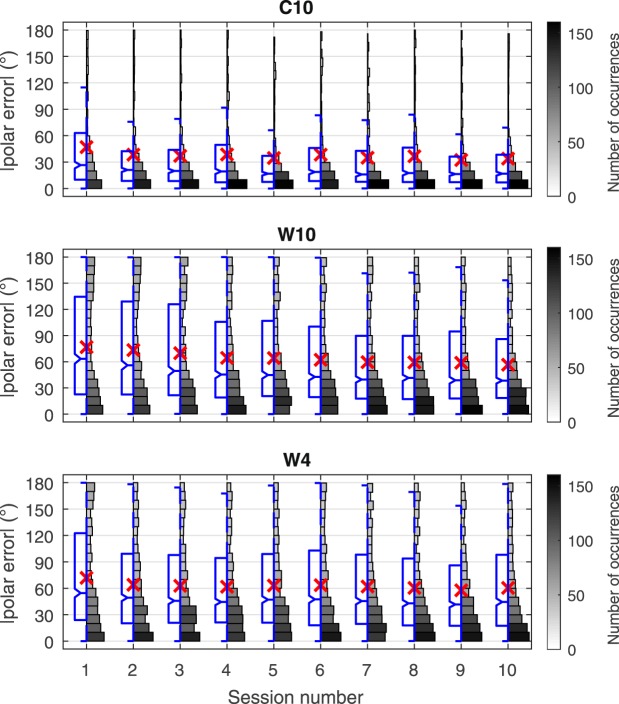
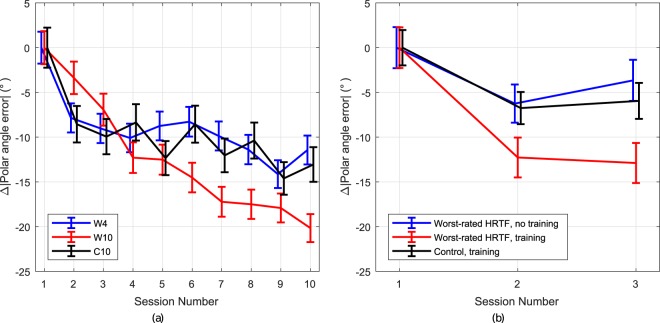
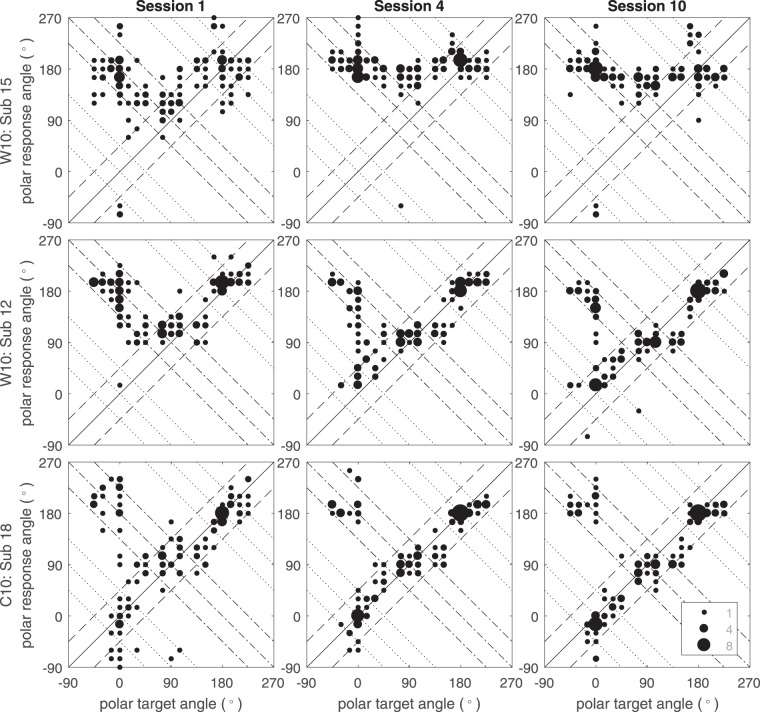
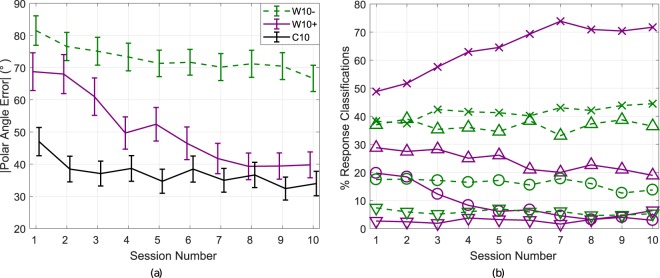
This study examines the effect of adaptation to non-ideal auditory localization cues represented by the Head-Related Transfer Function (HRTF) and the retention of training for up to three months after the last session. Continuing from a previous study on rapid non-individual HRTF learning, subjects using non-individual HRTFs were tested alongside control subjects using their own measured HRTFs. Perceptually worst-rated non-individual HRTFs were chosen to represent the worst-case scenario in practice and to allow for maximum potential for improvement. The methodology consisted of a training game and a localization test to evaluate performance carried out over 10 sessions. Sessions 1-4 occurred at 1 week intervals, performed by all subjects. During initial sessions, subjects showed improvement in localization performance for polar error. Following this, half of the subjects stopped the training game element, continuing with only the localization task. The group that continued to train showed improvement, with 3 of 8 subjects achieving group mean polar errors comparable to the control group. The majority of the group that stopped the training game retained their performance attained at the end of session 4. In general, adaptation was found to be quite subject dependent, highlighting the limits of HRTF adaptation in the case of poor HRTF matches. No identifier to predict learning ability was observed.
本研究考察了对头相关传递函数(HRTF)表示的非理想听觉定位线索的适应以及在最后一次训练后长达三个月的训练保持情况。本研究是在前一个关于快速非个体 HRTF 学习的研究的基础上进行的,使用非个体 HRTF 的受试者与使用自己测量的 HRTF 的对照受试者一起进行测试。选择感知上最差的非个体 HRTF 来代表实践中的最坏情况,并允许最大的潜在改进。该方法包括一个训练游戏和一个本地化测试,以评估在 10 次会话中进行的表现。第 1-4 次会话在 1 周的间隔内进行,所有受试者都参加。在初始阶段,受试者的极坐标误差定位表现有所提高。在此之后,一半的受试者停止了训练游戏部分,只继续进行本地化任务。继续训练的组表现有所提高,8 名受试者中有 3 名达到了与对照组相当的组平均极坐标误差。大多数停止训练游戏的组保留了他们在第 4 次会话结束时获得的表现。总的来说,适应情况因人而异,这突出了在 HRTF 匹配不佳的情况下 HRTF 适应的局限性。没有发现可以预测学习能力的标识符。