Rodgers Rachel A, Travers Brittany G, Mason Andrea H
Department of Kinesiology, University of Wisconsin-Madison, Madison, WI, United States.
Occupational Therapy Program in the Department of Kinesiology, University of Wisconsin-Madison, Madison, WI, United States.
Front Psychol. 2019 Jan 17;9:2720. doi: 10.3389/fpsyg.2018.02720. eCollection 2018.
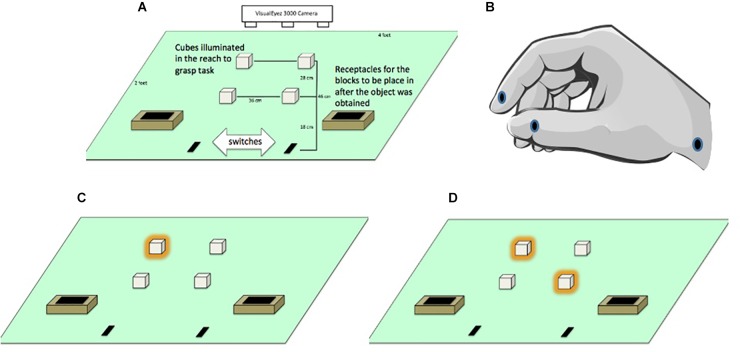
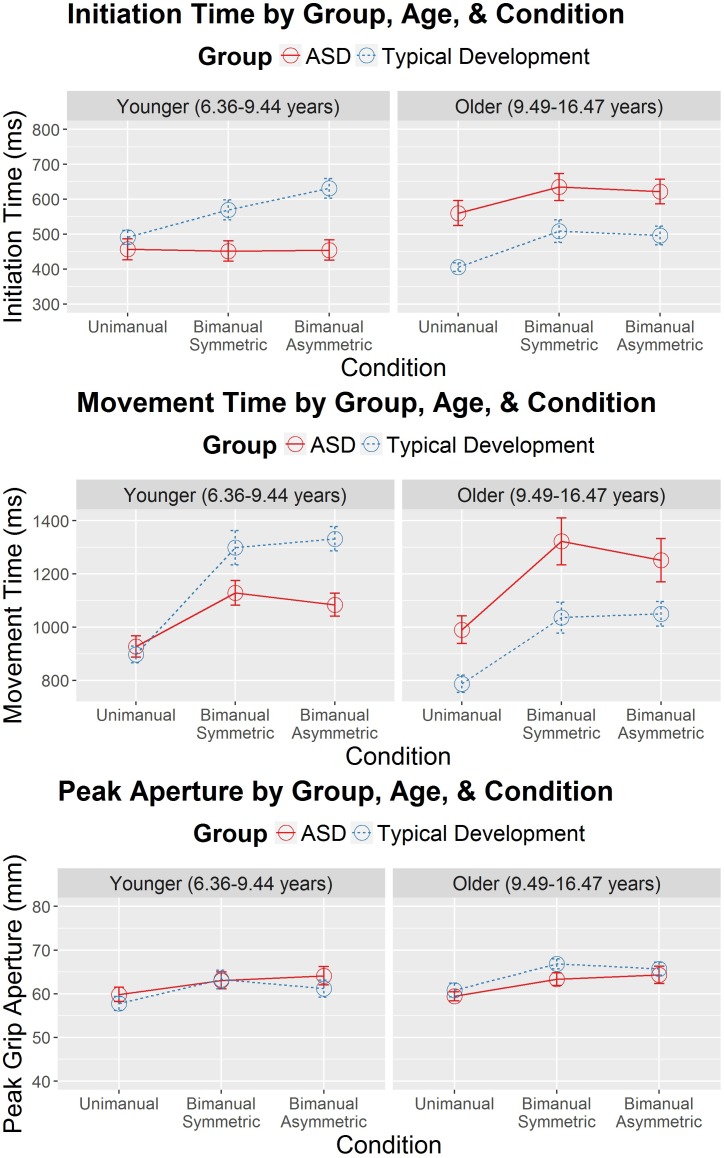
Reaching and grasping (prehension) is one of the earliest developing motor skills in humans, but continued prehension development in childhood and adolescence enables the performance of increasingly complex manual tasks. In individuals with autism spectrum disorder (ASD) atypical unimanual reaching and grasping has been reported, but to date, no studies have investigated discrete bimanual movements. We examined unimanual and bimanual reach to grasp tasks in youth with ASD to better understand how motor performance might change with increasing complexity. Twenty youth with ASD (10.1 ± 2.4 years) and 17 youth with typical development (TD) (9.6 ± 2.6 years) were instructed to reach and grasp cubes that became illuminated. Participants were asked to reach out with the right and/or left hands to grasp and lift targets located at near (18 cm) and/or far (28 cm) distances. For the unimanual (simplest) condition, participants grasped one illuminated cube (with either the left or right hand). For the bimanual conditions, participants grasped two illuminated cubes located at the same distance from the start position (bimanual symmetric condition) or two illuminated cubes located at different distances (bimanual asymmetric condition). Significant interactions among diagnostic group, task complexity, and age were found for initiation time (IT) and movement time (MT). Specifically, the older children in both groups initiated and performed their movements faster in the unimanual condition than in the bimanual conditions, although the older children with ASD produced slower ITs and MTs compared to typically developing peers across all three conditions. Surprisingly, the younger children with ASD had similar ITs and MTs as their peers for the unimanual condition but did not considerably slow these times to adjust for the complexity of the bimanual tasks. We hypothesize that they chose to re-use the motor plans that were generated for the unimanual trials rather than generate more appropriate motor plans for the bimanual tasks. An atypical spatiotemporal relationship between MT and peak aperture (PA) was also found in the ASD group. Together, our results suggest deficits in motor planning that result in subtle effects on performance in younger children with ASD that become more pronounced with age.
伸手和抓握(prehensile)是人类最早发展的运动技能之一,但儿童期和青少年期抓握能力的持续发展使人们能够完成越来越复杂的手动任务。据报道,自闭症谱系障碍(ASD)患者存在非典型的单手伸手和抓握行为,但迄今为止,尚无研究调查离散的双手运动。我们研究了患有ASD的青少年的单手和双手伸手抓握任务,以更好地了解运动表现如何随任务复杂性的增加而变化。20名患有ASD的青少年(10.1±2.4岁)和17名发育正常(TD)的青少年(9.6±2.6岁)被要求伸手抓握亮起的立方体。参与者被要求用右手和/或左手伸手去抓握位于近处(18厘米)和/或远处(28厘米)的目标并将其提起。对于单手(最简单)条件,参与者用左手或右手抓握一个亮起的立方体。对于双手条件,参与者抓握两个与起始位置距离相同的亮起的立方体(双手对称条件)或两个距离不同的亮起的立方体(双手不对称条件)。在起始时间(IT)和运动时间(MT)方面,发现诊断组、任务复杂性和年龄之间存在显著交互作用。具体而言,两组中的大龄儿童在单手条件下开始和执行动作的速度比双手条件下更快,尽管患有ASD的大龄儿童在所有三种条件下的起始时间和运动时间都比发育正常的同龄人慢。令人惊讶的是,患有ASD的年幼儿童在单手条件下的起始时间和运动时间与同龄人相似,但在双手任务复杂性增加时,并没有显著减慢这些时间。我们假设他们选择重新使用为单手试验生成的运动计划,而不是为双手任务生成更合适的运动计划。在ASD组中还发现了运动时间和最大孔径(PA)之间的非典型时空关系。总之,我们的结果表明运动计划存在缺陷,这对患有ASD的年幼儿童的表现产生了微妙影响,且随着年龄增长变得更加明显。