
预防美国处方类阿片药物滥用和预计的过量死亡。
Prevention of Prescription Opioid Misuse and Projected Overdose Deaths in the United States.
机构信息
Harold and Inge Marcus Department of Industrial and Manufacturing Engineering, Pennsylvania State University, University Park, Pennsylvania.
Institute for Technology Assessment, Department of Radiology, Massachusetts General Hospital, Boston.
出版信息
JAMA Netw Open. 2019 Feb 1;2(2):e187621. doi: 10.1001/jamanetworkopen.2018.7621.
IMPORTANCE
Deaths due to opioid overdose have tripled in the last decade. Efforts to curb this trend have focused on restricting the prescription opioid supply; however, the near-term effects of such efforts are unknown.
OBJECTIVE
To project effects of interventions to lower prescription opioid misuse on opioid overdose deaths from 2016 to 2025.
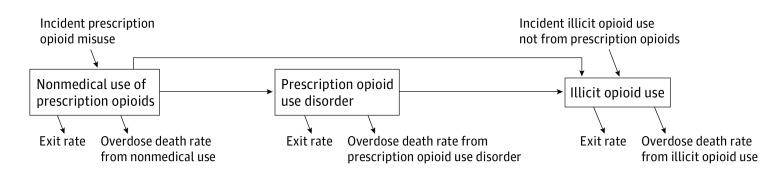
DESIGN, SETTING, AND PARTICIPANTS: This system dynamics (mathematical) model of the US opioid epidemic projected outcomes of simulated individuals who engage in nonmedical prescription or illicit opioid use from 2016 to 2025. The analysis was performed in 2018 by retrospectively calibrating the model from 2002 to 2015 data from the National Survey on Drug Use and Health and the Centers for Disease Control and Prevention.
INTERVENTIONS
Comparison of interventions that would lower the incidence of prescription opioid misuse from 2016 to 2025 based on historical trends (a 7.5% reduction per year) and 50% faster than historical trends (an 11.3% reduction per year), vs a circumstance in which the incidence of misuse remained constant after 2015.
MAIN OUTCOMES AND MEASURES
Opioid overdose deaths from prescription and illicit opioids from 2016 to 2025 under each intervention.
RESULTS
Under the status quo, the annual number of opioid overdose deaths is projected to increase from 33 100 in 2015 to 81 700 (95% uncertainty interval [UI], 63 600-101 700) in 2025 (a 147% increase from 2015). From 2016 to 2025, 700 400 (95% UI, 590 200-817 100) individuals in the United States are projected to die from opioid overdose, with 80% of the deaths attributable to illicit opioids. The number of individuals using illicit opioids is projected to increase by 61%-from 0.93 million (95% UI, 0.83-1.03 million) in 2015 to 1.50 million (95% UI, 0.98-2.22 million) by 2025. Across all interventions tested, further lowering the incidence of prescription opioid misuse from 2015 levels is projected to decrease overdose deaths by only 3.0% to 5.3%.
CONCLUSIONS AND RELEVANCE
This study's findings suggest that interventions targeting prescription opioid misuse such as prescription monitoring programs may have a modest effect, at best, on the number of opioid overdose deaths in the near future. Additional policy interventions are urgently needed to change the course of the epidemic.
重要性
在过去十年中,阿片类药物过量导致的死亡人数增加了两倍。为了遏制这一趋势,人们已经在努力限制阿片类药物的处方供应;然而,目前还不清楚这些努力的短期效果。
目的
预测降低处方类阿片类药物滥用的干预措施对 2016 年至 2025 年阿片类药物过量死亡的影响。
设计、地点和参与者:本研究采用系统动力学(数学)模型对美国阿片类药物流行情况进行分析,预测 2016 年至 2025 年期间非医疗处方或非法阿片类药物使用者的结局。该分析于 2018 年通过对 2002 年至 2015 年国家药物使用和健康调查和疾病控制与预防中心数据的回顾性校准进行。
干预措施
比较基于历史趋势(每年降低 7.5%)和比历史趋势快 50%(每年降低 11.3%)的情况下,降低 2016 年至 2025 年处方类阿片类药物滥用发生率的干预措施,以及在 2015 年后滥用发生率保持不变的情况下的情况。
主要结局和测量指标
在每种干预措施下,2016 年至 2025 年期间,处方和非法阿片类药物的阿片类药物过量死亡人数。
结果
在现状下,预计 2015 年至 2025 年期间,每年的阿片类药物过量死亡人数将从 33100 人增加到 81700 人(95%不确定区间[UI],63600-101700)(比 2015 年增加 147%)。2016 年至 2025 年期间,预计美国将有 700400 人(95% UI,590200-817100)死于阿片类药物过量,其中 80%的死亡归因于非法阿片类药物。预计使用非法阿片类药物的人数将增加 61%-从 2015 年的 930 万人(95% UI,830-1030 万人)增加到 2025 年的 1500 万人(95% UI,980-222 万人)。在所有测试的干预措施中,预计进一步降低 2015 年水平的处方类阿片类药物滥用发生率,将使过量死亡人数减少 3.0%至 5.3%。
结论和相关性
本研究结果表明,针对处方类阿片类药物滥用的干预措施,如处方监测计划,可能对近期阿片类药物过量死亡人数产生适度影响。急需采取额外的政策干预措施来改变这一流行趋势。



 Zotero 插件