Department of Pediatrics, Yale School of Medicine, New Haven, Connecticut.
JAMA Netw Open. 2018 Dec 7;1(8):e186558. doi: 10.1001/jamanetworkopen.2018.6558.
It is not yet known how many children and adolescents die each year from opioid poisonings and how mortality rates have changed over time.
To examine national trends in pediatric deaths from prescription and illicit opioids.
DESIGN, SETTING, AND PARTICIPANTS: Cross-sectional in which serial mortality data from the Centers for Disease Control and Prevention were analyzed. The population included 8986 children and adolescents (age, <20 years) who died in all US settings from opioid poisonings between 1999 and 2016. Data were collected and analyzed between June 1 and October 31, 2018.
All opioids.
Age-specific mortality rates per 100 000 were estimated with smoothing spline Poisson regression.
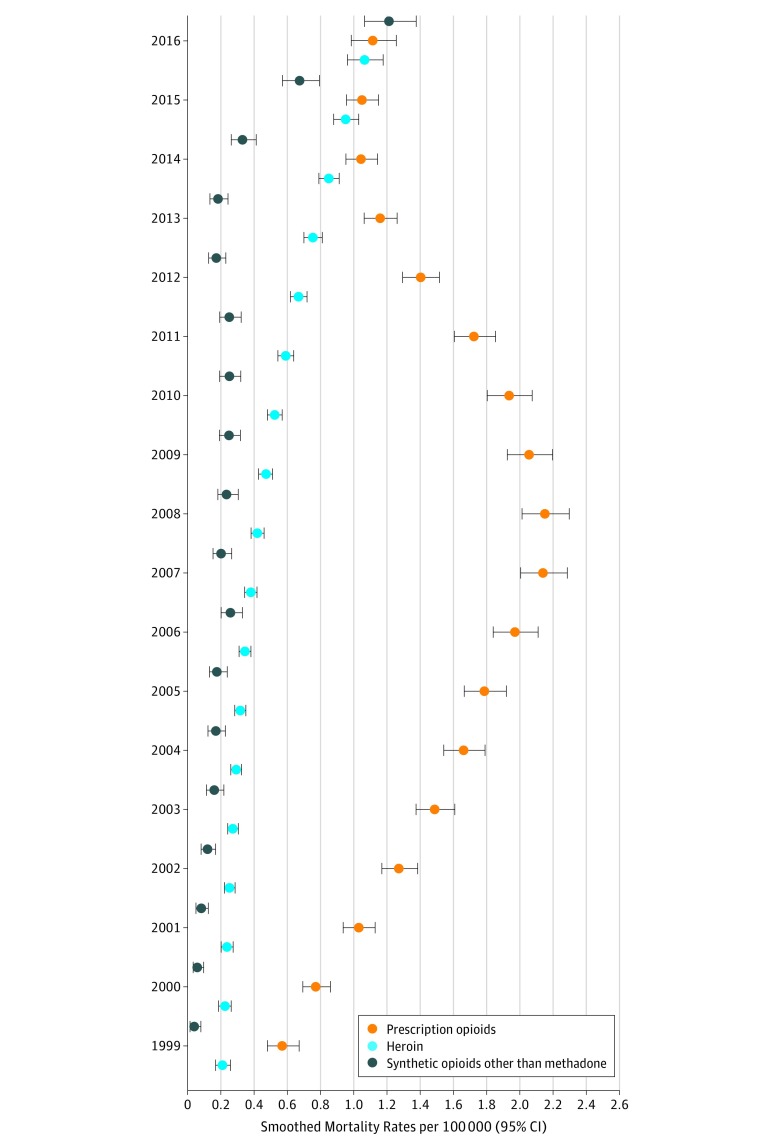
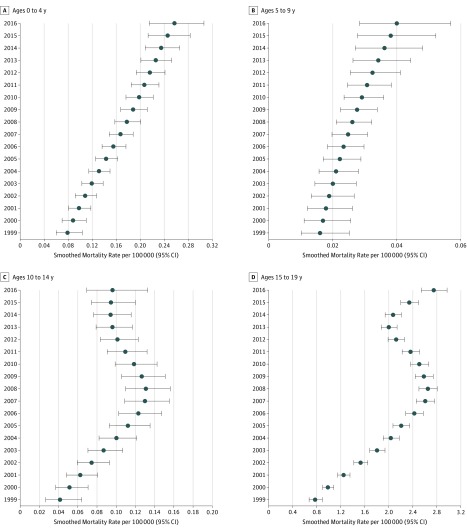
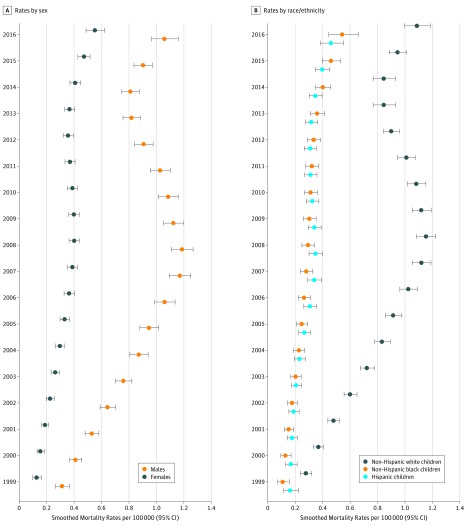
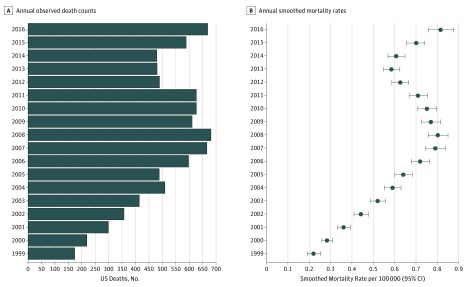
Of the 8986 children and adolescents who died between 1999 and 2016 from prescription and illicit opioid poisonings, 6567 (73.1%) were male, 7921 (88.1%) were among adolescents aged 15 to 19 years, and 605 (6.7%) were among children aged 0 to 4 years. The overall pediatric mortality rate increased from 0.22 (95% CI, 0.19-0.25) to 0.81 (95% CI, 0.76-0.88) per 100 000, an increase of 268.2% (P for time effect <.001). The highest annual rates were among adolescents aged 15 to 19 years, but time trends revealed a steady linear increase among children aged 0 to 4 years and those aged 5 to 9 years as well as a steady linear increase until 2008 among the cohorts aged 10 to 14 years and 15 to 19 years, when rates briefly declined before rising again. Among adolescents aged 15 to 19 years, heroin was implicated in 1872 deaths: rates increased from 0.21 (95% CI, 0.17-0.25) to 1.06 (95% CI, 0.97-1.17), an increase of 404.8%, whereas rates for prescription opioids increased by 94.7% from 0.57 (95% CI, 0.49-0.66) to 1.11 (95% CI, 0.99-1.25) (all P for time effect <.001). Between 2014 and 2016, there were 1508 opioid deaths among adolescents aged 15 to 19 years; of these, 468 (31.0%) were attributed to synthetic opioids. Across time, 7263 (80.8%) of all pediatric deaths were unintentional, 5537 (61.6%) occurred outside of a medical facility, and 3419 (38.0%) children died at home or another residential setting. Among children younger than 5 years, 148 (24.5%) deaths were attributed to homicide.
Over 18 years, nearly 9000 children and adolescents died from opioid poisonings, and the mortality rate increased nearly 3-fold. These findings suggest that the opioid epidemic is likely to remain a growing public health problem in the young unless legislators, public health officials, clinicians, and parents take a wider view of the opioid crisis and implement protective measures that are pediatric specific and family centered.
目前尚不清楚每年有多少儿童和青少年死于阿片类药物中毒,以及死亡率随时间的变化情况。
研究儿童和青少年因处方和非法阿片类药物死亡的全国趋势。
设计、地点和参与者:使用疾病控制和预防中心的连续死亡率数据进行的横断面研究。该人群包括 1999 年至 2016 年间所有美国环境中死于阿片类药物中毒的 8986 名儿童和青少年(年龄<20 岁)。数据收集和分析于 2018 年 6 月 1 日至 10 月 31 日进行。
所有阿片类药物。
使用平滑样条泊松回归估计每 10 万人的特定年龄死亡率。
在 1999 年至 2016 年间因处方和非法阿片类药物中毒而死亡的 8986 名儿童和青少年中,6567 名(73.1%)为男性,7921 名(88.1%)为 15 至 19 岁的青少年,605 名(6.7%)为 0 至 4 岁的儿童。总体儿科死亡率从 0.22(95%CI,0.19-0.25)增加到 0.81(95%CI,0.76-0.88),增加了 268.2%(P<.001)。最高年死亡率发生在 15 至 19 岁的青少年中,但时间趋势显示,0 至 4 岁、5 至 9 岁以及 10 至 14 岁和 15 至 19 岁的队列中,儿童的死亡率呈稳步线性上升,直到 2008 年,这些年龄段的死亡率短暂下降后再次上升。在 15 至 19 岁的青少年中,有 1872 人因海洛因而死亡:死亡率从 0.21(95%CI,0.17-0.25)增加到 1.06(95%CI,0.97-1.17),增加了 404.8%,而处方阿片类药物的死亡率则增加了 94.7%,从 0.57(95%CI,0.49-0.66)增加到 1.11(95%CI,0.99-1.25)(所有 P<.001)。2014 年至 2016 年间,有 1508 名 15 至 19 岁的青少年死于阿片类药物;其中,468 人(31.0%)归因于合成阿片类药物。一直以来,7263 例(80.8%)儿科死亡均为非故意的,5537 例(61.6%)发生在医疗场所之外,3419 例(38.0%)儿童死于家中或其他居住场所。在 5 岁以下儿童中,有 148 人(24.5%)的死亡归因于他杀。
在过去 18 年中,近 9000 名儿童和青少年死于阿片类药物中毒,死亡率几乎增加了 3 倍。这些发现表明,除非立法者、公共卫生官员、临床医生和父母更广泛地看待阿片类药物危机,并实施具体针对儿童和以家庭为中心的保护措施,否则阿片类药物流行可能仍然是一个日益严重的公共卫生问题。