Division on Substance Use Disorders, Department of Psychiatry, New York State Psychiatric Institute at Columbia University Irving Medical Center, 1051 Riverside Drive, Box 120, New York, NY, 10032, USA.
Department of Behavioral and Social Sciences, Brown University School of Public Health, Providence, RI, USA.
AIDS Behav. 2019 Apr;23(4):860-874. doi: 10.1007/s10461-019-02414-x.
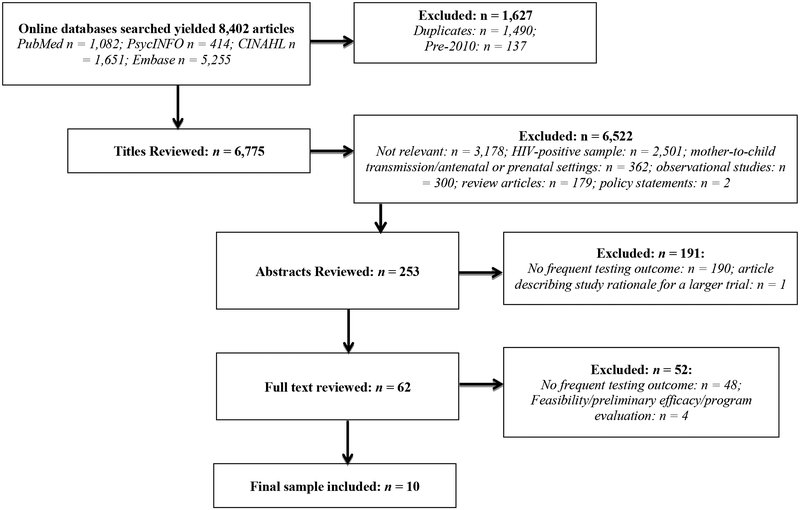
As of 2017, the Centers for Disease Control and Prevention (CDC) HIV testing guidelines recommend that those at increased risk for HIV are tested two to four times per year. Evidence-based interventions that promote frequent and repeated testing remain sparse. We conducted a systematic review to: (1) identify frequent testing interventions; and (2) determine which were successful in increasing frequent testing rates. We searched PubMed, PsycINFO, Web of Science, Embase, and CINAHL for peer-reviewed articles published between January 1, 2010 and September 30, 2017. Ten studies met inclusion criteria. Operationalization of frequent HIV testing varied widely across studies. Four interventions involved text message reminders for HIV testing, three involved community-based testing, two self-testing, and one rapid testing. Text message reminder interventions were most successful in increasing rates of frequent HIV testing. Future research should standardize frequent testing measurement to allow for more robust comparisons of intervention efficacy.
截至 2017 年,疾病控制与预防中心(CDC)的 HIV 检测指南建议,艾滋病毒感染风险增加的人每年进行两到四次检测。促进频繁和重复检测的循证干预措施仍然很少。我们进行了一项系统评价,以:(1)确定频繁检测干预措施;(2)确定哪些措施成功地提高了频繁检测率。我们在 PubMed、PsycINFO、Web of Science、Embase 和 CINAHL 中搜索了 2010 年 1 月 1 日至 2017 年 9 月 30 日期间发表的同行评议文章。有 10 项研究符合纳入标准。研究中频繁 HIV 检测的操作化差异很大。四项干预措施涉及 HIV 检测的短信提醒,三项涉及基于社区的检测,两项涉及自我检测,一项涉及快速检测。短信提醒干预措施在提高频繁 HIV 检测率方面最为成功。未来的研究应标准化频繁检测的测量方法,以便更有效地比较干预效果。