Chen Hungyen
Department of Agronomy, National Taiwan University, Number 1, Section 4, Roosevelt Road, Taipei, 10617, Taiwan.
Bot Stud. 2019 Feb 1;60(1):2. doi: 10.1186/s40529-018-0250-x.
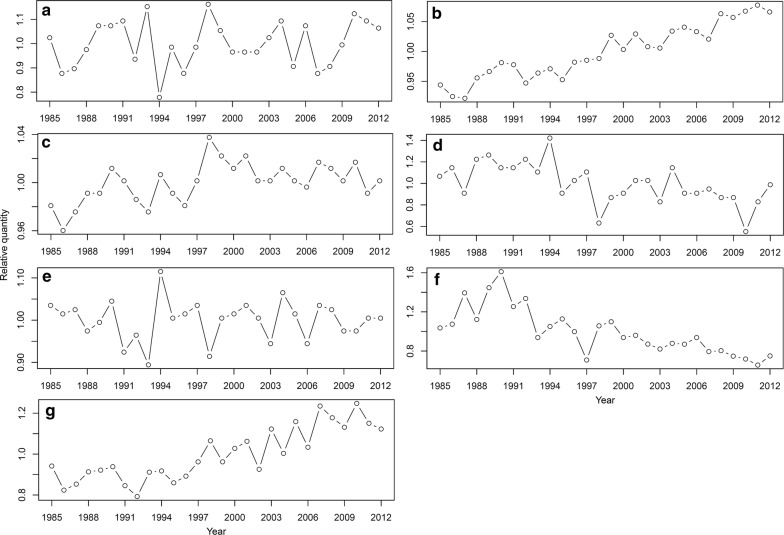
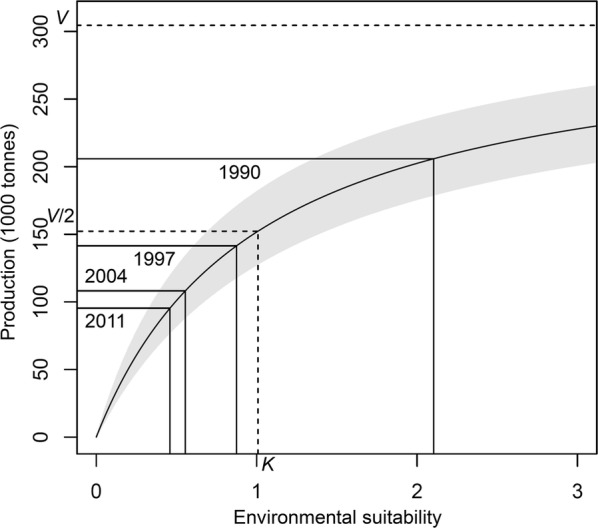
Both natural and human-induced disturbances are commonly responsible for an overall decrease of the world's seaweed. Along Japan's coastal areas, edible seaweed production has been decreasing for decades. In this study, a production-environmental suitability model to estimate the impacts of environmental factors on seaweed production was developed. The developed model not only estimates human-induced disturbances but also quantifies the impacts of environmental factors responsible for the decline of annual seaweed production. The model estimated the temporal variation in human-induced disturbances and the effects of environmental factors (i.e., rainfall, CO concentrations, temperature, typhoons, solar radiation, water nutrient levels, and water quality) on edible seaweeds in Japan from 1985 to 2012.
The environmental suitability for seaweed production in Japan was about 4.6 times greater in 1992 than in 2011, meanwhile as a result of human activities, human-induced disturbances of seaweed increased at a rate of 4.9 times faster during the period of 1998-2012 than the period of 1985-1997. The ratio of decreased production to decreased environmental suitability for seaweed production in Japan increased by 15.2% during the study years, which means that seaweed production has become more sensitive to environmental disturbances, including climatic factors and human activities in 1998-2012.
The results are novel in demonstrating temporal variations in the level of environmental suitability to seaweed production by using a simple mathematical model. The production-environmental suitability model successfully predicted seaweed production by reflecting the 28-year temporal variation of the observed seaweed production in Japan.
自然干扰和人为干扰通常是导致全球海藻总量下降的原因。在日本沿海地区,食用海藻产量几十年来一直在下降。在本研究中,开发了一个生产-环境适宜性模型,用于估计环境因素对海藻产量的影响。所开发的模型不仅能估计人为干扰,还能量化导致年度海藻产量下降的环境因素的影响。该模型估计了1985年至2012年日本人为干扰的时间变化以及环境因素(即降雨、一氧化碳浓度、温度、台风、太阳辐射、水体营养水平和水质)对食用海藻的影响。
1992年日本海藻生产的环境适宜性比2011年高约4.6倍,同时,由于人类活动,1998 - 2012年期间海藻的人为干扰增加速度比1985 - 1997年期间快4.9倍。在研究年份中,日本海藻产量下降与生产环境适宜性下降的比率增加了15.2%,这意味着在1998 - 2012年期间,海藻生产对包括气候因素和人类活动在内的环境干扰变得更加敏感。
通过使用一个简单的数学模型来展示海藻生产环境适宜性水平的时间变化,这些结果颇具新意。生产-环境适宜性模型通过反映日本观察到的海藻产量28年的时间变化,成功预测了海藻产量。